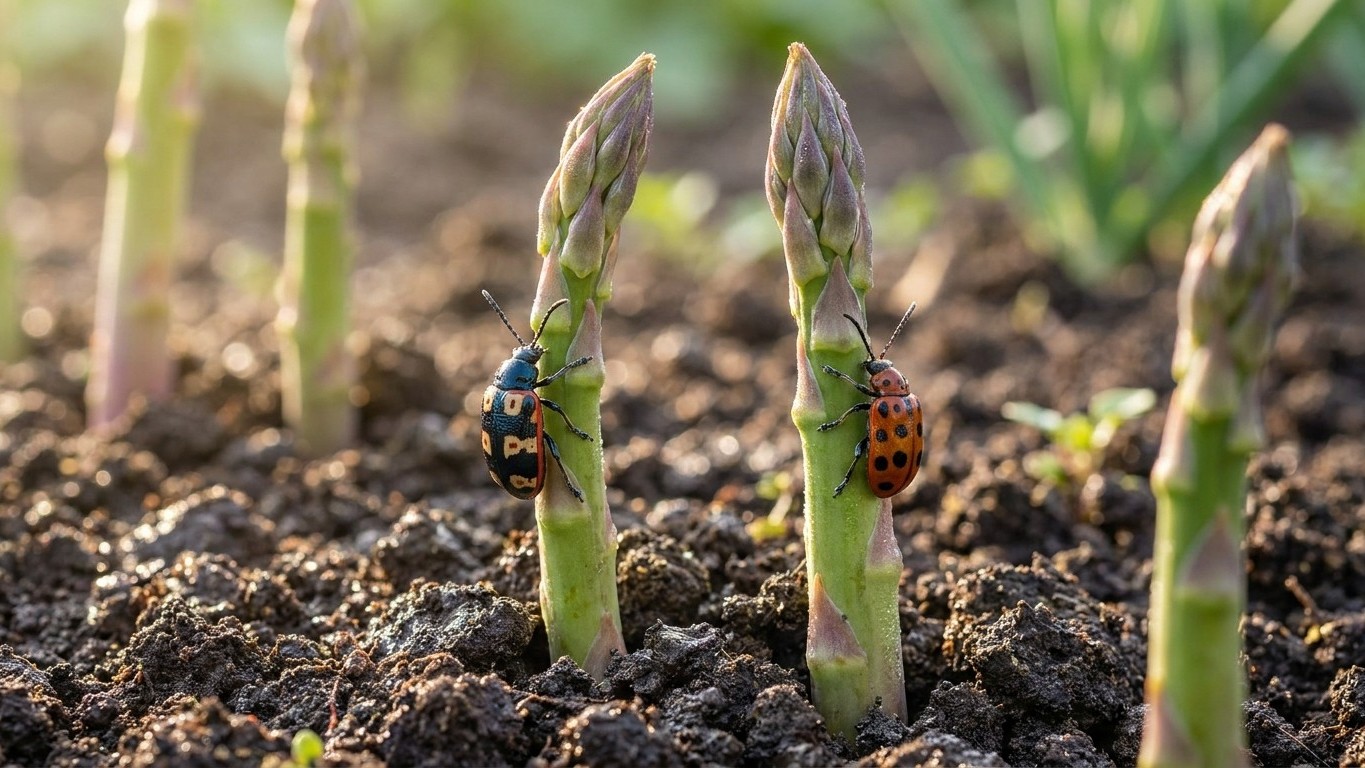

Eight species show up in University of Hawaii CTAHR Extension’s pest lists for garden vegetables statewide, and five of them have real business on an asparagus bed: aphids, beet armyworm, Chinese rose beetle, leafminers, and the Southern green stinkbug and mites pairing, plus whiteflies. The other two on the extension’s broader list target different crops entirely. Because asparagus in Hawaii is not harvested until year 3, most early feeding shows up on ferny foliage, not on a spear anyone is cutting for dinner.
Which pests attack asparagus in Hawaii
University of Hawaii CTAHR Extension documents eight pests active on vegetable gardens across the islands: Aphids, beet armyworm, cabbage webworm, Chinese rose beetle, Leafminers and bean fly, melon fly, Southern green stinkbug and mites, and Whiteflies. That is the full, short list this service publishes for this territory, and it does not get padded here with anything the extension itself has not put a name to.
Two names on that list can be set aside right away. Cabbage webworm feeds on crucifer leaves, cabbage, broccoli, kale, and has no reason to touch a fern-like asparagus stalk. Melon fly targets the fruit of cucurbits, cucumbers, melons, squash, and asparagus grows no fruit for it to sting. Bean fly, tucked into the same line item as leafminers, goes after legume stems and seedlings, so it belongs on a bean bed rather than an asparagus row.
That leaves five and a half worth watching. Aphids and whiteflies are generalist sap feeders that will colonize almost any soft new growth, including young asparagus ferns. Leafminers tunnel inside foliage on a wide range of vegetables and can do the same to asparagus needles. Chinese rose beetle is a night-feeding beetle that chews ragged holes in leaves of dozens of garden plants, ferns included. Beet armyworm caterpillars are similarly indiscriminate, stripping soft green tissue wherever they hatch. The Southern green stinkbug and mites entry covers two different feeders, a piercing-sucking bug and a group of tiny arachnids, both of which turn up on stressed or drought-stretched foliage.
Because asparagus is not harvested until year 3, and then only for four weeks the first cutting season before the harvest window lengthens, feeding by any of these five in the first two years mostly weakens the fern canopy that is building up the crown underground. That is a slower, quieter kind of damage than a chewed spear, but it is the one that decides how strong the bed is once cutting finally starts.
When each one shows up, and what it does first
There is no frost calendar to hang this on. Lowland Hawaii sees no freeze in inhabited areas, so nothing here is timed to a last-frost date the way it would be on the mainland. What actually paces pest activity is the fern’s own growth stage, from crown planting in an 8-inch furrow through the slow build of foliage over the following seasons.
Aphids and whiteflies tend to be the first visitors, clustering on the soft new spears as they push up and unfurl into ferns. The tell is usually a shiny, sticky film on the foliage before you ever spot the insects themselves, since both feed by sucking sap and excreting the honeydew that coats leaves below them.
Leafminers arrive once there is enough leaf surface to tunnel through, and the first sign is a pale, winding trail inside the fern needles rather than any hole you can see from outside. Chinese rose beetle feeding shows up as ragged, notched chewing on the edges of foliage, worse in the morning because the beetle feeds at night and hides during the day, often in soil or leaf litter nearby.
Beet armyworm damage looks similar at first, chewed green tissue, but the caterpillars leave behind frass, small dark droppings, on and under the plant, which the nocturnal beetle does not. Stinkbugs and mites both favor drier stretches of the year. Hawaii’s driest summer month averages just 0.5 inches of rain, and that kind of dry spell is when mite populations in particular tend to build, showing up first as a fine stippling or bronzing on fern needles rather than any obvious hole or bite mark.
Telling the damage apart from everything else
Not every ragged leaf or yellow patch on an asparagus fern is a pest. The state’s representative soil, the Hilo series, runs a surface pH around 5.8 and holds phosphorus unusually well for a garden soil, which means a nutrient deficiency here can look a lot like slow, generalized decline rather than a sharp insect symptom, and it is easy to blame the wrong cause.
A few pairings are worth separating before reaching for any control:
- Sticky, shiny leaves with sooty black film: usually aphids or whiteflies, since the honeydew they leave behind grows a mold; wipe a leaf and look for the tiny insects themselves on the underside.
- Winding pale trails inside the leaf tissue: leafminer tunneling, not a disease, and the trail itself is the diagnostic feature no fungus produces.
- Ragged chewed edges with dark droppings nearby: beet armyworm or Chinese rose beetle; check after dark with a flashlight, since the beetle only feeds at night.
- Fine stippling or bronzing, worse in dry weeks: mites or Southern green stinkbug, more likely during the driest stretch of summer than after a wet spell.
- Overall yellowing with no visible insect at all: more likely drainage or nutrition tied to the bed’s own soil, since Hawaii’s summer rainfall averages under two inches across June through August and a bed on heavy, poorly drained ground can swing between soggy and parched in the same season.
None of that replaces an actual look at the plant. A county extension agent can confirm what a home gardener is seeing far more reliably than a symptom list, and that is where an uncertain case belongs.
What actually works here, and what is a waste of time
Physical control does more work on this bed than any spray, mostly because the fern canopy stays in place for 10 to 15 years once it starts producing, so a habit set early pays off for a long time. Handpicking Chinese rose beetle at night, when it is actually out feeding, removes far more of the population than looking for it during the day when it is hidden in the soil. A fine mesh cover over young ferns keeps aphids and whiteflies off the softest growth without touching anything else in the bed.
Watering on a schedule that matches the dry stretch, rather than reacting after foliage already shows stippling, does more against mites than anything applied after the fact, since mite outbreaks track dry weather closely. Because no freeze occurs in inhabited areas of this territory, frost cloths, cold frames, or any protection built around a last-frost date are simply wasted effort here; that mainland habit has nothing to guard against in a Hawaii garden.
What is genuinely not worth doing is guessing at a chemical control without checking what is labeled for use in the state first. Pesticide labels and registrations vary by state, and University of Hawaii CTAHR Extension, along with the county extension office, is the authority on what is actually approved for a home garden here. Buying a product because it worked on a mainland vegetable patch, without confirming it is labeled for use in Hawaii, risks money spent on something that either is not legal to use here or is not effective against the pest actually present.
Where to check this for your own county
University of Hawaii CTAHR Extension is the service that documents these pests for the state, and it is the right first call for a specific garden problem rather than any general list. Pest pressure is not even across the islands: windward and leeward sides of the same island see different rainfall and humidity, and elevation shifts the picture further, so what CTAHR documents at the state level is a starting point, not a forecast for one particular yard.
The county extension office is the practical next step, since agents there see what is actually turning up in gardens nearby and can point to specific management guidance for the island and district in question. That local read matters more than the statewide list once a gardener is looking at an actual damaged plant rather than a general question.
The state’s representative soil, the Hilo series, is itself only a starting point rather than a diagnosis. A garden built on fill, on a river bottom, or on ground a builder has reworked can behave nothing like the mapped surface horizon values for that series, which is one more reason a local agent, and a soil test where drainage or nutrition is in question, beats guessing from a state-level fact sheet.
Common questions
Does frost ever threaten asparagus in Hawaii?
No. NOAA’s 1991-2020 climate normals record no freeze in inhabited areas of this territory, so frost timing has no bearing on when to plant, protect, or expect pest activity here.
Why does pest damage matter before harvest even starts?
Asparagus is not harvested until year 3, so any feeding in the first two seasons hits the fern canopy that is building the underground crown, which affects how strong the bed is once cutting finally begins rather than causing any immediate loss of spears.
Is yellowing foliage always a pest problem?
Not necessarily. The region’s representative soil holds phosphorus well but runs a slightly acid surface pH, and drainage or nutrition issues can produce generalized yellowing that looks nothing like the localized chewing, tunneling, or stippling that insects leave behind.
What is the single best time to check for mites?
During the driest stretch of summer, since mite populations tend to build when rainfall drops, and the region’s driest month averages only about half an inch of rain.