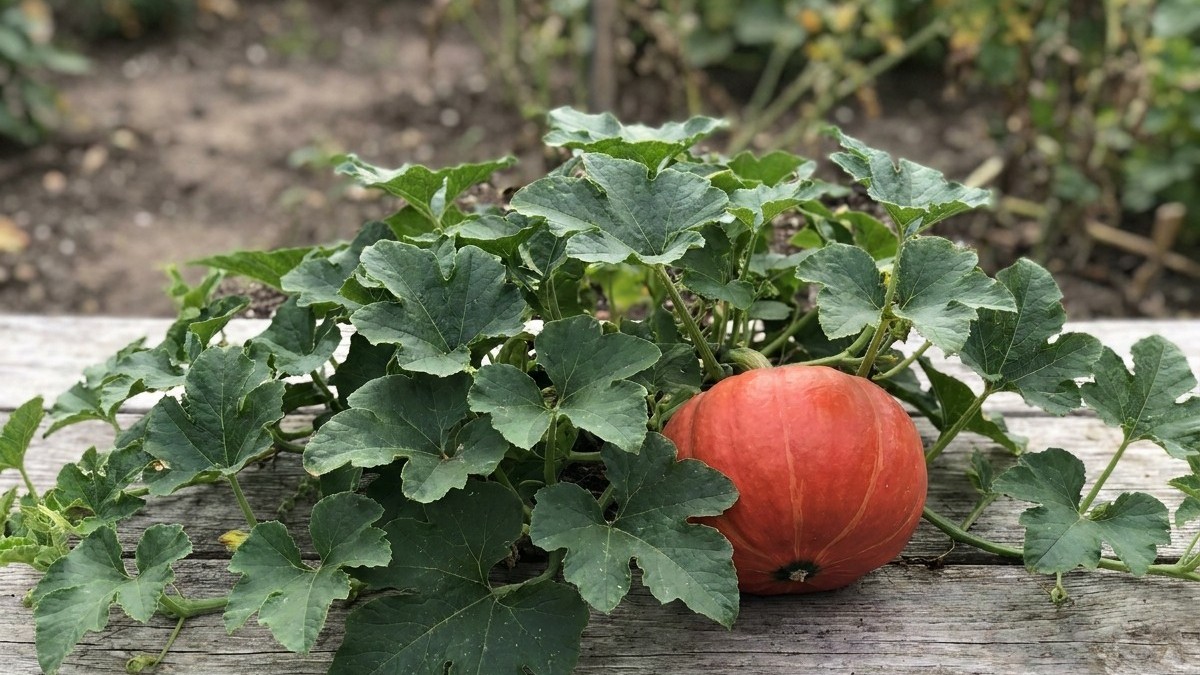

In Prince Edward Island, cut pumpkins before frost, with the stem still attached. A whole pumpkin then keeps three to six months if you store it cool and dark. Charlottetown’s average first fall frost is October 17, so a flower that opens after late August or early September probably won’t produce a ripe fruit. The clock runs 45 to 55 days from flowering, not from seeding.
The short answer
Start with the frost. At the Charlottetown A station, Environment and Climate Change Canada puts the average first fall frost on October 17. That is a mean, not a promise. In about one year out of two, the first frost arrives later than that date, which means it arrives earlier in the other half. Treat October 17 as the middle of a window, never as a safe date.
Now work backwards. Pumpkins need 45 to 55 days to mature after flowering, according to Utah State University Extension. Fifty-five days before October 17 is about August 23, and 45 days before is about September 2. So the latest a flower can open and still give a ripe pumpkin here falls in a window from roughly August 23 to September 2. A flower that opens inside that window is a gamble, since the frost may beat it. One that opens after it is almost certainly a green fruit that will never be worth cutting.
Two cautions on that window
The date comes from a single station. A province is not one climate, and northern or upland districts run weeks behind Charlottetown, which pulls the whole window earlier. If your garden sits inland or up a hill, shift your deadline accordingly and trust your own first frost over any average. The normals behind the figure also cover an older period than the one used for the US states on this site, so don’t line the two up date for date.
The data is on the official Environment and Climate Change Canada climate normals for the station, if you want to check it. For a broader look at whether your vines can make it, see Will Pumpkins Ripen Before Frost in Prince Edward Island?
When to cut
Cut before frost, and leave the stem on the pumpkin. That is the whole instruction from the extension source, and it is worth following to the letter. A pumpkin without its stem has an open wound at the top, and that is where decay gets in.
How long a whole pumpkin keeps
University of Illinois Extension says a whole pumpkin keeps three to six months in a cool, dark spot between 45 and 50 F. The second half of its advice is the part most people miss: keep pumpkins away from ripening fruit and vegetables such as apples, potatoes and tomatoes. Ripening produce gives off a gas that ages the pumpkin. That makes the porch beside the apple crate the worst place for it. Utah State’s guidance adds the other limit, which is to store them where they will not freeze.
Those figures are for a whole pumpkin. Neither source publishes a keeping time for a carved one, so none is given here.
When to sow here
Seeds go in when the soil reaches 65 F, and that moment is not the last frost date. Air warms faster than soil, and the gap is measured in weeks. On Prince Edward Island the average last spring frost is May 16 (again a midpoint, with frost still possible in the later half of years). The arithmetic goes like this.
- Start from May 16. That is the average last frost at the Charlottetown A station. In about half of years the last frost comes after it, so it marks the earliest you would even think about planting, not a green light.
- Add the soil lag. Soil reaches 65 F weeks after the last frost. Weeks after May 16 puts open-ground sowing at the very end of May at the earliest, and often well into June. A soil thermometer settles it better than a calendar.
- Subtract two weeks if you use row covers. Covers warm the soil and buy about two weeks. For the sake of the arithmetic only, suppose bare soil in your garden would hit 65 F on June 6. Under a cover it gets there around May 23. That is barely a week after the average last frost, so the cover also doubles as frost protection.
- Remember the seeding-to-flowering gap. The source gives no count of days from seeding to first flower, so none is invented here. Watch your own vines and note the date the first female flower opens. That date is when the real countdown starts.
- Count 45 to 55 days forward from that flower. If the result lands before your frost window (about August 23 to September 2 for the latest flowers at Charlottetown’s average), you are on track. If it lands after, sowing was too late or the season too cool.
Why the two clocks matter together
Between the two averages, last spring frost on May 16 and first fall frost on October 17, there are about 154 days. That sounds generous until you subtract the soil lag and the unknown stretch from seeding to flowering. Only then does the 45 to 55 days after flowering begin. Every week you shave off at the spring end is a week of margin at the fall end.
Waiting for 65 F soil feels slow, but sowing into cold ground usually costs more time than it saves. For the basics of site, spacing and variety choice, Growing Pumpkins in Prince Edward Island covers the rest of the growing season.
What goes wrong here
A short season shows up in a handful of predictable ways. Most of them trace back to one flower, one frost or one week of soil that was too cold.
- A late flower that never colors. A blossom that opens after the last-flower window may set a fruit, but 45 to 55 days will not fit before frost. The pumpkin stays green and hard to judge. Remedy: once you pass the window, pinch off new blossoms and the smallest fruit so the vine feeds the pumpkins that can still ripen.
- A fruit caught by frost. Frost on a pumpkin that is still on the vine ends the keeping time before it starts, since the sources stress storing pumpkins where they will not freeze. Remedy: watch the forecast from the middle of September on, cover vines and fruit on frost nights, and cut with the stem on before any hard cold. A frosted pumpkin is best used soon rather than counted on for the long storage window.
- A vine that dies back before the skin hardens. When leaves collapse early, the fruit loses its supply of sugars while the rind is still soft. Early dieback often points to feeding damage from insects. The state’s What Eats Pumpkin in Prince Edward Island, and When page explains the timing, so it is not repeated here. Remedy: check leaves and stem bases weekly, and if the vine is failing, cut the fruit with its stem rather than leaving it on a dying plant.
- Seeds sown into cold soil. A May planting looks efficient on paper, but soil below 65 F stalls germination and wastes the seed. Remedy: use a soil thermometer, or use row covers to bring the date forward by about two weeks instead of rushing.
- Good pumpkins stored in the wrong place. A whole pumpkin can last three to six months and still spoil in a few weeks beside apples, potatoes or tomatoes. Remedy: give it a cool, dark spot between 45 and 50 F, away from ripening produce and away from freezing.
Common questions
Is October 17 a safe date to harvest by?
No. It is the average first fall frost at Charlottetown A, so frost arrives earlier in about half of years. Cut pumpkins that are ready ahead of the forecast rather than waiting for the date.
Do the 45 to 55 days start at seeding?
No. They start when the flower opens. The source publishes no count from seeding to first flower, so the safest habit is to note the date of the first female blossom and count forward from there.
What if my garden is in a northern or upland part of the island?
Plan on an earlier window. Those districts run weeks behind the Charlottetown station, so the August 23 to September 2 range for the latest flowers is too late for you. Your own first fall frost, noted in past years, is the better guide.
How long does a carved pumpkin keep?
No keeping time for a carved pumpkin is published in the sources used here. The three to six months at 45 to 50 F applies only to a whole pumpkin, which is a good reason to carve late and keep the rest uncut.