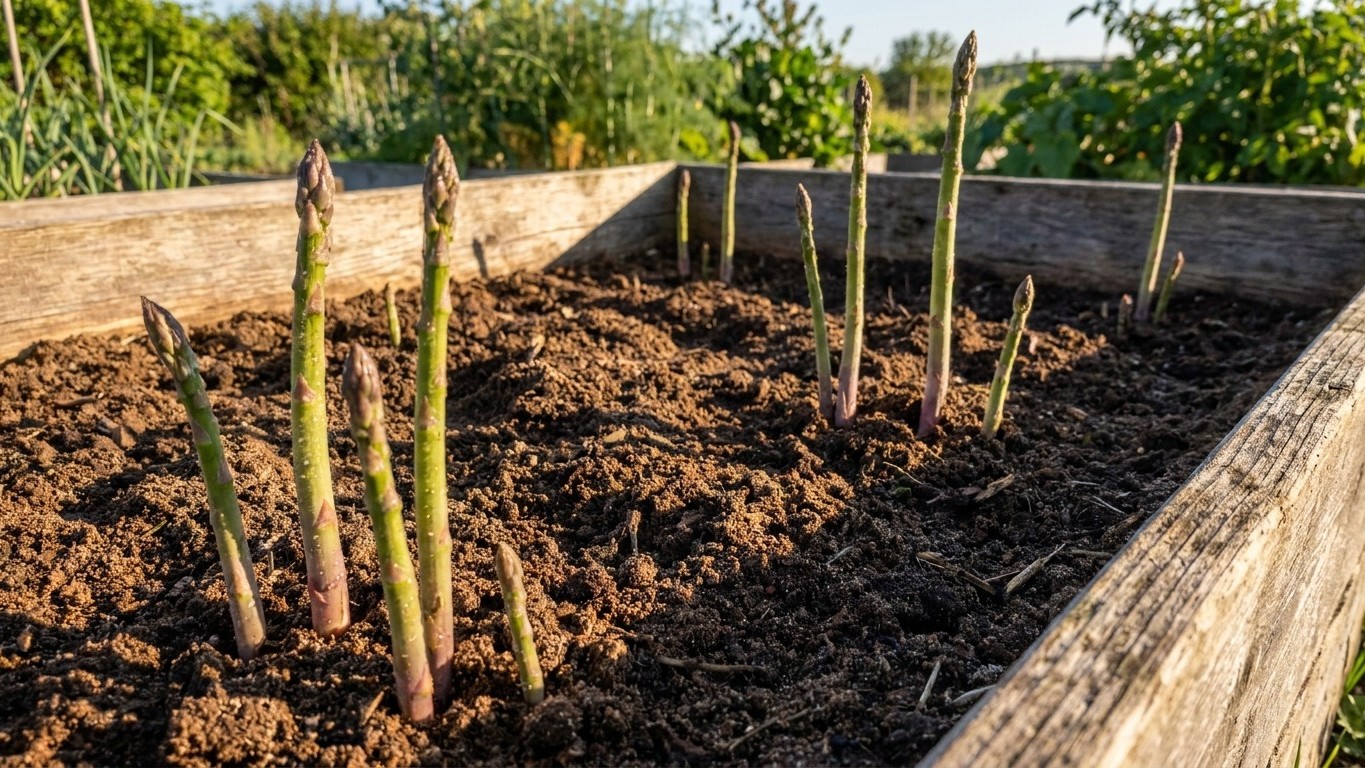

Stop cutting when most of the spears coming up are thinner than a pencil. That signal, not a calendar date, ends the season in Nova Scotia. The bed doesn’t get a first cut until its third year, and then the cutting window runs four weeks, then six, then eight. Spears you do cut keep best with their butts standing in water, in air held at 0 to 2°C (32 to 35.6°F). Here is what that asks of Nova Scotia ground, rain and frost dates.
The short answer
Nova Scotia’s commonest soil is a Podzol, the acid, leached ground that forms under conifers, where rain has washed the bases out of the surface. It covers 53 percent of the mapped surface, with Gleysolic soils next. The median surface horizon has a pH of about 5.2 (strongly acid) and a loam to silt texture: 52 percent sand, 10 percent clay, 38 percent silt. It holds about 2.1 percent organic matter and is classed as imperfectly drained. Those numbers come from Agriculture and Agri-Food Canada’s Canadian Soil Information Service, from 472 mapped surface horizons in the province’s agricultural regions.
The commitment is what makes that “imperfectly” matter. A bed lasts 10 to 15 years, and the only soil requirement Utah State University Extension names is that the ground drains. Most soils will do if they are well drained. Imperfect drainage is a borderline grade, not a clear pass. In most vegetable beds a heavy spot is a seasonal nuisance you amend. Here the crowns stay put for a decade or more, so a wet pocket is a decision you can’t undo. The sandy share of the median profile and its low clay are encouraging. But a median is not your yard, and river bottoms, low wet ground and any lot a builder has scraped or filled can behave nothing like it.
Before you dig a furrow, dig a test hole where the bed will go. Fill it with water, let it empty, fill it again, and watch. If water is still standing the next morning, don’t plant at grade. Pick a rise or build the bed up above the wet ground. A soil test will give you your own pH and organic matter figures, since the 5.2 above is a regional median and not your reading. The longer case for fifteen-year drainage is in Will Nova Scotia Soil Hold an Asparagus Bed for Fifteen Years?.
What the bed asks before the first cut
Crowns are planted in 8-inch furrows in early spring. Nothing is harvested until year 3. That means no “just a few spears” in year 2 to taste the reward early. The bed then produces for 10 to 15 years, and the cutting season grows with it: about four weeks in year 3, six weeks the year after, then eight.
Inside those windows, the pencil rule ends the season. Most of the spears coming up thinner than a pencil means stop, whatever the date on the wall. The thin spears show the bed has little left to give, and the ferns you leave standing afterward are what rebuild the crowns for next year. Those ferns also draw visitors, which is covered in What Eats Asparagus in Nova Scotia, and When.
Will the summer here water it for you?
The bed wants 1 to 2 inches of water every other week for its first two years, then every three weeks after that. Halifax Stanfield, the Environment and Climate Change Canada reference station, normally sees 284 mm (11.2 inches) of rain across June, July and August, out of 1397 mm (55.0 inches) for the whole year. August is the driest summer month at 93 mm (3.68 inches), and June and July run barely ahead of it. These are normals, not a forecast, and they cover an earlier 30-year period than the US figures elsewhere on this site, so don’t set them side by side. Here is how to turn them into a watering plan.
- Do the paper arithmetic. August’s 93 mm spread over a fortnight comes to roughly 42 mm, about 1.6 inches. On paper, a normal summer delivers close to what a young bed asks for, so the gardener adds little in a typical year, and even less once the schedule relaxes to every three weeks.
- Put a rain gauge on the plot. A station at the airport is not your garden. A slope, a hill’s rain shadow or a paved yard can change what lands. The gauge is what settles it, so count what actually fell over the last two weeks.
- Subtract, then top up the gap. If the gauge shows 0.5 inch in a dry fortnight, you add the missing inch or so by hose. If it shows 2 inches, you add nothing. The normal is only a starting expectation.
- Discount storm rain. A single summer thunderstorm mostly runs off instead of soaking in, and hot days drive evaporation. An inch that arrived in forty minutes doesn’t count the same as an inch that fell over a gentle afternoon.
- Read your soil before you read the sky. The loam to silt profile with its imperfect drainage holds water longer than sand does, so here the risk tilts toward too wet more often than too dry. A pocket of sandy fill is the exception, and may need water far sooner.
After the two-year mark, relax to once every three weeks. Take that as a ceiling on your effort, not a quota, in a summer that keeps delivering.
When to put the crowns in
Crowns go in during early spring. In Nova Scotia, that points to around the last frost. At Halifax Stanfield (climate ID 8202250), Environment and Climate Change Canada’s normals put the last spring frost on average around May 7. This is a mean, not a safe date. In one year out of two the last frost falls later than that, so treat May 7 as the middle of a window, not the all-clear. The station sits on the coast near Halifax, and northern or upland districts of the province can run weeks behind it. Check your own local frost record before you open a furrow.
Dig the furrow 8 inches deep and set the crowns in it. Don’t fill it all at once. The furrow is backfilled gradually across the year, 2 inches every other month, so the shoots always have a little soil to push through. Topping it all off on planting day buries the crowns too deep too fast, and in a wet, imperfectly drained soil that is exactly the wrong place to be asking them to sit.
The alternative to crowns is seed. Utah State University Extension builds its guidance around crowns and doesn’t publish a seed timetable, so I won’t invent a sowing date here. Seed adds a step, because the seedlings have to be raised before they go into the ground, and the clock toward that first cut starts later.
Four varieties are named in the source, with only their sex given. Jersey Giant and Jersey Knight are all-male; UC 157 F1 and Purple Passion are male/female. No flavor, yield or reason to prefer one over another is published, so choose on availability. For the broader picture of growing the crop here, see Growing Asparagus in Nova Scotia.
Common questions
How do I know the season is over?
Look at the spears, not the calendar. When most of what is coming up is thinner than a pencil, stop cutting and let the ferns grow. A few thick spears among many thin ones don’t change the call.
Can I take a few spears in the second year?
No. The source is plain that asparagus is not harvested until year 3. Then the windows run four weeks, six weeks, and eight weeks in the following years. Taking spears early costs the crowns the growth that carries the bed through its 10 to 15 years.
How do I keep cut spears?
The target is 0 to 2°C (32 to 35.6°F) with near-saturated air, 95 to 100 percent humidity, according to the UC Davis Postharvest Technology Center. Both edges of that window bite. Above 10°C (50°F), spears toughen within hours. At -0.6°C (30.9°F) or lower, they get a water-soaked look and collapse into extreme softness. A fridge thermometer tells you where yours sits, since the dial setting doesn’t. In a home kitchen, stand the butts in a shallow glass of water or wrap them damp. The cut end loses water faster than anything else on the spear.
Which variety should I plant?
The source lists four, and gives only their sex: all-male Jersey Giant and Jersey Knight, and male/female UC 157 F1 and Purple Passion. It publishes no flavor, yield or other reason to prefer one. Whatever you choose, the drainage of the spot matters more than the label on the crown.