
Stop cutting when most of the spears coming up are thinner than a pencil. That is an object you can hold, not a week on the calendar. A new bed gets no cutting at all until year 3. After that, the first harvest runs 4 weeks, the next 6, the one after 8. Cut spears keep best at 32 to 35°F, with the butt ends standing in water.
The short answer
North Dakota’s representative soil is the Williams series, a Mollisol, the deep, dark prairie ground of the same family that built the Corn Belt. USDA records its surface as a loam to silt: 38 percent sand, 22 percent clay, 40 percent silt, with organic matter around 4.0 percent and a pH of about 7.2. It is rated well drained. Asparagus is the one crop where that last word carries the whole decision, because a bed lasts 10 to 15 years and the only soil requirement the Utah State University Extension guide sets is that the ground drains. On paper, the state’s typical soil passes.
On paper. The Williams series is the soil that stands in for the state, not the soil under your fence line. North Dakota spans hundreds of soil series, and river bottoms, hill country and any lot a builder has scraped or filled can behave nothing like it. The figures above are representative values for a mapped surface layer, not a measurement of a worked garden bed. The 7.2 is not your pH either, and the extension source publishes no pH target for asparagus, so a soil test will give you your number but this page cannot hand you a goal for it.
What if the spot does not drain? Elsewhere in the garden, heavy ground is an annual nuisance you amend each season. Here it is a fifteen-year commitment, so move the bed or build it up above the surrounding grade rather than planting and hoping. Our guide on Will North Dakota Soil Hold an Asparagus Bed for Fifteen Years? walks through how to read your own ground before the crowns go in.
The wait matters just as much as the soil. Crowns go into furrows 8 inches deep, and nothing comes off the bed until year 3. Not a handful of spears in year two, not a taste test. Then the harvest window grows: 4 weeks, then 6, then 8.
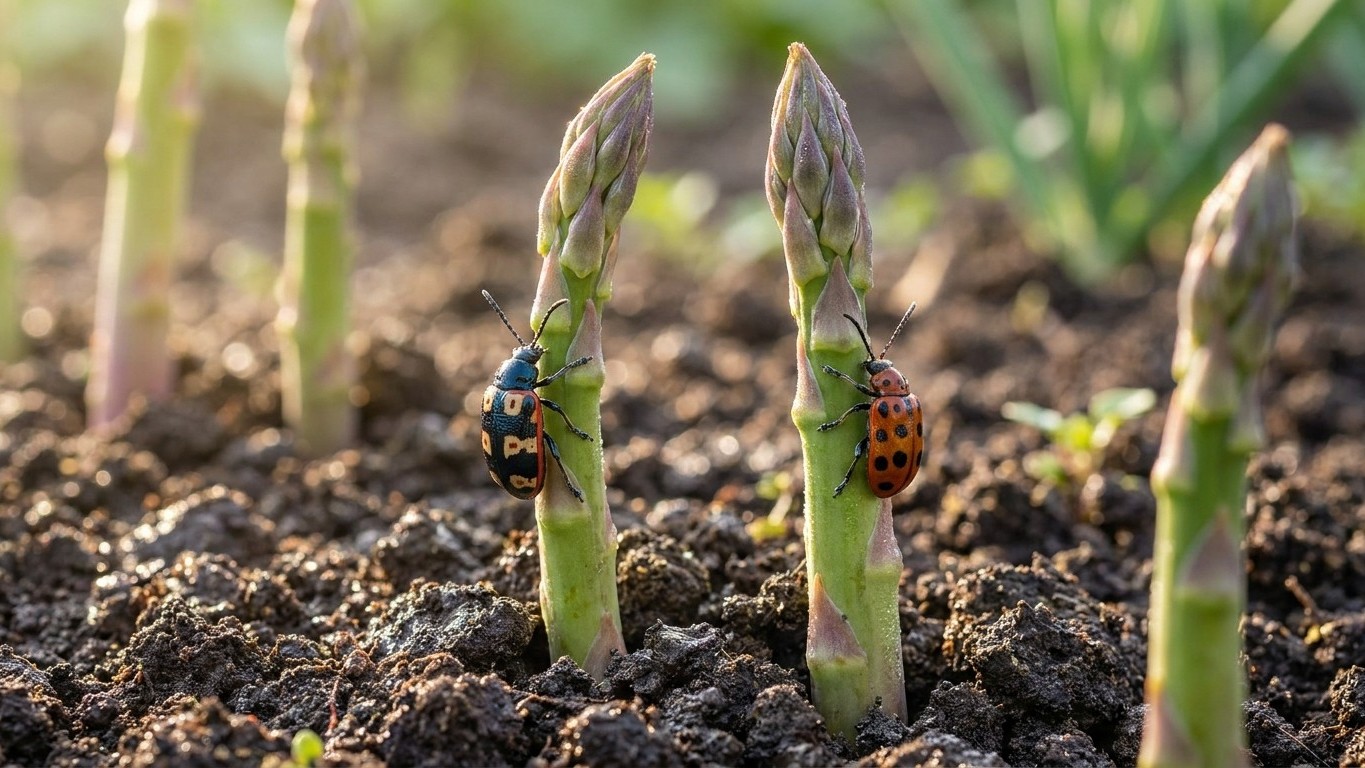
The end of each window is where the pencil rule comes in. Early in the season spears come up thick. As the weeks pass, more of them come up thin, and when most of what you see is thinner than a pencil, you are done cutting. Leave those spears to grow. I would not try to turn this into a date, since a cool spring and a hot one will move it by a stretch, and the plant is the better calendar. If pests are chewing on the thin ones, What Eats Asparagus in North Dakota, and When covers who is likely at the table and in which weeks.
Will the summer here water it for you?
Mostly, but not on schedule. The bed wants 1 to 2 inches of water every other week for its first two years, then every three weeks after that. North Dakota’s summer, per the 30-year climate normals at the reference station, delivers about 10.0 inches across June, July and August, out of 23.9 inches for the whole year. June brings 4.29 inches, July 3.07, and August, the driest month, 2.6.
- Do the monthly math. Watering every other week at 1 to 2 inches works out to roughly 2 to 4 inches a month. June’s average clears even the top of that range, July sits in the middle, and August lands at the lower-middle. In an average summer, the rain covers most of the job.
- Find the gap in August. If you aim for the 2-inch end of the range, August leaves a shortfall of about 1.4 inches in a normal year. That is the realistic amount a gardener adds, and it is smaller than most people expect.
- Distrust the average. Normals are not a forecast. Summer rain here often arrives as a thunderstorm, and a hard downpour on hot ground runs off rather than soaking in. A month with its full rainfall on paper can still leave the bed dry between storms.
- Know your soil. A loam to silt like the Williams series, with about 4.0 percent organic matter, holds a good inch better than sand does. If your lot is sandy, or a river-bottom mix, the bed may need water more often than the schedule suggests.
- Measure instead of guessing. Set a rain gauge on the plot itself. The reference station is not your garden, and a slope, a windbreak or a nearby town can shift the numbers. After the second year, the schedule stretches to every three weeks, and the gauge tells you which of those weeks you can skip.
Heat belongs in this calculation too, since hot days pull water out of the ground faster than the schedule assumes. In a dry August, count what actually fell, not what the chart says should have.
When to put the crowns in
Early spring. That is the extension source’s whole instruction, and it publishes no calendar date and no soil-temperature trigger to go with it. The frost dates give you a way to anchor the timing locally. At the reference station, the last spring frost falls around May 4 to May 15, based on the 30 to 70 percent probability band of a 32°F freeze in the climate normals.
Those are airport-station figures, and a mean frost date is an average, not a promise. Suburban and rural gardens usually see their last spring frost later, often by one to two weeks, and more at elevation. So a farm plot might still be flirting with a freeze into the third week of May while the reference city has long since cleared. Check your own county’s frost dates, and treat the dates above as a starting point. The source also does not say how much frost a freshly planted crown tolerates, so I would not push the schedule to the edge.
The planting itself is a slow burn. Crowns sit in a furrow 8 inches deep, and the furrow is not filled at once. You backfill it gradually across the year, about 2 inches every other month, so the soil rises as the plants grow. Filling it all at planting time defeats the point of digging deep. For the broader planting picture, see Growing Asparagus in North Dakota.
Seed is the alternative to crowns, and it is the route this page can say least about. The sources behind it carry no sowing date, no germination figure and no estimate of the extra time it adds. The year-3 harvest rule is written for crowns, and the source does not say how it applies to a seed-started bed, so read the seed packet and ask your county extension office.
Either way, you choose a variety, and the information on that is thin. Four are named: Jersey Giant and Jersey Knight are all-male, while UC 157 F1 and Purple Passion are male and female. Nothing published here ranks them on flavor or yield, or gives a reason to prefer one, so the sex of the plants is all the guidance there is.
Common questions
When do I stop cutting asparagus each year?
Stop when most of the spears coming up are thinner than a pencil. Once a bed reaches full production the season can run 8 weeks, but the pencil is the signal, not the week count.
How should I store the spears I cut?
Aim for 32 to 35°F with near-saturated air, 95 to 100 percent humidity, per the UC Davis Postharvest Technology Center. In a home kitchen, that means standing the butt ends in water or wrapping them damp, since the cut end loses moisture faster than anything else. Put a thermometer in the fridge to check it.
Why not just keep them as cold as possible?
Because both edges bite. Above 50°F, spears toughen rapidly, within hours. At about 31°F or below, they freeze, turn water-soaked, and collapse into mush on thawing. The target sits in the narrow band between the two.
Can I cut a few spears in the first or second year?
No. The source says the bed is not harvested until year 3, and the harvest then grows from 4 weeks to 6 to 8. Skipping the wait is how a 10-to-15-year bed gets cut short.