
Two things eat into spinach season in West Virginia: days that keep lengthening, and air and soil that keep warming. This page is about the calendar, not insects. The two limits stack, and together they leave a spring window and an autumn window with a hot gap between them. Here is how wide each one is in Charleston, the reference city for the numbers below.
The short answer
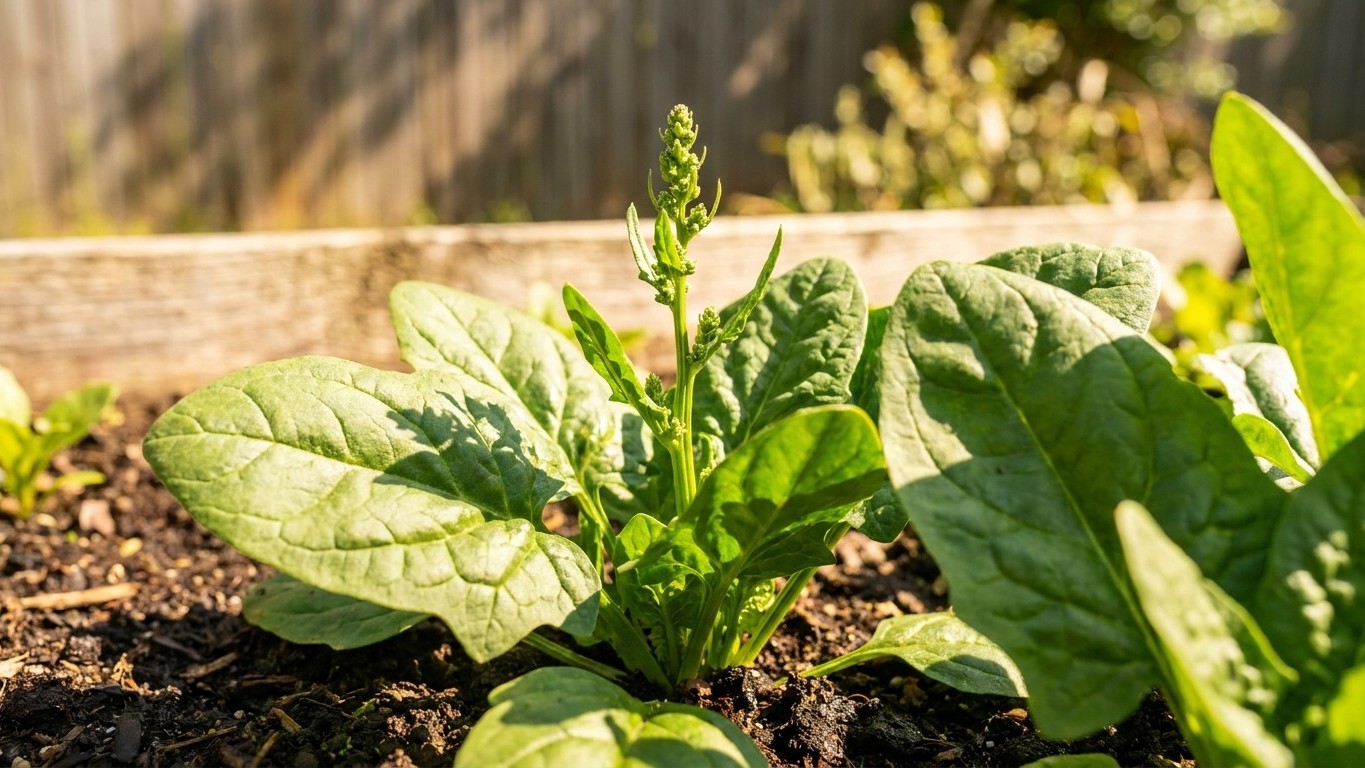
On the longest day of the year, Charleston gets 14 h 41 of daylight. That number matters for spinach more than most gardeners expect. According to Utah State University Extension, spinach bolts during long days and warm temperatures, and the long days count on their own. The plant does not wait for a heat wave to start building a flower stalk. A cool summer therefore does not buy extra weeks. A day that runs nearly fifteen hours pushes the plant toward flowering whatever the thermometer says, and once the stalk rises the leaves shrink and the plant’s job becomes seed.
So is the limit here the day length or the heat? Both. They work as a pair, and each closes a different door.
The heat half is easy to underestimate. Charleston averages 16.0 days a year at 90 F or higher. That sounds like a little over two weeks of discomfort, and for a tomato it is. For spinach, the ceiling is 75 F. Utah State puts the best growth where temperatures do not exceed that, and 75 F is also where the leaves turn bitter. One number, two consequences. A 90 F day is a count of the hottest days, not a measure of the season, so the number of days above 75 F runs far higher than 16. Spinach feels the whole stretch, not just the worst afternoons.
Soil adds a third constraint that shows up in autumn. Seed germination drops once soil is warmer than 80 F. A gardener who sows spinach in the heat of late summer can lose the crop before it comes up.
Elevation helps with only one of these. Mountain gardens run cooler, which eases the heat limit, but day length is set by latitude, not altitude. Higher ground does not shorten the days. Cooler air at elevation can stretch the spring a bit, though it also brings frost sooner in fall, a point that comes back below. Read the full picture for the state in Growing Spinach in West Virginia, and the flowering mechanism in more depth in Will Spinach Bolt Early in West Virginia?
One more caution about varieties. The Utah State source names four: Bloomsdale, Melody, Teton and Olympia. It publishes no data on any of them, so there is no basis here for calling one slower to bolt than another. Pick by what you can find locally, and treat claims about bolt resistance as unverified.
How long the spring window really is
The rule is to sow 2 to 3 weeks before the last frost, and to expect growth to stop being good above 75 F. At Charleston, the last frost falls between April 9 and April 23. That is a band, not a single day, and it comes from NOAA NCEI 1991-2020 Climate Normals (the 30-70% probability band for a 32 F freeze). Here is how the spring works out, step by step:
- Find the opening. Three weeks before April 9 is March 19. Two weeks before April 23 is April 9. Sowing runs from roughly mid-to-late March through the first week of April, a window about three weeks wide.
- Pick a date inside it. An early sowing sits closer to the 3-week mark and gets more cool days before warmth arrives. A late one at 2 weeks gets fewer. Both fit the rule.
- Let the plants grow. The source publishes no days-to-maturity for spinach, so there is no honest way to say that harvest lands on a certain date. Plan to harvest steadily as leaves reach a usable size rather than waiting for a deadline.
- Watch for 75 F. The ceiling is a temperature, never a calendar date. Once daily highs sit above it for several days running, growth is no longer good and bitterness is on the way. These figures do not include a date for when Charleston crosses that line, so a cheap outdoor thermometer in the garden does the job better than a guess.
- Pull the crop. When the stalk starts to rise or the leaves taste harsh, the season is over. Cut it and move on.
Put in words, the usable spring is short: three weeks of sowing opportunity, then however many weeks the plants get before the air stays above 75 F. In a state where river valleys warm quickly in May, that is a matter of weeks, not months. Sowing at the early end of the band is the only lever you control.
Higher elevations see a later last frost than a river valley, so a gardener on a ridge should shift every date in this list later and trust the local frost rather than the Charleston band.
The autumn crop, and when the soil lets you sow
Autumn is where West Virginia gardeners get the best spinach, and the reason is plain: the day length begins shrinking and the air cools. The constraint is getting the seed to sprout in the first place.
Obstacle one: soil still too warm
Germination is reduced above 80 F soil. That is the block, not cold. In a valley that sees 16.0 days a year at 90 F or higher, soil in August can hold heat well past the point where seed sprouts reliably. The window opens when the soil falls below 80 F, and this page has no published date for when that happens in any given location. A soil thermometer pressed a couple of inches into the bed, read in the morning, answers the question better than a calendar. Many gardeners also water the row before sowing and shade the bed with a board or cloth until seedlings appear, which can take the edge off the soil temperature.
Obstacle two: the frost that ends the season
The first fall frost in Charleston falls between October 18 and November 1, per the same NOAA NCEI 1991-2020 Climate Normals. The source rule for autumn is to plant 50 to 75 days before the date you want to harvest, so count backward from a realistic harvest date.
Working from the Charleston band:
- To harvest by October 18, sow between about August 4 and August 29.
- To harvest by November 1, sow between about August 18 and September 12.
Put the two together and the arithmetic points to a sowing span from early August to mid-September. The early end collides with warm soil, and the late end leaves little margin. The middle of the range, late August into early September, is where soil temperature and the 50-to-75-day count most often meet. The count itself is a planting rule, not a promise of maturity, since no days-to-maturity figure is published for spinach.
Charleston is a river valley, and higher elevations across the state freeze noticeably earlier in fall. A gardener at elevation should count back from an earlier frost, which pulls the whole sowing window earlier too. That squeezes it against the warm-soil problem from the other side. For the full timing breakdown, see When to Sow Autumn Spinach in West Virginia.
Common questions
Does a cool mountain summer let spinach last longer?
It helps with heat, not with day length. Long days alone trigger flowering, and elevation does not shorten them. Cooler air can delay the bitterness that comes above 75 F, but it does not remove the bolting trigger.
Which variety should I plant?
The Utah State source names Bloomsdale, Melody, Teton and Olympia. It gives no data about any of them, so no variety comparison is published here.
How many days until I can harvest?
The source gives no days-to-maturity for spinach. For fall, the only guidance is to plant 50 to 75 days before the date you want to harvest.
How long does harvested spinach keep?
Treat two weeks as a ceiling, not a plan. UC Davis Postharvest says spinach will not maintain good quality for more than 2 weeks, and that at its best storage point of 32 F with 95-98% relative humidity. At 41 to 50 F, the range a fridge door actually holds, wilting and yellowing come faster. Put it at the back of the bottom shelf, the coldest part of the fridge, not in the door.