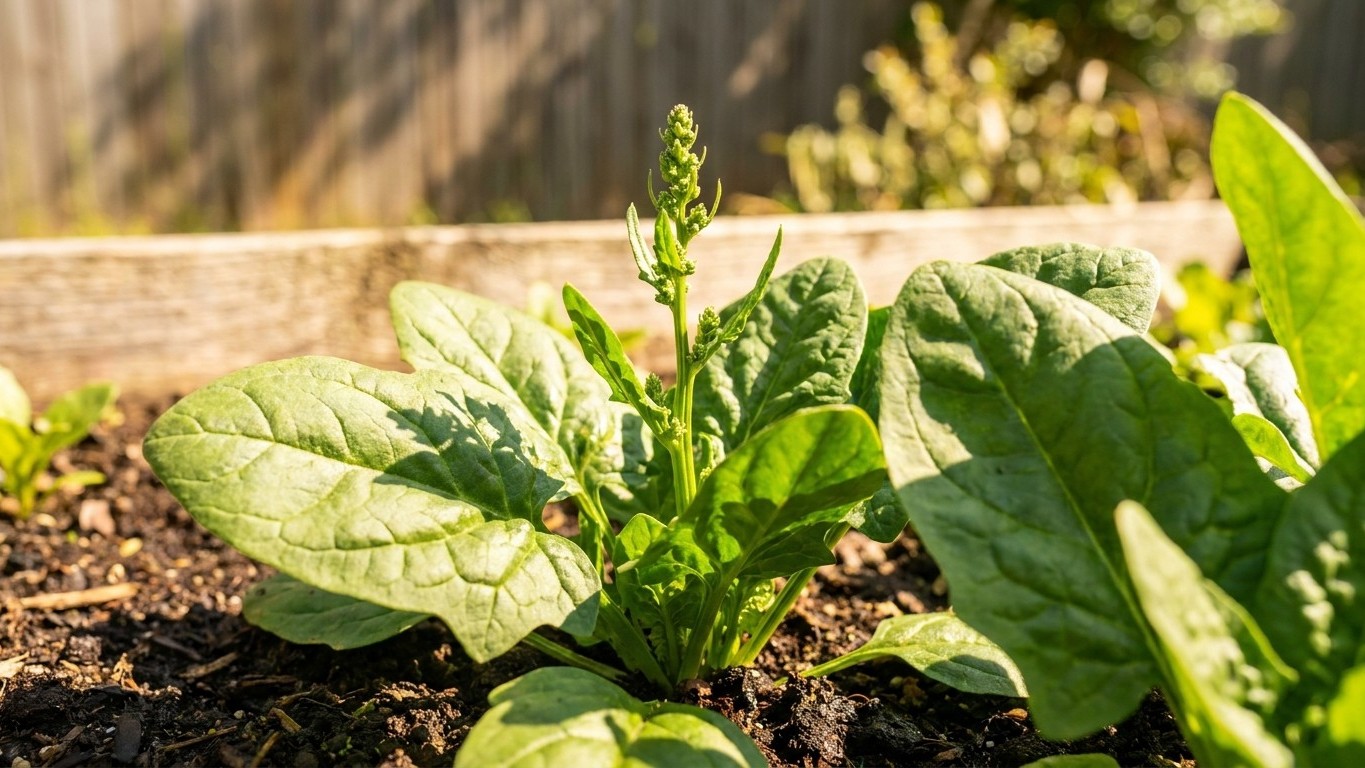

Yes. West Virginia’s spinach will bolt early once the calendar rolls into late spring, and it isn’t the heat doing most of the damage. It’s the length of the day itself. A cool, cloudy June won’t buy extra weeks here, because the trigger for flowering is daylight hours, not just temperature. The real strategy is to treat spinach as a short-season crop that gets squeezed into spring and again into fall, not as something you grow straight through summer.
The short answer
On the longest day of the year, the Charleston area sees 14 hours and 41 minutes of daylight. That number matters more than most gardeners expect, because spinach responds to day length on its own, separate from whatever the thermometer says. Long days push the plant toward flowering (bolting), and 14 hours and 41 minutes is well past the point where that switch flips. A mild, overcast summer doesn’t slow the clock down. The plant is reading the sun, not the forecast.
That’s the piece people miss. It’s tempting to think a cooler-than-average June means more time before spinach turns bitter and shoots up a flower stalk, but day length keeps climbing toward the solstice regardless of temperature, and spinach reacts to that climb whether the air feels like spring or summer. So the ceiling on spring Spinach in West Virginia isn’t purely a heat problem. It’s a light problem first.
Heat still plays a role, just a secondary one. The reference station in Charleston averages 16.0 days a year at 90 F or hotter, which is a real but moderate heat load compared to much of the country. Spinach grows best where temperatures stay under 75 F, and that ceiling is also where the leaves start turning bitter. So even in a year without much 90-degree weather, the crop is fighting two things at once as late spring arrives: lengthening daylight pushing it toward flower, and warming afternoons pushing it toward bitterness and stress.
Put plainly, the limit in West Virginia is both. Day length would be enough on its own to end the spring spinach crop by late May or so. Heat arrives on a similar timeline and finishes the job, particularly in warmer years or in low-lying spots along river valleys where afternoon highs run a few degrees ahead of surrounding hills. Utah State University Extension, the only source behind the growing guidance here, lists four garden spinach varieties, Bloomsdale, Melody, Teton, and Olympia, but publishes no days-to-maturity figures or bolt-resistance ratings for any of them. That means there’s no data-backed way to say one holds up longer than another in a West Virginia spring; the timing pressure described above applies regardless of which one goes in the ground.
How long the spring window really is
- Sowing date. Seed goes in the ground 2 to 3 weeks before the last spring frost. In West Virginia, that frost falls between April 9 and April 23 depending on location, which puts a realistic sowing window from roughly the third week of March into the first days of April.
- Early growth. Cool-soil germination and the first few weeks of leaf growth happen through April, while daylight is still short enough that bolting isn’t yet a concern.
- The pinch point. By the back half of May, two things converge at once: day length is closing in on the long-day trigger that pushes spinach toward flowering, and afternoon temperatures in much of the state are starting to brush past that 75 F growth ceiling on a regular basis. Either one alone would slow the crop down; together, they tend to end it.
- Usable harvest window. That leaves roughly six to seven weeks of good spring growing between sowing and the point where the crop turns toward bolting, most of it consumed by mid-to-late May. Gardeners at higher elevations, where spring arrives later and stays cooler a bit longer, may stretch that window by a week or so, but the same daylight ceiling still applies statewide.
The autumn crop, and when the soil lets you sow
Fall spinach dodges the day-length problem entirely, since daylight is shrinking rather than growing as the season winds down. The obstacle in autumn is different: it’s about getting the timing right on both ends, with too-warm soil blocking germination early and frost cutting the season short later.
Soil still too warm to germinate
Spinach seed germinates poorly once soil temperatures climb above 80 F, and in much of West Virginia, soil in early August is still holding onto summer heat. That means the very start of the theoretical fall sowing window, in early August, often isn’t usable yet. Gardeners typically need to wait until soil has cooled noticeably, which in practice pushes the realistic start of fall sowing into mid-to-late August in most of the state, and later still at higher, cooler elevations.
The frost that ends the season
Utah State University Extension’s guidance for a fall crop is to sow 50 to 75 days before the date you want to harvest, and West Virginia’s first fall frost arrives between October 18 and November 1 at the Charleston reference station. Counting back from that range puts a sowing window running from roughly early August through mid-September, depending on how close to frost you’re comfortable harvesting. Combine that with the soil-temperature limit above, and the truly workable window narrows to about mid-August through mid-September for most of the state.
Higher elevations complicate this further. The Charleston station sits in a river valley, and areas at greater elevation across West Virginia tend to freeze noticeably earlier in autumn, which shortens the back end of that 50-to-75-day countdown and rewards sowing on the earlier side of the window, soil temperature permitting.
Common questions
Can I grow spinach through a West Virginia summer if I keep it shaded?
Shade can lower leaf temperature somewhat, but it doesn’t change day length, and day length alone is enough to trigger bolting once the solstice approaches. Shade might buy a few extra days, not extra weeks.
Does elevation change when spinach bolts in spring?
Day length is the same at any elevation in the state, so the flowering trigger arrives on the same calendar schedule. What changes with elevation is temperature, so higher, cooler gardens may stay under the 75 F ceiling a bit longer, which can modestly extend the harvest window before bolting takes over.
Is there a spinach variety that resists bolting better in West Virginia’s climate?
Utah State University Extension names four varieties commonly grown in home gardens, Bloomsdale, Melody, Teton, and Olympia, but does not publish bolt-resistance data or maturity timing for any of them, so no variety can be recommended over another based on that source.
Why does the guide say 75 F both stops growth and causes bitterness?
Both effects come from the same heat stress. Once temperatures push consistently above 75 F, spinach growth slows and the leaves tend to develop the sharper, more bitter flavor that shows up right around the time the plant is also gearing up to bolt.