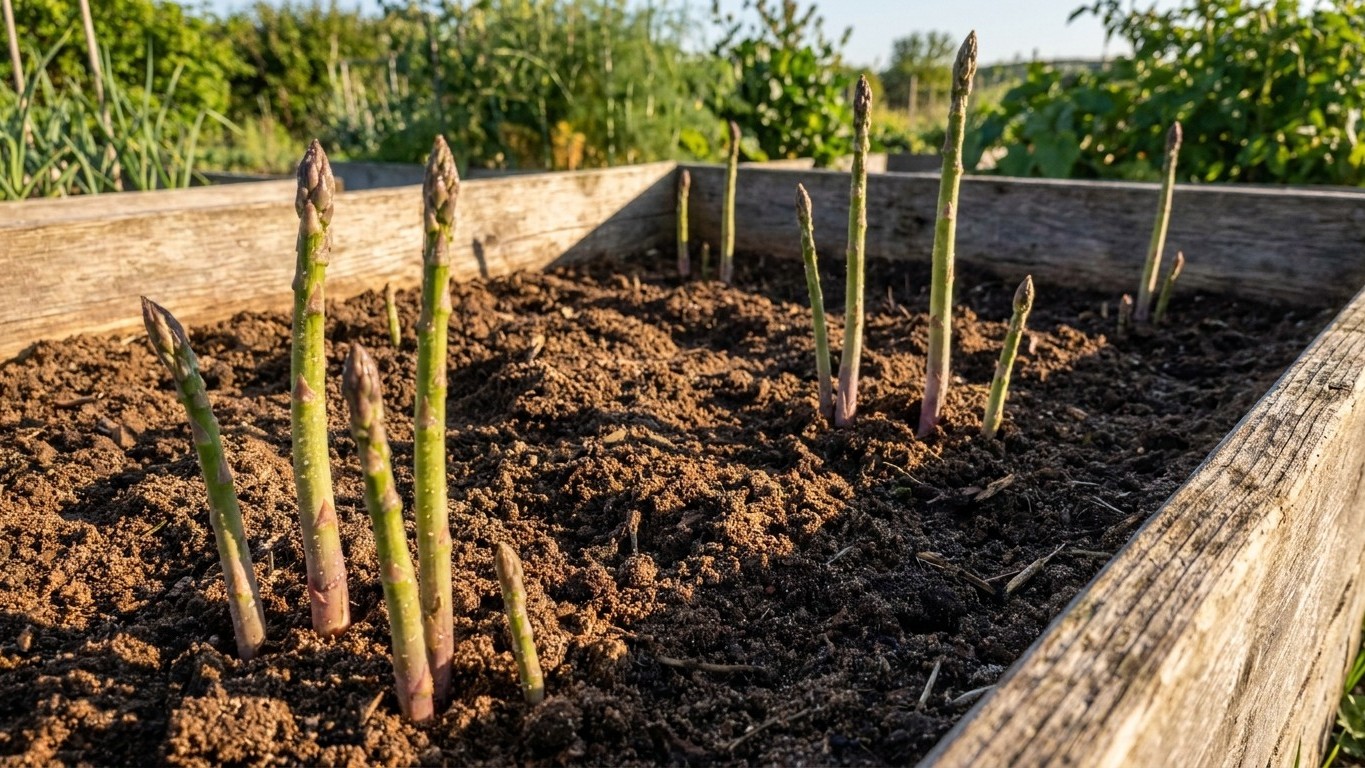

Stop cutting when most of the spears coming up are thinner than a pencil. That’s an object you can hold up to the bed, not a date on the calendar. Keeping what you cut is a separate job with a narrow target: 32 to 35°F, air close to saturated, and the cut ends standing in water. Both jobs depend on a bed that lasts long enough to harvest, and in Utah that starts with the ground.
The short answer
Utah’s state soil is the Mivida series, an Aridisol, the kind of soil a dry climate produces. USDA’s representative values for its surface layer read 72 percent sand, 9 percent clay and 19 percent silt, with about 1.5 percent organic matter and a surface pH near 8.1, which is alkaline. Soils like this often carry salts. The detail that matters most for asparagus is that the series is classed as well drained. A bed lasts 10 to 15 years, and the only soil requirement in Utah State University Extension’s guidance is that the ground drains. On that one test, the state’s typical soil passes easily.
Typical is not the same as yours. A state this size spans hundreds of soil series, and river bottoms, hill country and any lot a builder has scraped or filled can behave nothing like Mivida. If your spot holds water after a storm, or the topsoil was stripped and the subsoil compacted, treat that as a fifteen-year decision rather than a seasonal nuisance. A tomato bed with heavy soil gets fixed next spring. An asparagus bed does not. Your options are a raised bed built up with better-draining soil, or a different corner of the yard. A simple check is to dig a hole where the bed would go, fill it with water, and see whether it has emptied by the next day. A soil test then gives you your own pH and salt numbers, which the state figures can’t. The full drainage question is worked through in Will Utah Soil Hold an Asparagus Bed for Fifteen Years?
When the cutting stops
Nothing gets cut until year 3. Not a few spears, not a taste test. In that first harvest season the cutting runs about 4 weeks. The next season it runs 6 weeks, and after that 8. Those lengths are the ceiling, because the bed is still building strength. Within any season, the signal to quit is the pencil rule: when most of the spears coming up are thinner than a pencil, put the knife away and let the rest grow into ferns.
Keeping the spears once they’re cut
UC Davis Postharvest gives the target as 32 to 35.6°F with 95 to 100 percent relative humidity. Both edges of that window bite. Above 50°F, spear toughening occurs rapidly. At about 31°F or lower, freezing injury sets in, and the spears turn water-soaked and collapse on thawing. High humidity matters because spears lose water through the cut end faster than anywhere else. The kitchen translation is simple: stand the butts in an inch or so of water, or wrap them in a damp towel, and keep them cold. A refrigerator thermometer will tell you where your fridge really sits.
Will the summer here water it for you?
No. The bed wants 1 to 2 inches of water every other week for its first two years, then every three weeks after that. The Salt Lake reference station, using the most recent 30-year normals from NOAA NCEI, records about 2.0 inches of rain across June, July and August, out of 15.5 inches for the whole year. Here is how that plays out.
- Rain barely registers. June averages 0.95 inches, July 0.49 and August 0.58. Over the whole summer, rain delivers roughly one watering’s worth, and in July the average falls short of even the low end of a single application.
- You supply nearly all of it. For the first two years, that means a deep soaking every other week through the dry months, and the hose is doing the work the sky won’t.
- Sand makes the gap wider. If your ground resembles the state soil, with its 72 percent sand, water passes through within the day. A drained bed is what you want, but it also means light, frequent sprinkles are wasted. Water deeply, less often, and the roots follow it down.
- Heat and thunderstorms shave the rain further. Hot days pull moisture out of the surface, and a single summer downpour tends to run off rather than soak in. Treat the monthly average as what the region can usually expect, not a promise for any given week.
- From the third summer, ease off. The interval stretches to every three weeks, and by then the bed is also being cut, so skipping the watering is a bad trade.
- Settle it with a gauge. These are normals for one station in a mild valley. A slope, a rain shadow or a different city changes them. A cheap rain gauge on your own plot tells you what actually fell.
Across most of Utah, the higher, colder ground sees its own pattern, so use the numbers above as a baseline and not a prescription.
When to put the crowns in
Crowns go in during early spring. Around April 12 to April 29 is when the last spring freeze at 32°F typically arrives at the Salt Lake reference station, based on NOAA NCEI’s most recent 30-year normals (the 30 to 70 percent probability band). Those are averages, so some years the freeze comes earlier and some years later. Salt Lake also sits in a mild valley. Most of Utah is higher and colder, so your planting window may slide later, and southern Utah runs warmer. Your own county’s Extension office knows your local timing better than a valley station does.
Plant the crowns in furrows 8 inches deep. Do not fill the furrow in on planting day. It gets backfilled gradually across the year, about 2 inches every other month, as the spears push up. Filling it all at once is the common shortcut, and it is the wrong one.
Four varieties come up in the Utah State University Extension guidance, and the only thing it says about them is their sex. Jersey Giant and Jersey Knight are all male. UC 157 F1 and Purple Passion are male and female. No flavor, yield or reason to prefer one over another is published there, so any ranking you read elsewhere isn’t coming from that source. I’d treat the choice as a coin flip, and buy from whichever supplier has healthy-looking crowns.
Seed is the alternative route. It is slower, since you are growing the crown yourself before the clock on year 3 really starts. The Extension source used here gives no seed-starting dates or spacing, so I won’t invent any. Check with your county office before you sow. The overview in Growing Asparagus in Utah covers the bed as a whole, and What Eats Asparagus in Utah, and When covers what turns up once the spears do.
Common questions
Can I cut a few spears in the second year?
No. Asparagus isn’t harvested until year 3. The first two years are for the crowns to settle in, and the 4-week, then 6-week, then 8-week harvest schedule starts only after that.
How do I know it’s time to stop cutting for the season?
Look at the spears. When most of them are thinner than a pencil, stop. It is a fact about the plant, not a week number, so it will fall at different times in different beds and different elevations.
What temperature should I store cut spears at?
Aim for 32 to 35°F with humidity of 95 to 100 percent. Spears toughen fast above 50°F and freeze and turn mushy at about 31°F or below. Standing the butts in water or wrapping them in a damp towel gives you the humidity. The sources used here don’t give a number of days they’ll keep.
Should I fill in the planting furrow right away?
No. The furrow is 8 inches deep at planting and is backfilled over the year, about 2 inches every other month, not all at once.