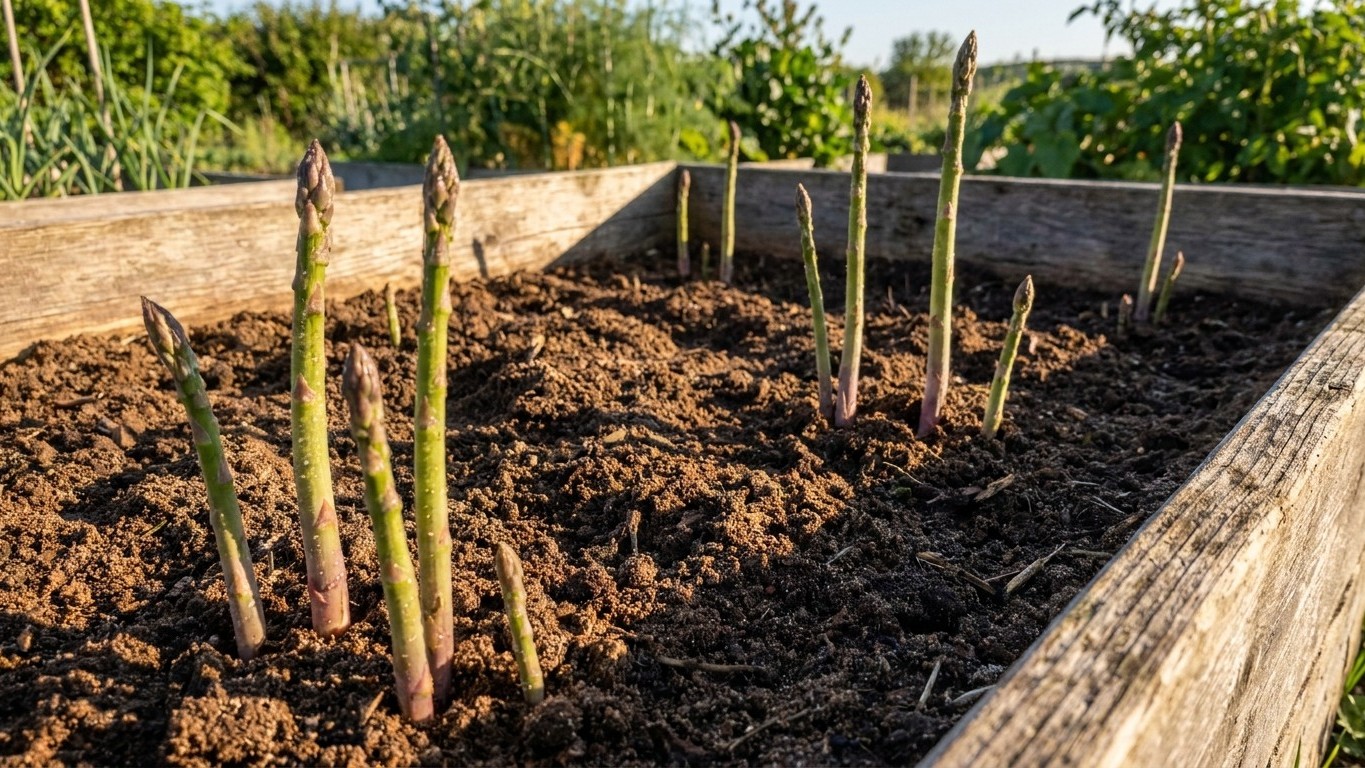

Utah’s dominant garden soil, the Mivida series, drains well by nature: 72 percent sand keeps water moving through rather than pooling around the crowns. That single trait matters more than anything else here, because an Asparagus Bed is a fifteen-year commitment, and the crop’s only real soil demand, according to Utah State University Extension, is good drainage. On a state-representative soil like this one, the ground itself isn’t the obstacle. What comes next is whether your own patch of dirt behaves like the state average, and how you’ll keep it watered through a dry Utah summer.
The short answer
Yes, in most cases. The Mivida series, the soil USDA lists as representative of Utah, is classified well drained, with a sandy surface texture (72 percent sand, 9 percent clay, 19 percent silt) that lets water pass through rather than sitting at the root zone. That matters enormously for asparagus, because Utah State University Extension is specific on this point: most soils will grow asparagus successfully as long as they are well drained. Crowns go into 8-inch furrows, the plants aren’t harvested until the third year, and after that they can keep producing for ten to fifteen years straight. There’s no annual do-over with this crop. The bed you plant is the bed you’re stuck with, for better or worse, until the roots finally give out.
The Mivida series also runs alkaline at the surface, with a pH around 8.1, and carries organic matter around 1.5 percent, both typical of a dry-climate Aridisol. Utah State University Extension’s guidance is silent on soil pH for asparagus, so there’s no published target to chase here, alkaline or otherwise, and no reason to treat the state figure as a warning sign on its own.
Here’s the caveat that matters more than the soil name: Mivida is what USDA records as representative of Utah, not a survey of your backyard. A homeowner in a valley with heavier river-bottom clay, or on a lot where a builder scraped and refilled the topsoil, could be working with something that holds water far longer than this series does. The state soil is a starting point, not a diagnosis of one garden. If your ground is heavy, slow to drain, or puddles for hours after a storm, the fix isn’t to avoid asparagus, it’s to build up. A raised bed or a mounded row lifts the crowns above standing water, and working in coarse organic matter loosens compacted soil over time. Given how long this bed will sit in the same spot, a simple test before planting, whether that’s a percolation check with a shovel and a bucket of water, or a lab test through a local extension office, is worth the hour it takes.
Will the summer here water it for you?
Not even close, and the gap is bigger than most gardeners expect. Utah State University Extension’s watering guidance for a new asparagus bed calls for 1 to 2 inches of water every other week for the first two years, then a lighter 1 to 2 inches every three weeks once the planting matures. Compare that to what a Utah summer actually delivers, based on 1991-2020 climate normals: about 2.0 inches of rain total across June, July and August combined, with July, the peak of the growing season, delivering just 0.49 inches on its own. June brings 0.95 inches and August 0.58 inches. Here’s what that means in practice:
- Year one and two, June through August: the bed asks for roughly 1 to 2 inches every other week, meaning six watering cycles across the summer. Natural rainfall over that same twelve weeks totals about 2.0 inches, barely covering one or two of those cycles. The rest has to come from a hose or drip line.
- July specifically: at 0.49 inches for the entire month, this is the driest stretch of the growing season, and also when a young bed needs consistent moisture the most. Expect to supply nearly all the water yourself during this month.
- Mature beds, year three onward: the schedule eases to every three weeks, but the summer rainfall total still falls far short. Supplemental watering remains necessary through the season, just less frequently than in the establishment years.
- What decides the actual amount: the Mivida series’ sandy texture lets water drain through quickly rather than holding it in the root zone, so a sandy bed can need water sooner after a dry spell than a clay one would. A rain gauge on your own property, tracked against these normals, is the only way to know how much your particular bed needs on top of what falls naturally.
None of this is unusual for the region. It’s simply the arithmetic of a dry-summer climate meeting a crop that wants steady moisture through its first two establishment years.
When to put the crowns in
Crowns go into the ground in early spring, planted into furrows about 8 inches deep. Utah’s last spring frost, based on NOAA NCEI’s 1991-2020 climate normals for the region’s reference station, falls somewhere around April 12 to April 29, a 30 to 70 percent freeze-probability band rather than a fixed date. Treat that window as a guide, not a promise. It’s an average built from three decades of data, and a mean frost date tells you what’s typical, not what this particular spring will do. Salt Lake’s valley floor tends to run milder than the state as a whole; higher elevations and northern Utah run colder, southern Utah warmer. Anyone gardening outside the immediate valley should lean toward the later end of that window, or check locally before crowns go in.
Once the furrow is dug and the crowns are set in place, the soil doesn’t go back in all at once. Utah State University Extension’s method calls for backfilling gradually, about 2 inches of soil added back into the furrow every other month across the year, rather than filling it in on planting day. That slow schedule gives the emerging shoots room to push upward without being buried too deep too soon.
Crowns versus seed
Crowns are the route Utah State University Extension describes in detail, and they’re the faster path to an established bed. Starting from seed is possible as an alternative, but it adds an extra season of growth before the plants reach crown size, pushing the entire harvest timeline back further. For a crop where the first harvest doesn’t come until the third year regardless of starting method, most home gardeners find crowns the more practical choice.
Which variety
Utah State University Extension names four varieties, distinguished only by their flowering type, with no guidance published on flavor, yield, or which performs better in Utah conditions specifically. Jersey Giant and Jersey Knight are all-male varieties. UC 157 F1 and Purple Passion are male/female types. Beyond that distinction, the source offers no reason to prefer one over another, so the choice comes down to what’s available rather than any documented performance difference.
Once the bed is in, patience is the whole game. No spears get cut in the first or second year, full stop. In year three, harvest runs about 4 weeks. The year after, it stretches to roughly 6 weeks, and the year after that, about 8 weeks, gradually building toward the plant’s full production. Within any given season, the signal to stop cutting isn’t a date on the calendar. It’s the spears themselves: once most of them come up thinner than a pencil, that’s the plant telling you to let it grow into fern for the rest of the season and rebuild its energy for next year.
Common questions
Does Utah’s alkaline soil hurt asparagus?
Utah State University Extension’s guidance doesn’t set a pH target for asparagus, so there’s no published threshold to measure against. The Mivida series runs around 8.1 at the surface, but this figure describes the state’s representative soil, not a documented requirement for the crop.
Can I harvest anything in the first two years?
No. The source is clear that no spears are cut until year three. Cutting earlier weakens the crowns before they’ve built enough root reserves to support the plant long-term.
How much extra water will a new bed need over an average summer?
With average summer rainfall around 2.0 inches across June through August, and the bed calling for 1 to 2 inches every other week during its first two years, most of the watering has to come from irrigation rather than rain, particularly in July when natural rainfall drops to about 0.49 inches.
Is there a winter chilling requirement to worry about?
That figure isn’t published in the source used here. Utah State University Extension’s guidance covers planting depth, watering, and harvest timing, but it doesn’t specify a chilling requirement, so no number should be assumed on that front.