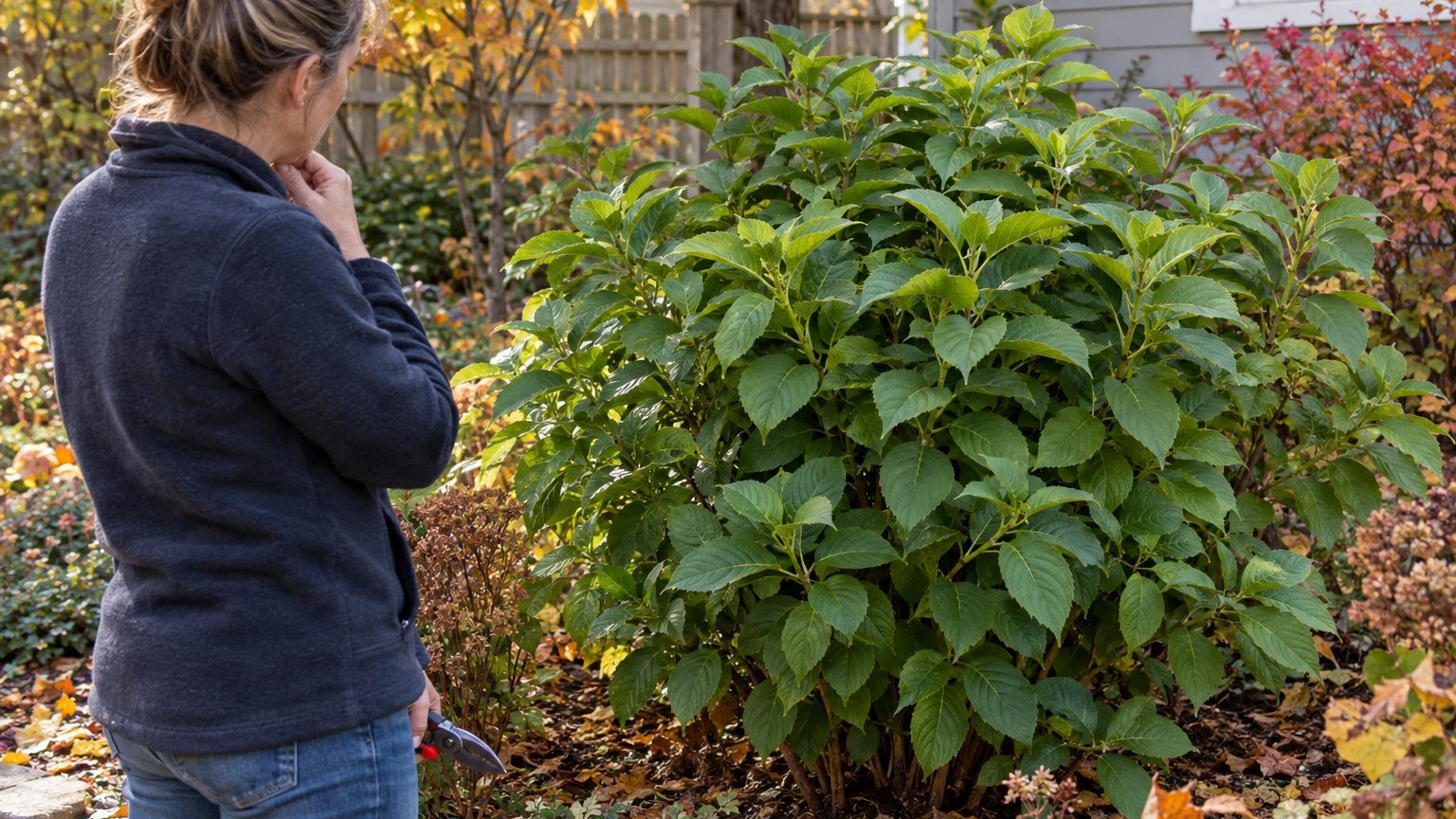

A hydrangea that leafs out well and never blooms is usually dealing with one of four problems. The flower buds were frozen or pruned off. The plant is a type that needs different pruning than it got. It lacks sun. Or it is simply young. Which one applies depends on the type you own, because bigleaf and panicle Hydrangeas look alike in a nursery pot and behave in opposite ways.
Why this matters
Hydrangeas fall into two camps, and the camp decides everything. Bigleaf (H. macrophylla, the mop-head and lacecap types) flowers on last year’s wood. Its buds form the previous summer and sit on the stems through winter. A hard freeze, a late spring frost or a spring haircut removes them, and the plant answers with a full set of leaves and nothing else. Oakleaf, mountain and climbing hydrangeas also bloom on old wood. Panicle (H. paniculata) and smooth (H. arborescens, the Annabelle type) bloom on the current season’s growth, so a hard cut in late winter costs them nothing.
Skip the diagnosis and you tend to repeat the cause. Someone with a bigleaf trims it every spring “to keep it tidy” and wonders for years why it never flowers. Someone with a panicle in deep shade feeds it harder instead of moving it. The leaves look so healthy that the problem is easy to wave off. A leafy plant with no flowers is not sick. It is telling you the buds never made it. The rules for cutting each type are laid out in When to Prune Hydrangeas, and Why Cutting the Wrong One Costs a Year.
When to do it
Time the check to the plant’s own stages, not the calendar. The first look comes right after the leaves have fully opened. By then you can see which stems are alive, because dead ones stay bare or leaf only at the base. Scratch a bit of bark with a thumbnail. Green underneath means living wood. Brown and dry means the stem is finished.
The second look comes once the plant has finished its main push of growth. On a bigleaf, this is when next year’s buds are being set. Look at the stem tips. A plump, rounded bud usually means a flower is forming, while a slim, pointed one is typically just leaves. If the tips are chewed or ragged, something has been browsing them. Hydrangeas do get browsed by deer, so do not assume they are safe.
Age is the third stage to consider. A plant moved or planted recently often spends its first season building roots instead of flowers. A climbing hydrangea (H. petiolaris) is famously slow to start flowering. Neither of those is a fault to fix. The right answer there is patience, and the fix for everything else is below.
How to do it

Start by naming your type
Check the plant tag, your purchase record or the leaf and flower shape. Bigleaf has broad, glossy, toothed leaves and round or flat flower heads. Panicle has cone-shaped blooms. Oakleaf has lobed leaves like an oak’s. The table shows what each type implies.
| Type | Blooms on | USDA hardiness | Most likely reason for leaves only |
|---|---|---|---|
| Bigleaf / mop-head / lacecap | Last year’s wood | 6a-11b | Buds killed by frost or removed by spring pruning |
| Mountain | Last year’s wood | Not listed here | Pruning; buds take late frost better than bigleaf |
| Oakleaf | Last year’s wood | Not listed here | Pruning, or winter damage |
| Climbing | Last year’s wood | Not listed here | Youth; very slow to start flowering |
| Panicle / peegee | Current season’s growth | 3a-8b | Too little sun |
| Smooth (Annabelle type) | Current season’s growth | Not listed here (hardiest of the genus) | Too little sun or very late growth |
Match the fix to the type
For old-wood types, stop cutting living stems. Remove only the wood that fails the scratch test, and leave the rest so the buds on it can form. If a late frost is forecast after the plant has leafed out, throw an old bedsheet or frost cloth over it that evening and pull it off the next morning. Shallow-rooted bigleaf and panicle both do better with a layer of shredded bark or leaf mulch over the root zone. Your zone and type decide how much winter protection counts as enough, and the per-state pages cover that.
For panicle and smooth types, look at light first. Panicle is the one hydrangea that takes full sun well. Bigleaf wants dappled sun or partial shade and protection from afternoon sun. Watch the spot for a day and note when the sun hits it. A panicle hidden behind a house wall gets leaves and few flowers. A bigleaf baking in afternoon sun wilts and spends its energy surviving.
Then look at feeding. Heavy feeding favors leaves over flowers, and a high-phosphorus fertilizer on a blue bigleaf also pushes the color toward pink, because it locks aluminum up in the soil. If you have been feeding often, stop for a season and see what the plant does on its own.
What goes wrong

The most common error is the spring cleanup on an old-wood hydrangea. The signature is clean cut stubs on the stems and a plant that looks tidy but never flowers. Cutting bigleaf, oakleaf, mountain or climbing hydrangeas back in spring removes the buds you wanted. It takes a full growing season to get them back.
The mistake that looks like extra care is the bloom-booster fertilizer. It feels logical: no flowers, so feed for flowers. But hydrangea buds are set by wood age, light and winter survival, not by a bag label. Extra feeding of any kind tends to push soft, leafy growth, and the phosphorus-heavy formulas can turn blue bigleaf flowers pink when they do arrive. If color is a goal for you, How to Turn Hydrangeas Blue or Pink, and What Actually Works covers it, and it applies only to bigleaf and mountain types.
Shade is the next one. A panicle that has slowly been overtaken by a growing tree can go from covered in blooms to mostly leaves over several seasons, and you rarely notice the shift. Compare current sun hours to the day you planted it.
Last, there is damage you can misread as a failure to bloom. Browsed stem tips show torn, uneven edges instead of clean cuts. On panicle, bud blight is named among its diseases, so brown, dead flower buds that never open point there instead of to a lack of flowers. Leaf spot, powdery mildew and bacterial wilt also occur on hydrangeas, but they mark stress, not the lack of buds.
Doing it differently
Container plants have a particular weakness. A pot exposes the roots and stems to colder air than ground soil does, and bigleaf is shallow-rooted to begin with. Move a potted bigleaf to a sheltered spot, such as against a wall or into an unheated garage, once it has gone dormant. That protects the old wood where the buds sit.
Some bigleaf cultivars are bred to flower on both old and new wood, so a frost that takes the old buds does not leave the plant bare. The tag should say so if yours is one of them. If it does not, treat the plant as a standard old-wood bloomer.
Sometimes the better move is a different hydrangea. The NC State Extension Gardener Plant Toolbox calls panicle a good substitute for the mop-head hydrangea where that species is not winter hardy, and it blooms on new growth, so late frosts matter far less. Mountain hydrangea is another option, since its buds take late frost better than bigleaf. For a bigleaf that never blooms in your yard, swapping it is often more sensible than trying a fourth fix.
When blooms do come, Drying Hydrangea Flowers So They Keep Their Colour explains how to keep them. For the full picture of care across the whole plant, see How to Grow Hydrangeas.
Common questions
Should I cut it back to force blooms?
Only if it is a panicle or smooth type, which flower on new growth and can be cut hard in late winter. On a bigleaf, oakleaf, mountain or climbing hydrangea, cutting back removes the buds. If you cut dead stems, the source advises leaving hollow ones standing at 12 to 24 inches, since native bees nest in them.
Will a bloom-booster fertilizer help?
Usually not. Blooming depends on type, wood age and light. High phosphorus also locks up aluminum and moves blue flowers toward pink.
How long should a new plant take to flower?
No set figure is published here. Recently planted or moved hydrangeas often focus on roots first. A climbing hydrangea is very slow to start flowering, so give it extra time before concluding something is wrong.
Does my zone change the answer?
Yes. Hardiness runs from USDA zones 3a through 9b across the genus, but it depends entirely on the type. Bigleaf is rated 6a-11b and panicle 3a-8b. Pruning timing and winter protection are local, so check the state page for your area after you have identified your type.