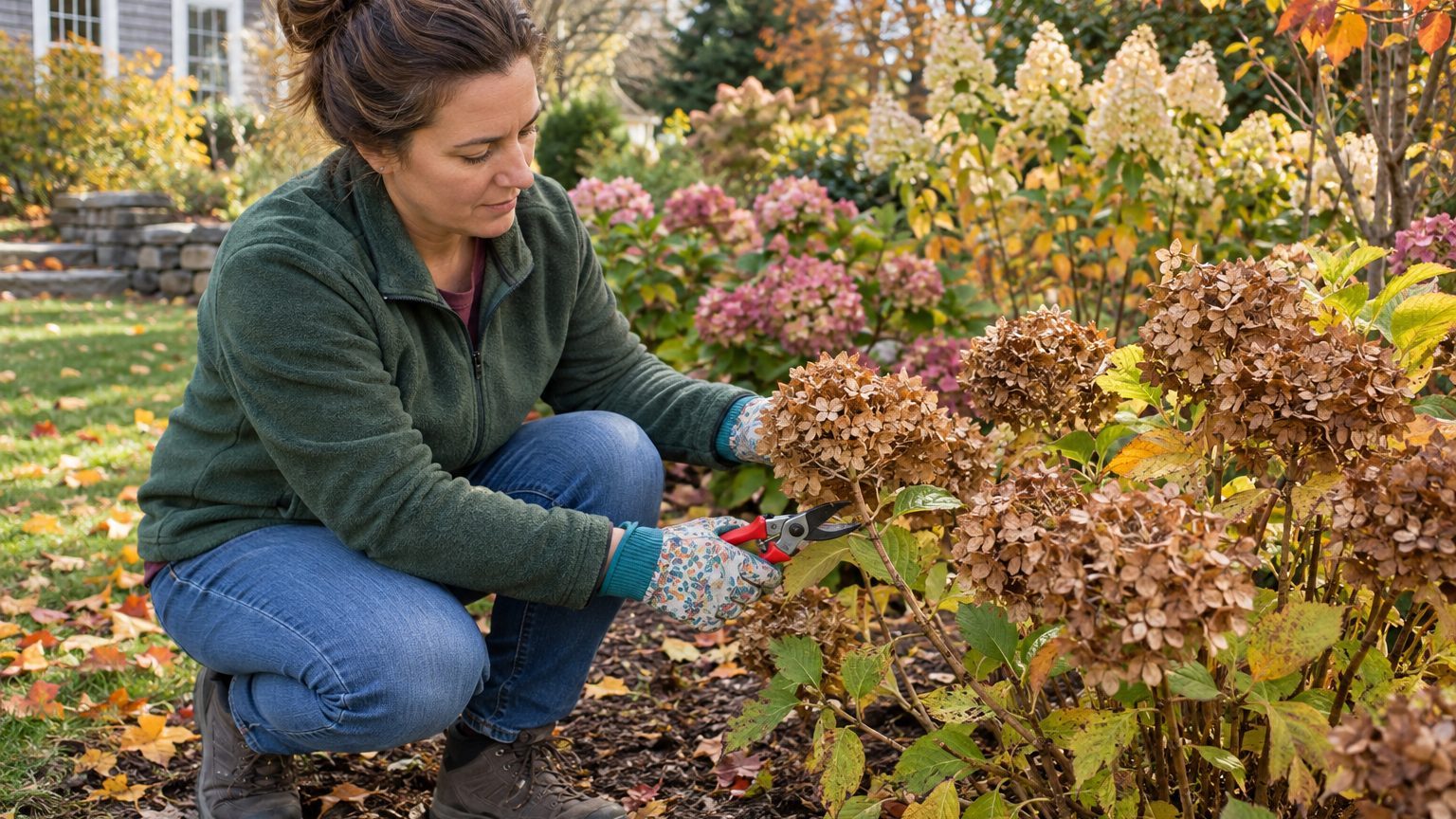

The answer splits by wood type, not by calendar. Bigleaf, oakleaf, mountain, and climbing Hydrangeas set their flower buds the summer before, so they must be cut right after they bloom, never in fall or spring. Panicle and smooth hydrangeas bloom on the current season’s growth, so they take a hard, late-winter cut without losing a single flower.
Why this matters
For old-wood bloomers, a flower bud formed in late summer sits dormant through fall and winter, waiting for spring. Cut that stem anytime between August and early spring, and you remove a bud that was already finished, months before you touch the pruners. The plant survives fine. It just skips flowering entirely for one full season, because there’s no time left to form new buds before the growing window closes again.
New-wood bloomers work the opposite way, which is why skipping their pruning doesn’t cost a bloom cycle at all. It costs structure. Left uncut year after year, panicle and smooth hydrangeas build tall, thin stems that can’t hold up their own flower heads, and centers get crowded enough that airflow drops and leaf spot or powdery mildew move in. Pruning here isn’t about protecting buds. It’s about keeping the plant upright and healthy.
When to do it
Watch the plant, not the date on a calendar, because timing depends on your zone and your type. Old-wood bloomers give a clear signal: once the flower heads fade and start browning, that’s the window. For bigleaf hydrangea specifically, the practical deadline is before August 1, since buds for next year are forming by then and any later cut removes them. Mountain hydrangea follows the same old-wood rule, though its buds tolerate a late frost better than bigleaf’s do.
New-wood bloomers are read differently. You’re watching for full dormancy: leaves down, stems bare, no swelling at the buds yet. That’s the cut point for panicle and smooth hydrangeas, and it happens before spring growth restarts, not after.
| Type | Blooms on | Prune when | Mature size |
|---|---|---|---|
| Bigleaf / mop-head / lacecap | Last year’s wood | Right after flowering, before Aug. 1 | 3-6 ft |
| Panicle / peegee | Current season’s growth | Late winter, fully dormant | 8-25 ft |
| Smooth (Annabelle type) | New wood | Late winter, fully dormant | Varies by cultivar |
| Oakleaf | Old wood | Right after flowering | ~5 ft |
| Mountain | Old wood | Right after flowering | Similar to bigleaf |
| Climbing | Old wood | Right after flowering, minimal cuts | 15+ ft |
Your exact date will vary with your zone, so treat this as the biological rule and check the type-specific and state pages for local timing.
How to do it

Old-wood types: bigleaf, oakleaf, mountain, climbing
Start by deadheading the spent flower heads back to the first strong pair of leaf buds below them. That alone tidies the plant without touching next year’s growth. If you also need to reduce size or open up the shrub, remove no more than a third of the oldest, thickest canes in a single pass, cutting them near the base with bypass pruners for anything under about three-quarters of an inch thick, and loppers for anything heavier. Cutting an old cane out entirely encourages fresh shoots to replace it, which keeps the shrub renewing itself instead of aging into a woody tangle.
Climbing hydrangea deserves a lighter hand than the others. It’s slow to establish and slower still to start flowering, so any pruning beyond controlling its spread along a wall or trellis just pushes bloom further out. Cut only what’s growing where you don’t want it.
Oakleaf rewards restraint too. Its wine-red autumn foliage is one of the reasons people grow it, and heavy shaping ruins the natural, layered form that shows that color off. Light cuts right after bloom, removing dead or crossing wood, is usually all it needs.
New-wood types: panicle, smooth
These take a genuinely hard cut. For panicle hydrangea, cutting back to roughly a two- to three-foot framework produces fewer, larger flower heads on sturdier stems; a lighter cut leaves more stems and more, smaller blooms, which is a style choice rather than a right-or-wrong answer. Smooth hydrangeas, including Annabelle types, tolerate being cut nearly to the ground each year and will still put out a full flush of new growth and flowers in the same season.
Use clean, sharp bypass pruners for this work, and make each cut just above a healthy bud pair at a slight angle, so water runs off the cut rather than sitting on it. Wipe the blades with rubbing alcohol between plants, since leaf spot and bacterial wilt both spread easily on pruning tools. When you’re done, an old-wood shrub should look barely touched, just cleaner. A new-wood shrub should look like a stubby framework close to the ground, which feels drastic the first time but is exactly right.
One habit worth building into every pruning session: leave a portion of the cut stems standing at 12 to 24 inches rather than clearing everything to the ground. Native bees nest inside those hollow stems, and leaving them in place until they naturally break down gives that generation somewhere to overwinter. And if you’re handling bigleaf hydrangea cuttings, keep the debris out of reach of pets and kids. Large quantities of leaves, bark, flowers or stems from this species specifically are documented as toxic, causing nausea, stomach pain, vomiting and sweating, and the same risk applies to cats, dogs and horses.
What goes wrong

The single most common mistake is treating every hydrangea the same, which usually means giving an old-wood bloomer a tidy fall cleanup. It looks responsible: cutting things back before winter, clearing the bed, making everything look neat for spring. On a bigleaf, oakleaf, mountain, or climbing hydrangea, that same tidy instinct removes buds that are already formed and waiting, which is exactly how a healthy, well-tended plant produces zero flowers the following year.
Over-pruning is the second failure point, even on the right type at the right time. Removing more than a third of an old-wood shrub’s canes in one pass stresses a plant that’s already shallow-rooted, and both macrophylla and paniculata fall into that category, which is part of why mulching around the base matters as much as the cut itself.
A subtler error is misreading dead wood on bigleaf hydrangea after a hard winter. Stems that look lifeless in early spring are sometimes just slow to leaf out, not actually dead, and cutting them prematurely removes wood that would have flowered. Scratch a small patch of bark near the base; green underneath means it’s alive and worth waiting on.
Dull or dirty tools cause damage that shows up weeks later as ragged, torn cuts that heal slowly and become entry points for leaf spot or bacterial wilt, both named issues for this genus.
Doing it differently
Container-grown macrophylla and paniculata are more exposed at the roots since both are shallow-rooted by nature, and pots offer less insulation than open ground. The pruning rule doesn’t change, but the stakes for winter root protection go up, so mulch or move containers somewhere sheltered rather than adjusting the cutting schedule itself.
Raised beds behave close enough to in-ground planting that no separate pruning approach is needed; drainage is the main benefit there, not timing.
Within a single old-wood type, style choices matter more than rules. Panicle hydrangea, the only type in this genus that takes full sun well and the one recommended as a mop-head substitute where bigleaf isn’t hardy, can be trained toward a hard annual cut for a few dramatic, heavy blooms, or a lighter touch for a fuller shrub with more numerous, smaller flower heads. Neither is wrong; it depends on whether you want a statement plant or a full hedge. Climbing hydrangea is the one case where doing less really is doing it better, given how slow it already is to reach flowering size.
Common questions
Can I prune a hydrangea that never blooms?
Often the fix isn’t pruning at all but timing. A bigleaf, oakleaf, mountain, or climbing hydrangea that gets cut in fall, winter, or spring will look perfectly healthy and still skip flowers, simply because the buds were removed before they had a chance to open. Check your pruning history against the wood type before assuming a disease or site problem.
Do panicle hydrangeas need pruning every year?
No. Annual pruning shapes the plant and can produce larger flower heads, but panicle hydrangea will still bloom on unpruned new growth. Skipping a year mainly affects form and stem sturdiness, not whether it flowers.
What happens if I accidentally prune a bigleaf hydrangea in spring?
You’ve likely removed the buds that were set the previous summer, which means little to no bloom that season. The plant itself isn’t harmed and will set new buds normally after this year’s flowering window, so the setback is one season, not permanent.
Should I prune hydrangeas the same year they’re transplanted?
Hold off on anything beyond removing dead or damaged wood. A newly transplanted hydrangea is putting its energy into root establishment, and heavy pruning on top of that stress, especially on an already shallow-rooted type, asks more of the plant than it can comfortably give in year one.