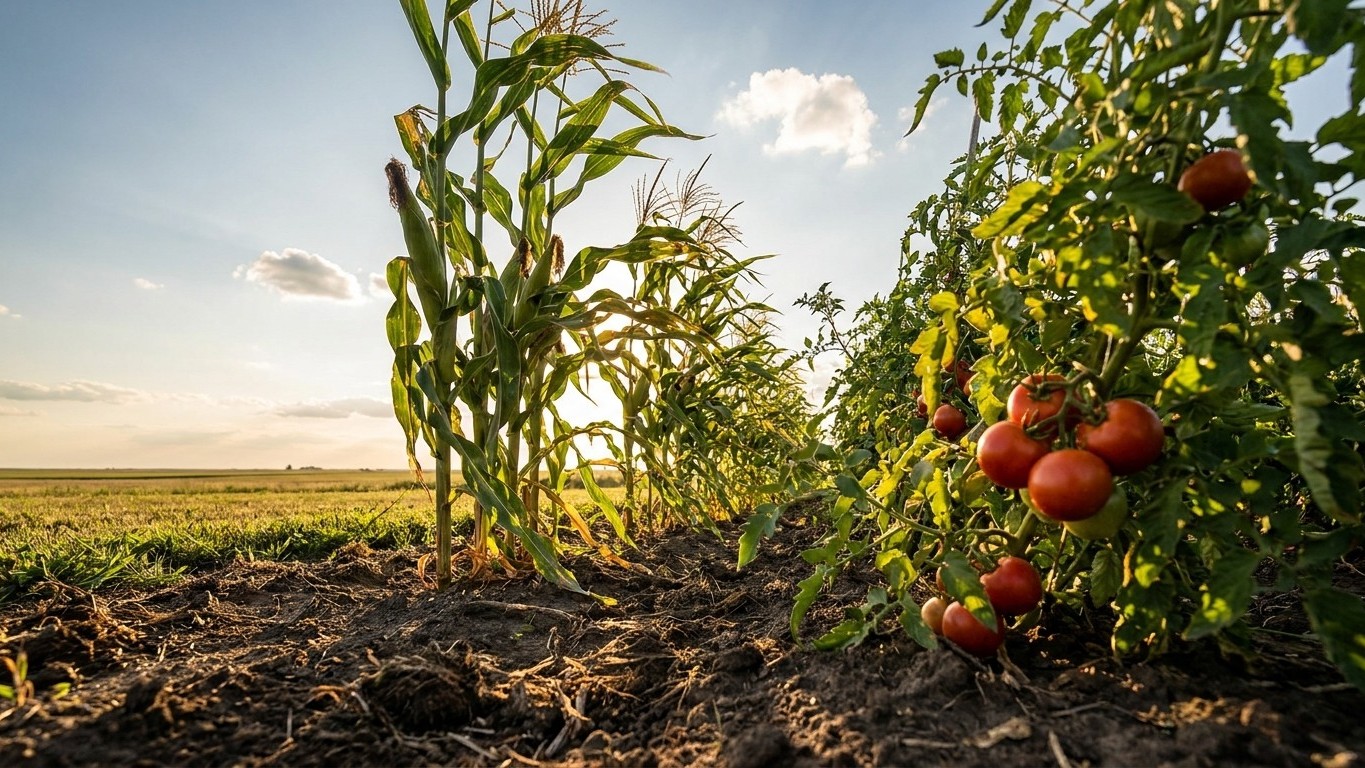

Plan on at least 60 days from planting to ripe ears, and the planting can’t happen until the soil warms. That warming comes after the June 5 average last frost at Whitehorse A. Only the quickest types fit before the August 25 average first frost, so a 90-day corn is off the table. After picking, sugar drains from the kernels within days. That’s why the old advice about running from garden to pot holds up. For the full growing picture, see Growing Sweet Corn in Yukon.
The short answer
Soil warms later than the frost date
The average last spring frost at Whitehorse A is June 5. That’s a midpoint, not a safe date: in one year out of two, the last frost falls later. Sweet corn wants soil above 60 F, and soil reaches that after the last frost, not on the same day. Frost is a matter of cold air on a clear night. Soil is slower, a cold sponge that lets go of winter gradually. How many days later it hits 60 F is not published here, so there is no calendar date to give you. A thermometer pushed 4 inches into the bed will tell you.
Clemson Extension puts the depth and the floor plainly: “Do not plant before the soil temperature at the 4-inch depth is at least 50 ºF. Wait to plant extra-sweet varieties until soil temperatures reach 65 °F.” The two numbers are not interchangeable. Ordinary sweet corn can start near 50 F, but an extra-sweet seed sown at that temperature tends to rot instead of sprouting. A gardener who changes varieties can fail one year after succeeding the year before, and soil temperature is often the reason. Timing details are in When to Sow Sweet Corn in Yukon.
Counting against the fall
The average first fall frost is August 25. Between the two mean dates sit about 81 days, and that’s before you subtract the wait for warm soil. Half of all years, the first frost arrives before August 25. Both figures come from the airport station at Whitehorse. Northern and upland districts run weeks behind it, and the Canadian normals cover an earlier 30-year period than the US figures used elsewhere on this site.
Heat is not the problem. Whitehorse A averages 0.92 days a year above 30 °C and 0.28 days above 32 °C. Those count extreme days, not the season. What limits corn here is the length of the frost-free stretch.
Two clocks, then a fast fade
Two clocks answer different questions. The 60 to 90 days from planting tell you whether a variety fits the season. A second clock, 17 to 24 days from silk emergence, tells you which week to pick. Ready means three signs together: dry brown silks, husks still moist and green, and milky juice when you puncture a kernel.
Then the fade starts. Clemson Extension: “Sweet corn loses sugar from the kernel rapidly at high temperatures… Sweet corn can be stored under optimal conditions for about five days, but will lose sweetness with each day of storage.” Five days is a ceiling, not a promise. Genotype matters too: su loses sugar fastest, se holds it longer, sh2 longest.
Does a late variety fit here?
A 60-day variety
Sometimes. Start with the roughly 81 days between the two mean frost dates. Sow on the day soil reaches 60 F, which falls after June 5, and you have 60 days to spend out of a smaller number. In an average year, a few weeks of margin might remain. In a late spring or an early fall, the margin is gone. Remember that the August 25 date is a midpoint, and the first frost comes sooner in about half of all years.
Your choice of type shifts that margin. An extra-sweet type wants 65 F soil at 4 inches, so it must wait longer than an ordinary type that can start near 50 F. Every day of waiting comes out of the margin. The sources I’m working from name no variety, so read the days-to-maturity on the packet and pick from the short end of the range. Whatever you grow, plant it in blocks of three or more rows, not one long line. Utah State University Extension asks for that shape for pollination.
A 90-day variety
No. Even if you could plant on June 5, the average last frost, ninety days would run past the average first frost on August 25 with nothing to spare. And you can’t plant on June 5, because the soil hasn’t warmed yet. So the 90-day number fails twice. It needs more days than the average season holds, and it starts later than the season does. A warm summer in Whitehorse won’t fix it, because the problem is days on the calendar, not degrees.
A gardener in a sheltered pocket with a longer frost-free run might do better, but the figures here come from the Whitehorse A station and don’t promise that. If a seed packet says 90 days, leave it on the rack.
What goes wrong here
- Soil sown too cold. Seed in soil under its threshold sits, then rots, and you replant after losing weeks the season can’t spare. Remedy: measure at 4 inches, not on the surface, which reads warmer. Wait for 50 F with ordinary types and 65 F with extra-sweet ones. Don’t use the last frost date as a signal, because soil warms later. Slow germination also keeps seed exposed longer to whatever is feeding below ground, a separate matter covered in What Eats Corn in Yukon, and When.
- A variety too late for the season. The corn grows well all summer, then meets frost with ears still unfilled. Remedy: count days from planting, not from the frost date. Pick the short end of the 60 to 90 range and skip anything that needs the full 90. With about 81 days between the mean frost dates, the arithmetic leaves little room for argument.
- Sweetness lost to the neighbors. This one has nothing to do with climate. Sweetness fades when su, se and sh2 types tassel at the same time, because pollen from one lands on the silks of another. The source gives no separating distance, so I won’t invent one. The condition is timing. Remedy: grow one type per season, or make sure different types do not tassel together. Staggering is hard in a short season, which makes a single type the simpler path. Keep each planting in a block of three or more rows.
Common questions
Is June 5 a safe planting date?
No. It is the average last frost at Whitehorse A, the midpoint of a window. In one year out of two, frost comes later. Soil at 60 F follows the frost date, so treat a thermometer at 4 inches as the instruction.
How do I know an ear is ready?
Look for three signs together: dry brown silks, husks still moist and green, and milky juice from a punctured kernel. The silk clock, 17 to 24 days from silk emergence, tells you which week to start checking. One sign alone can mislead you.
How long can I keep picked sweet corn?
Clemson Extension says it “can be stored under optimal conditions for about five days, but will lose sweetness with each day of storage.” Treat five days as the most you’ll get. Types differ: su fades fastest, se holds longer, sh2 longest.
Is Yukon too cool, or too hot, for sweet corn?
The limit is the calendar. Whitehorse A averages 0.92 days a year above 30 °C and 0.28 above 32 °C, so extreme heat is rare. That count measures hot days, not season length. What decides the crop is the frost-free stretch, about 81 days between the two mean dates, and how much of it soil warmth leaves you.