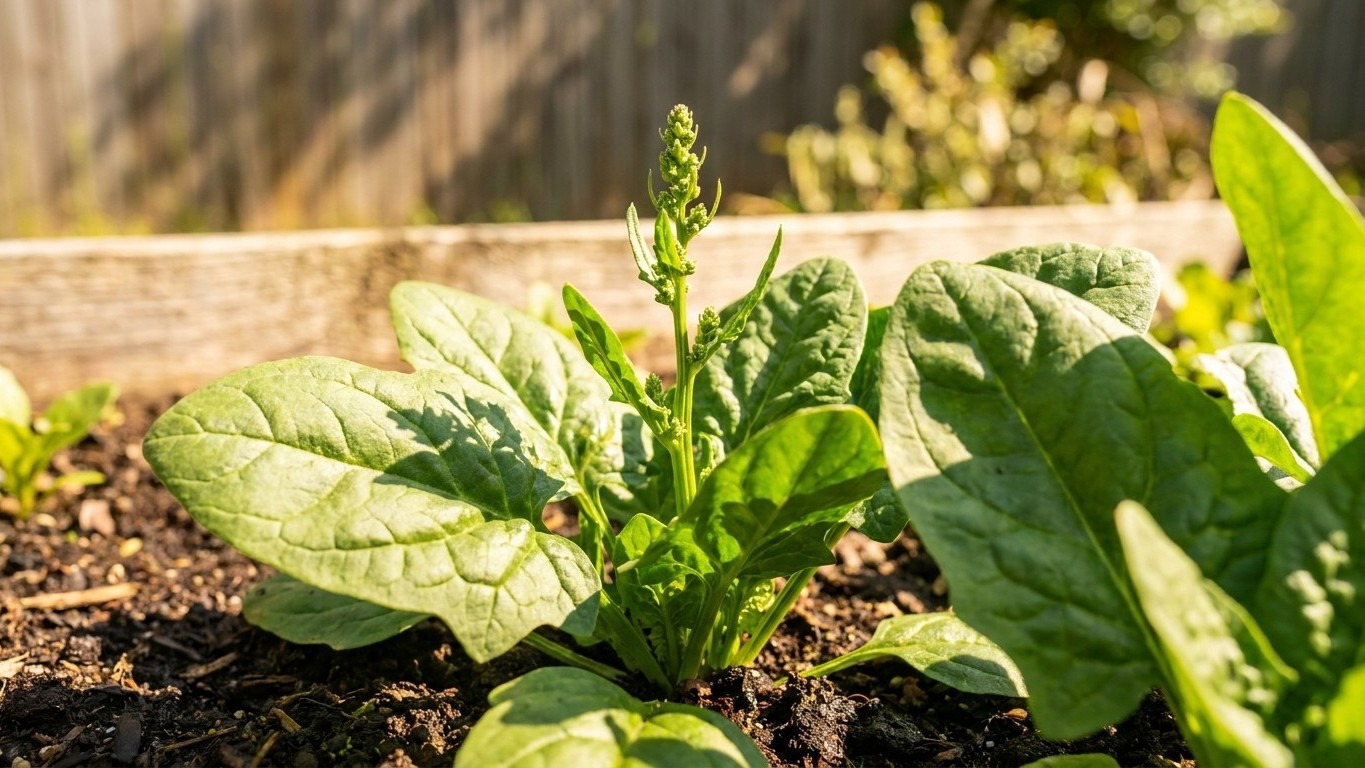

Cut Montana spinach in spring, before heat and the longest days push it to flower, and try a second crop in autumn if the soil cooperates. Seed goes in two to three weeks ahead of the last frost, which at the Billings reference station falls between April 29 and May 10. After the cut, spinach is a short-lived crop. It holds for up to two weeks, and only at 32°F. The dates below show where that spring window starts, where it ends, and why autumn is harder than it looks.
The short answer
On the longest day of the year, Billings gets 15 h 32 of daylight. That number matters more than any thermometer reading, because spinach flowers (bolts) in response to long days as well as warm temperatures. Long days alone are enough to trigger it. A cool, wet July does not rescue the crop, because the sun rises and sets on the same schedule whether the afternoon hits 62 F or 92 F. Gardeners in cool northern valleys often assume the chilly nights will buy them extra weeks. They don’t. For more on how the flowering trigger plays out in practice, see Will Spinach Bolt Early in Montana?
So the limit here is both day length and heat, and the two stack. Utah State University Extension puts the comfortable ceiling for growth at 75 F. Above that, spinach stops growing well, and 75 F is also where the leaves turn bitter. One number, two consequences. Billings averages 28.3 days a year at 90 F or more, so the heat does arrive, but it is the long daylight of late spring and early summer that sets the outer boundary even in a cool year.
The practical meaning for “when to cut” is simple. Cut while the plants are still leafy and the weather is still below that 75 F line, and do not wait for the planting to get bigger. Spinach that has started to bolt sends up a central stalk and its leaves take on a bitter edge. There is no benefit to hanging on to it. The source used for this page publishes no days-to-maturity figure for spinach, so any “ready in so many days” number you see belongs to a specific seed packet, not to this page. The same goes for varieties. The extension source names Bloomsdale, Melody, Teton and Olympia, and publishes no data on any of them, so there is nothing to compare here.
How long it keeps after the cut
UC Davis’s postharvest program is blunt: spinach is highly perishable and “will not maintain good quality for more than 2 weeks.” Its optimum is 32°F at 95 to 98 percent relative humidity. Wilting, yellowing and decay increase after 10 to 14 days of storage, and they come faster at 41 to 50°F, which is about what a home refrigerator holds in the door and on the upper shelves. Read that two weeks as a ceiling, not a plan. In a home fridge, the coldest spot is the back of the bottom shelf, so that is where spinach goes, never the door. Expect yellowing in days rather than weeks if it sits somewhere warmer. The full data is on the UC Davis spinach fact sheet.
How long the spring window really is
Work through it in order, because each step is set by the one before.
- Find the sowing dates. Seed goes in 2 to 3 weeks before the last spring frost. With that frost falling between April 29 and May 10 in Billings (NOAA NCEI 1991-2020 normals, the 30-70% probability band), the sowing dates run from about April 8 at the earliest to about April 26 at the latest. That is a spread of just over two weeks, and you are not required to use all of it.
- Check what that date means for your own valley. Billings is one of the milder valleys in the state. Mountain valleys elsewhere in Montana can frost in any month, so their last-frost date, and their sowing date, will land later or be less certain. Use the Billings dates as the earliest end of the range, not as a statewide rule.
- Let the plants grow in cool weather. From sowing, the crop grows only while temperatures stay under 75 F. No calendar date for crossing that line is published here, and 75 F is a growth ceiling and a bitterness threshold, not a date. What can be said is that the 28.3 days a year at 90 F or more all come after the spring crop should be finished, and that day length keeps increasing until the solstice at 15 h 32.
- Count it in weeks. Sowing opens in the second week of April and closes by the end of that month. The harvest has to fit between germination and the first run of warm days, and with no published days-to-maturity for spinach, the honest answer is a few weeks, not a season. Sow early in the range, cut early, and treat any late cutting as a bonus.
- Cut the whole planting before heat decides for you. Spinach cut in a cool spell can be eaten fresh or stored; spinach cut after it turns bitter is hard to rescue. Pests also tend to find a planting that lingers, which What Eats Spinach in Montana, and When covers by season.
Put plainly, spring gives Montana growers a window measured in weeks, and its length depends mostly on how quickly April turns into warm May weather. A planting that goes in at the start of the range has the best chance of being finished before the heat. A planting that goes in at the end of the range has the least.
The autumn crop, and when the soil lets you sow
Autumn spinach is the better-tasting crop in much of the country, since the days are shortening and the weather is cooling. In Montana, two separate things get in the way. Neither of them is the cold you’d expect.
Soil that is still too warm
Utah State University Extension notes that seed germination is reduced when the soil is above 80 F. That is the obstacle that matters at sowing time, and it has nothing to do with frost. The calendar can say “go” while the top two inches of a south-facing bed are still baking. In a hot stretch, seed sown into soil that warm will germinate poorly and sometimes not at all.
The window opens when the soil falls, not on a date you pick. A cheap soil thermometer, pushed in to seed depth in the morning, is a better guide than the almanac. Watering the bed and shading it for a week before sowing can pull the temperature down. Because Billings sees 28.3 days a year at 90 F or more, expect the soil to hold its heat well into late summer in a typical year.
The frost that ends the season
At the other end of the season, the first fall frost at the Billings reference station falls between October 1 and October 14 (NOAA NCEI 1991-2020 normals, 30-70% band). Use that as the finish line. The source recommends planting 50 to 75 days before the date you want to harvest, and it publishes no other maturity figure for spinach.
Count backward from October 1 and the sowing dates run from about July 18 to August 12. Count backward from October 14 and they run from about July 31 to August 25. Put the two ranges together and the full calendar spread is July 18 to August 25. Those are the hottest weeks of the Montana year, which is the whole difficulty. The late end of that range is the realistic one for most beds, since the soil has had more time to cool, and the days are already shortening after the June solstice.
A few things follow from the arithmetic:
- A planting that waits for cool soil past August 25 is racing a frost date that may not leave 50 days.
- Higher valleys frost earlier than Billings, which shortens every number above.
- If the soil is still above 80 F on your target date, sow anyway only in a shaded, watered bed.
Success in autumn depends on landing between a soil that has cooled enough and a frost that has not come yet. In a mild year the gap is comfortable. In a short one, there may be no gap at all, and the first-frost number is only a planning line, not a guarantee. The basics of the crop are in Growing Spinach in Montana.
Common questions
Can I still eat spinach that has started to bolt?
The leaves are edible, but they turn bitter above the 75 F threshold, and the flower stalk signals the plant is finished growing leaves. Cut what you have, use it quickly, and pull the plants.
Does a cool summer in the mountains let spinach keep producing?
No. Long days alone trigger flowering, and Billings gets 15 h 32 of daylight on the longest day. A cool summer slows the heat problem but does not remove the day-length one.
How long does cut spinach last in the fridge?
UC Davis says it will not keep good quality beyond 2 weeks, and that is at 32°F with high humidity. At 41 to 50°F it declines faster. Store it at the back of the bottom shelf, not in the door, and plan to eat it well before the two-week mark.
Which variety should I plant?
The extension source names Bloomsdale, Melody, Teton and Olympia. It publishes no data on any of them, so this page cannot say which bolts later or matures faster. Read the seed packet for each one, and compare packets rather than relying on a general reputation.