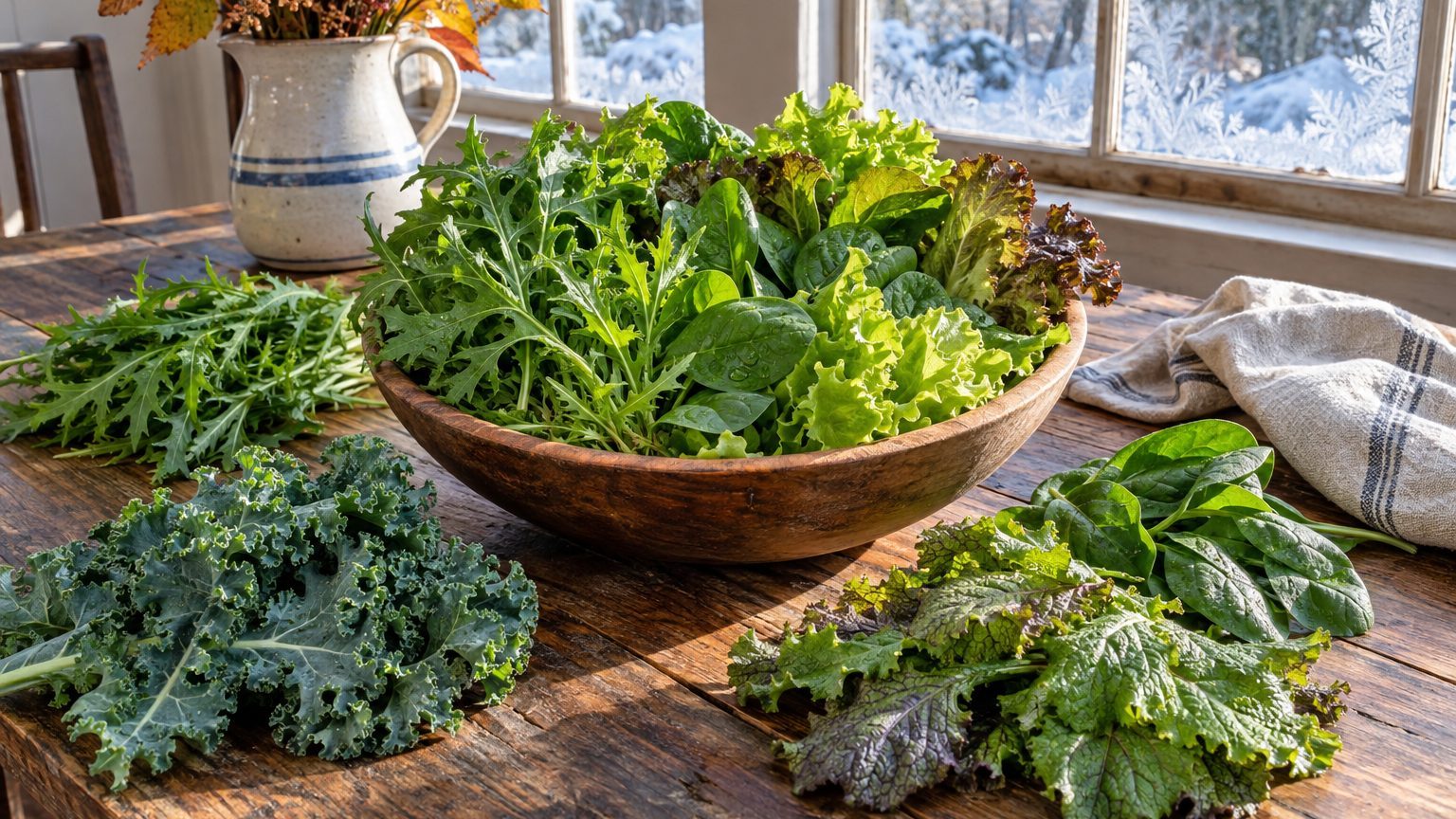

Grow heat-tolerant loose-leaf lettuces, Asian greens, mustards, arugula and kale for winter salads in Hawaii. Treat crisphead lettuce and true spinach as long shots below the cooler uplands. Cold is not what limits you here, because inhabited Hawaii has no frost season. Warmth, rain and exposure decide which leaves survive, and the best pick shifts with elevation. The Winter Salads for Hawaii Gardens overview covers the bigger picture.
The short answer for Hawaii
The coldest month in Honolulu, the reference station for NOAA’s 1991-2020 Climate Normals, still has a mean daily minimum of 66.8°F. At the station NOAA used, the number of days per year at or below 32°F is zero, and the freeze dates cannot even be computed. Frost happens only on the high volcanic summits (Mauna Kea, Mauna Loa, Haleakala), never where people garden. A mainland salad calendar built on frost dates therefore has nothing to hang on. Your winter limit is heat, and the plants that win are the ones that keep making leaves without bolting.
Choose by type, not by famous name
The table sorts salad crops by how they handle mild winters with warm nights. Treat it as a starting bet, then adjust for your own site.
| Type | Fit in lowland Hawaii | Why |
|---|---|---|
| Loose-leaf lettuce (cut-and-come-again) | Good | Harvested young, so it is eaten before heat turns it bitter |
| Asian greens (bok choy, tatsoi, mizuna) | Very good | Fast-growing and tolerant of warm nights |
| Mustards and arugula | Very good | Quick to harvest, peppery flavor holds up in warmth |
| Kale and chard | Very good | Sturdy leaves, long harvest, little bolting pressure |
| Butterhead and crisphead lettuce | Fair to poor at sea level | Needs a longer cool spell to form a tight, sweet head |
| True spinach | Poor at sea level | Bolts quickly in warmth; substitutes do better |
The pattern is simple. Anything you can pick young and often beats anything that needs to sit in the ground for a full head. A bed of mixed baby greens gives you a salad within weeks, while a head of crisp lettuce asks for a patience the climate does not grant.
Warm-weather greens that sit outside the usual salad canon are worth a place too. Okinawa spinach and Malabar spinach are the standard stand-ins for the spinach you cannot easily grow, and both are common in island gardens. For timing the sowings, When to Sow Winter Salads in Hawaii picks up where this page stops.
What will not work here
Start with the mainland rules. “Sow six weeks before your last frost” is useless advice, since NOAA’s data returns no usable last or first frost dates for the places Hawaiians garden. Gardeners who wait for a cold snap to sweeten their greens will wait forever, and anyone buying row covers to protect against frost is spending money on a problem they do not have.
Crisphead lettuce is the classic casualty. It wants a long stretch of cool days and cool nights to fill out a head, and with winter nights that never fall below the mid-60s on average at the coast, the plant tends to run to seed before the head firms. You get a tall, bitter stalk. Spinach behaves the same way. Seed packets that promise a spring or fall crop assume a cold edge to the season that Hawaii’s lowlands simply do not have.
Seed germination can fail too. Lettuce seed is known to sulk when soil is warm, so seeds sown in a sun-baked bed may never come up. Starting trays in shade, or sowing in the cooler part of the day and keeping the soil moist, helps. Pushing a bed toward full midday sun in a leeward lowland is the quickest way to lose a whole planting.
Water is the next trap. Salads have shallow roots, and on a dry leeward coast a weekly soaking leaves them stressed between drinks. Stressed lettuce turns bitter and bolts sooner. Those beds need small, frequent watering and some afternoon shade, from a tree, a fence or a strip of shade cloth.
The windward side has the opposite problem. Persistent rain and humidity punish close spacing, since leaves that never dry invite rot and fungal disease, and slugs thrive. Tight rows that look productive in a dry-climate book become a wet, crowded mess. Give plants room for air to move, favor raised beds that drain well, and think of rain as a disease risk, not a free watering.
One more mistake: copying the same recipe across islands. Honolulu’s dry leeward side and a rainy Hilo slope are separate growing regions that happen to share a state flag.
What changes across Hawaii
The USDA Plant Hardiness Zone Map (2023 edition, built on 1991-2020 normals) puts Hawaii in zones 9a through 13a. That is a huge spread, wider than most entire regions of the mainland, and it means there is no single answer for the state. The zones come from one variable only, the average annual extreme minimum temperature, so they tell you about cold survival and say nothing about rain, wind or how hot your afternoons run. In Hawaii those other factors do most of the work.
If you garden at the coast, the type table above applies as written. Go for Asian greens, mustards, kale and cut-and-come-again lettuce, and use shade. If you garden upslope, the picture opens. Higher elevation means cooler days and nights, which is why gardeners in the uplands can try butterhead lettuce, and sometimes true spinach, with better odds. The higher you go, the more your garden begins to look like a mainland one, and the more a mainland seed catalog starts to make sense. Frost still stays on the summits, not in the gardens, but cooler nights stretch how long a lettuce holds its leaves.
Exposure matters as much as altitude. A windward garden at a given elevation can differ from a leeward one more than two gardens a thousand feet apart on the same slope. Wetter sites should lean on disease-resistant, quick-cropping greens and wide spacing. Drier sites should lean on mulch, shade and tough crops like kale and chard.
To see where your own property falls, use the USDA Plant Hardiness Zone Map and look up your ZIP code. Do not guess from a neighbor’s garden on a different slope. Then treat the zone as one clue among three, alongside your rainfall and your exposure.
Where to check this for your own county
This page is the statewide view, and a county recommendation beats a state one every time. Hawaii’s main counties (Hawaii, Honolulu, Kauai and Maui) cover everything from desert-dry coast to cloud forest, and a single statewide list cannot account for that.
Your best source is CTAHR Cooperative Extension, the University of Hawaii’s land-grant extension service. Once you are there, look for two things. First, a local planting calendar or vegetable guide written for your island or district, because dates and crop lists differ sharply between a windward and a leeward site. Second, any record of varieties trialled in your county, meaning cultivars that growers have actually tested in local conditions rather than ones that simply do well in a catalog photo.
Trial results are worth more than any general rule. A variety that bolts at sea level elsewhere may perform fine in your upland district, and the reverse is just as true. Extension staff and Master Gardener volunteers can also tell you which pests are active in your area, from slugs on wet slopes to leafminers and aphids in drier ones, and what to do about them.
If the county office has a page for your exact elevation or district, use it over anything here. If it does not, ask. A quick question to the extension office about a specific variety usually saves a season of guesswork. For the broader set of crops and the reasoning behind them, you can always return to the Winter Salads for Hawaii Gardens guide.
Checking this against your own garden
Your own observations outrank every date and table on this page, because your yard has a microclimate no statewide source can see. Three things are worth watching, and none needs equipment.
Soil warmth by feel. Push your hand into the bed in the morning, and again in mid-afternoon. If the soil feels warm even early in the day, lettuce seed will probably struggle to sprout there, and you should move sowing to a shadier bed or a tray. A bed that stays cool to the touch is your lettuce spot.
The first true leaves. Seedlings first show rounded seed leaves, then the shaped true leaves. If they come on quickly and stay compact, the spot suits the crop. If seedlings stretch tall and thin, it is probably too warm or too shaded in the wrong way. A center stalk starting to rise on a lettuce means bolting has begun, and the plant is telling you the bed is too hot.
The first flush of male flowers. On a squash or cucumber vine nearby, male blossoms tend to arrive in a rush when growth is strong and warm. If your vines are still pumping them out, your site is running warm, and tougher greens like kale, chard and mustards are a safer winter bet than lettuce.
Keep notes for a season. A few lines on when you sowed, what came up and when it bolted will teach you more than any calendar.
Common questions
Can I grow lettuce in Hawaii in winter?
Yes, with the right type. Loose-leaf varieties that you harvest young do well at most elevations, especially with afternoon shade. Heading lettuces are far more reliable in the cooler uplands than at the coast.
Do I need frost protection for winter greens?
No, not where people garden. NOAA’s normals show zero days per year at or below 32°F at the reference station, and frost occurs only on the high summits of Mauna Kea, Mauna Loa and Haleakala. Spend that effort on shade and drainage instead.
Is spinach worth trying?
True spinach is a gamble at low elevations because it bolts in warmth. Many island gardeners grow Okinawa spinach or Malabar spinach instead, which handle the heat. If you garden upslope, a small test planting of true spinach costs little.
Which greens are easiest for a wet, windward garden?
Kale, chard, bok choy and mustards are forgiving choices, as long as you space them for airflow and use raised beds. Rinse every leaf well before eating, since slugs are common in wet conditions and the Hawaii Department of Health advises careful washing of garden produce because of rat lungworm.