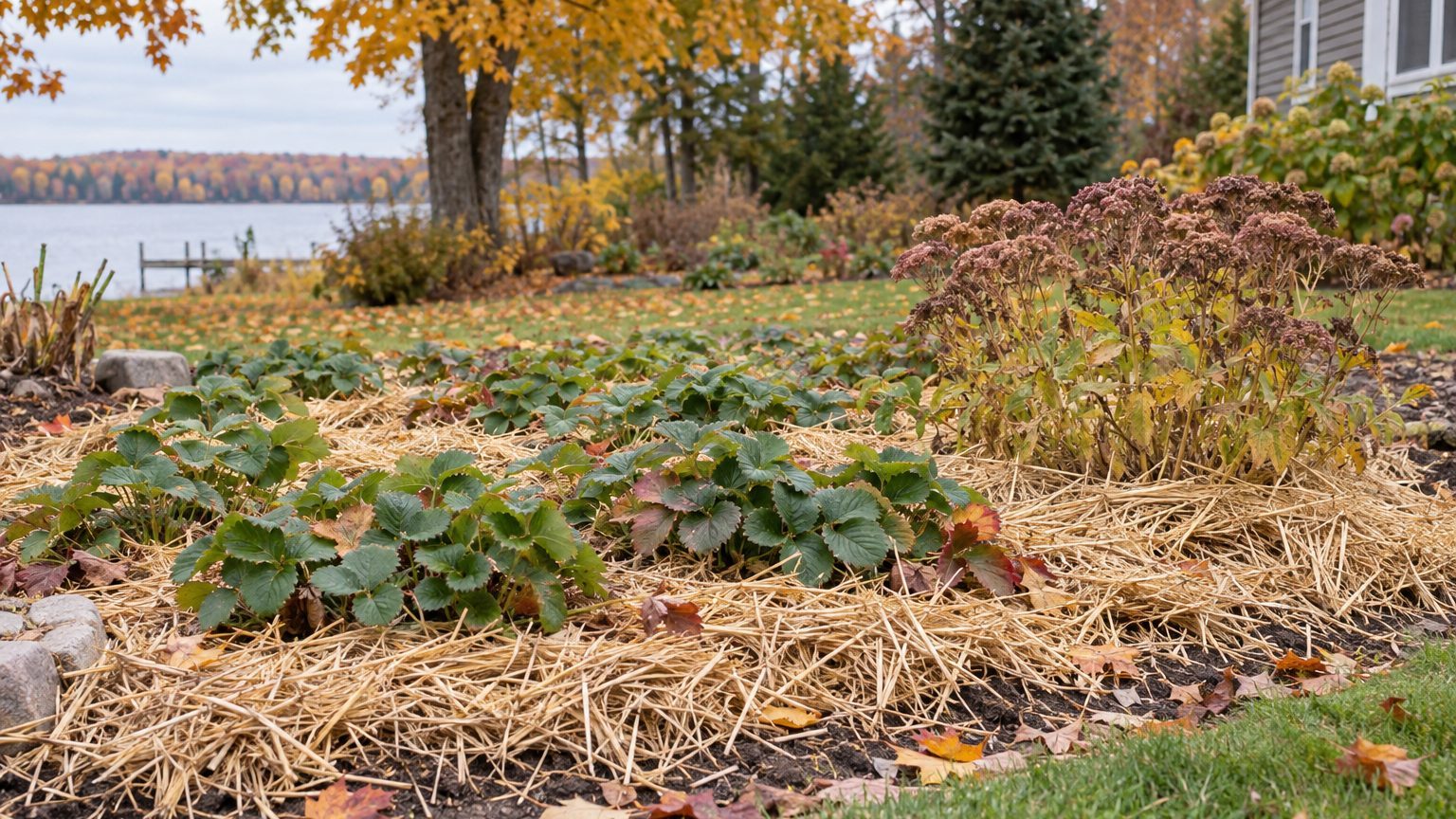

In Rhode Island, winter mulch for strawberries and tender perennials goes on in late fall, after the soil surface has started to freeze. That is later than the first frost. NOAA’s 1991-2020 normals put Providence’s first 32°F frost between October 24 and November 3, and the mulch follows well behind it. Gardeners who mulch on the first cold night usually end up with matted, soggy beds and a rodent apartment complex.
When to put winter mulch down in Rhode Island
Winter mulch is not a blanket. A blanket keeps a warm body warm. Mulch keeps frozen soil frozen. Plants don’t die from one deep freeze so much as from the cycle of freezing, thawing and freezing again, which swells the soil and pushes shallow crowns up and out of the ground. A layer laid over already-frozen soil holds it steady through January thaws and February sun.
Put it down while the soil is still warm and the layer does the opposite. It traps heat and moisture against the crowns and stems, which invites rot, and it gives mice and voles a cozy place to settle in before the cold even arrives. Plants also need a little time to harden off in the cold. Smothering them early interrupts that.
Rhode Island has the climate that makes this ritual worth the trouble. According to NOAA NCEI’s 1991-2020 climate normals for Providence, the mean daily minimum in the coldest month is 22.1°F. That is well below freezing, so the ground really does freeze here, and mulch has real work to do. It isn’t just decoration.
Reading the calendar
NOAA’s 1991-2020 normals put the first fall freeze at Providence between October 24 and November 3, using the band where the probability of a 32°F reading sits between 30 and 70 percent. Treat that as the signal to start watching, not to start spreading. Mulch after the soil surface begins to freeze, which falls after the October 24 to November 3 first-frost range, not within it.
A simple field test works better than a date. Push a trowel into the bed on a cold morning. If the top of the soil is crusty and stiff, and stays that way through the afternoon on several days running, it’s time. If it thaws to mud by lunch every day, hold off.
Adjusting for your own yard
The Providence figures come from an airport weather station, and they are a reference-city number, not a statewide guarantee. Suburban and rural gardens typically see the first fall frost earlier than the airport, often by one to two weeks. Farther inland and at higher elevation it comes earlier still, so the freeze that makes mulching worthwhile arrives sooner there than it does along the water. Rhode Island spans USDA zones 6a-7b (2023 map), and your yard sits somewhere inside that range.
To pin down your own local timing, look at first and last frost dates in Rhode Island and then check your county. More Rhode Island guides cover the rest of the seasonal calendar.
Strawberries
Strawberry crowns sit right at the soil surface, with their roots packed into the top few inches. That makes them the first plants to suffer when frozen soil heaves. Each thaw loosens the ground, each freeze lifts it, and by March a bed can have crowns perched on pedestals with roots exposed to wind. Bare cold does its own damage too. Without a cover, crowns and leaves in an open bed dry out and take a beating on windy, sunless days.
What to use and how deep
Clean straw is the standard choice. It stays fluffy, lets air move through, and sheds water better than most alternatives. “Clean” matters: straw from a field of grain gone to seed will sprout a lawn in your berry bed by May, so look for bales labeled weed-free or seed-free. Hay is a poor substitute for the same reason, and because it holds more moisture.
On depth, the one figure I can stand behind comes from NC State Extension, whose Extension Gardener Handbook says: “A 2-inch to 3-inch layer of mulch suppresses most annual weed seeds and makes it easy to hand-pull any that do germinate.” That sentence is about weeds, not winter protection specifically, but it shows the right order of magnitude for a mulch layer. Straw settles and compacts under snow, so lay it evenly across the whole bed within that 2-inch to 3-inch range. Piling it higher doesn’t protect better and tends to smother the crowns. The strawberry growing basics cover bed preparation and renovation, which sets up the winter work.
Taking it off in spring
Mulch comes off in stages. As the weather warms and new growth starts to push up through the straw, the leaves look pale and yellowish from lack of light. That is the cue. Rake the straw off the crowns as soon as you see new growth pushing through, and leave it in the aisles so you can pull it back over the plants on frost nights. Blossoms are the most frost-sensitive part of the plant, and a cover thrown over them on a cold evening can save the crop.
There is no verified last-frost date in the numbers I’m using here, so use the spring dates for your county rather than the calendar on the wall. Pulling mulch too early loses some protection. Pulling it too late keeps the soil cold and the crowns sodden, slowing growth.
Perennials and borderline plants
Most established perennials chosen for New England never need a winter coat. They evolved for this. The ones that benefit are a smaller group, and Rhode Island’s zone spread helps explain which. The USDA Plant Hardiness Zone Map (2023 edition, built on 1991-2020 normals) places the state in zones 6a-7b. That map relies on the average annual extreme minimum temperature, which is a different measure from the Providence figure of 22.1°F for the mean daily minimum in the coldest month. Together they say that winters here are cold enough to freeze the ground, but not cold enough to flatten everything.
Which plants earn the mulch
Three groups come out ahead. The first is anything planted this fall. New roots haven’t anchored, so heaving can pop a whole plant out of the ground. The second is shallow-rooted perennials that are famous for lifting, such as coral bells and garden mums. The third is anything rated at the edge of your zone, where one hard winter could finish it. Plants rated safely colder than yours, and long-established clumps with deep roots, can generally do without. Perennial herbs such as lavender and sage sit in an odd middle spot. Many hate wet crowns more than cold ones, so they need protection from wetness as much as from temperature. The notes on getting perennial herbs through the winter go into the details.
Check each plant’s rated hardiness against your own zone, and mulch anything new or borderline once the ground begins to freeze, after the October 24 to November 3 Providence frost range and earlier inland.
A ring, not a pile
Shape matters as much as timing. Spread the mulch around the plant in a ring, and keep a small bare gap right at the stems or crown. Mulch piled against the base holds moisture on the tissue that most needs to stay dry, and it hides a perfect doorway for voles to feed on bark and crowns. NC State Extension’s handbook says, for trees: “Provide a 3-inch layer of mulch to reduce water loss and maintain uniform soil moisture and temperature around roots.” The same order of depth, 2 to 3 inches, works for most perennial beds. Going higher than that is how a ring turns into a volcano. For more on the habit, see mulching without killing the plant.
What goes wrong
Winter mulch fails in a handful of predictable ways, and every one of them comes down to timing or technique. Here is how each looks in the garden and how to head it off.
| Problem | What it looks like | How to prevent it |
|---|---|---|
| Mulching too early | Soft, yellowing crowns and a sour smell under the layer by midwinter | Wait until the soil surface is freezing, after the first-frost range |
| Matted, rotting mulch | A slick, gray layer of whole leaves or wet grass clippings stuck to the plant | Use fluffy clean straw or shredded material, not whole wet leaves |
| Voles nesting | Runways in the snow and gnawed bark or crowns in spring | Mulch late, keep it off the stems, keep a ring shape |
| Forgetting to uncover | Pale, leggy growth and slow, rot-prone crowns in spring | Check beds as growth begins and pull the cover back |
The spring mistake nobody notices
The last item on that list is the one that sneaks up on people. Mulch left in place after the soil warms holds cold, damp air against the plants just as they need light. Look under the mulch as growth begins in spring, and uncover the crowns before the soil warms and the new shoots turn pale. A quick peek every few days once the snow is gone costs nothing. Slow, wet springs are the riskiest, because the mulch stays soggy and the crowns sit in it.
As for voles, they don’t create the problem alone. They need a place to hide, and a thick mulch laid over unfrozen ground is the most welcoming one a garden can offer. Late application, a thin even layer and a bare gap at the stems remove most of the invitation.
Common questions
Is October too early to mulch strawberries in Rhode Island?
Almost always, yes. NOAA’s 1991-2020 normals put the first 32°F freeze in Providence between October 24 and November 3, and the soil still takes time after that to start freezing. A frost on the lawn doesn’t mean the ground has frozen, so use the trowel test described above rather than a calendar date.
Can I use leaves instead of straw?
On perennials, shredded leaves work fine and cost nothing. Whole leaves tend to mat into a wet layer that smothers crowns, and on strawberries that is exactly the rot problem you’re trying to avoid. For strawberries, stick with clean straw.
How thick should the layer be?
NC State Extension’s handbook gives “A 2-inch to 3-inch layer of mulch” for weed suppression and a “3-inch layer” for moisture around tree roots. Staying in that range is a sound guide for beds. Going deeper adds weight and moisture without adding protection.
Does snow do the same job as mulch?
Snow cover insulates well, but it isn’t reliable from one winter to the next, and a bare, frozen week in January can happen anywhere in the state. Mulch is the backup that doesn’t melt. Keep in mind that the 22.1°F coldest-month figure for Providence is an average of daily lows, so individual nights run colder than that.