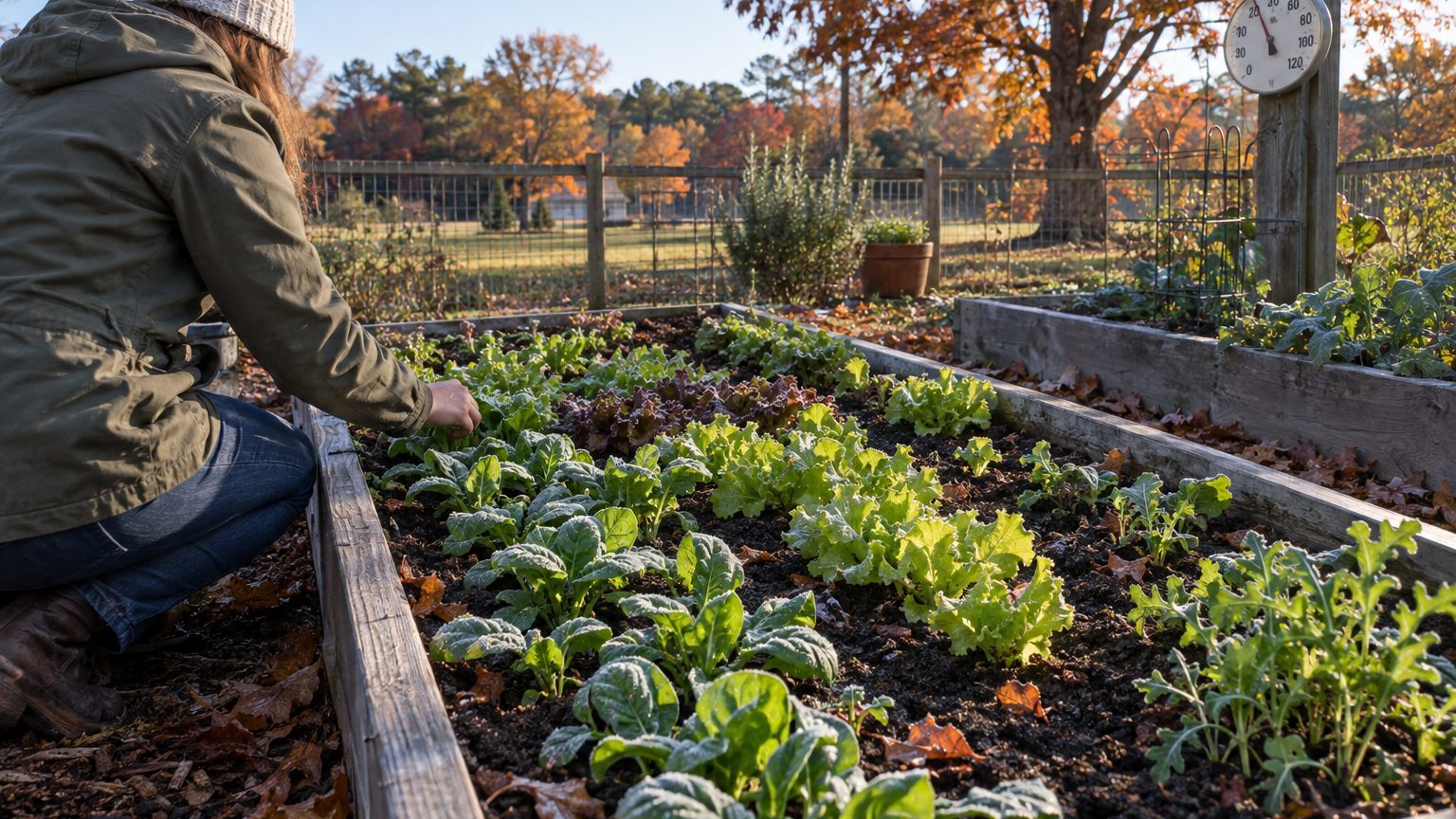

Sow winter salads in South Dakota from late July through about August 23 for fall and winter picking, then again under cover from mid-March to mid-April. Both windows are counted from Sioux Falls frost figures: a last spring freeze between April 29 and May 9, and a first fall freeze between September 24 and October 4. Gardens outside town usually freeze sooner, so treat these dates as a starting line.
The short answer for South Dakota
Those frost dates are not deadlines. They come from the NOAA NCEI 1991-2020 Climate Normals for the Sioux Falls airport station, and they mark the band where the probability of a 32°F freeze runs between 30 and 70 percent. A freeze can still land outside that band in any given year. The dates describe odds, not a guarantee.
The sowing windows come from counting backward off those odds. Winter salad crops need to be established, not just sprouted, before the light fades. The usual rule of thumb is six to eight weeks of growth before the first fall freeze. In spring, you start seedlings under cover four to six weeks ahead of the last freeze. Those week counts are gardening convention, not part of the NOAA data. The arithmetic looks like this:
| Sowing goal | Counted from | Window for the reference city |
|---|---|---|
| Fall sowing for fall and winter harvest | 6 to 8 weeks before the September 24 to October 4 fall freeze band | Late July to about August 23 |
| Late-winter sowing under cover | 4 to 6 weeks before the April 29 to May 9 spring freeze band | Mid-March to mid-April |
The fall window matters more. Spring sowings give you a quick early crop, but fall sowings are what the whole idea of Winter Salads for South Dakota Gardens rests on. Plants that reach near-full size by the time the freezes begin can sit in a cold frame or low tunnel and be picked leaf by leaf through the dark months. Plants that sprout late just sit there.
One adjustment applies to nearly everyone. The Sioux Falls figures come from an airport weather station. Suburban and rural gardens typically see the last spring frost later and the first fall frost earlier, often by one to two weeks, and by more at elevation. If your garden is outside town, shift the fall window toward its early end. Sowing in the last week of July is not a mistake in a cold pocket. Sowing on August 23 might be.
Which greens go into those windows is a separate decision. The Best Winter Salads for South Dakota covers that by type.
What will not work here
Leaving the beds uncovered will not work. The mean daily minimum in the coldest month at Sioux Falls is 8.5°F. That is an average of the nightly lows, so plenty of nights fall below it. At those temperatures even the hardiest salad greens stop growing, and tender lettuces are lost outright. A South Dakota winter harvest means a cold frame, low tunnel or hoop house, and plans that skip the cover will not hold.
Sowing after the fall freeze band has begun will not work either. A seed started in the first week of October, when the band ends, gets only a few weeks of usable growth before days shorten and the weather turns. The seedlings stall at a size too small to harvest and wait for spring. Two months earlier, the same seed becomes a plant. Two months is the whole difference.
Sowing into hot late-summer soil is the opposite trap. The window opens in late July, when beds on the Plains can be both hot and dry, and lettuce seed in particular tends to sprout poorly in warm soil. Watering once a week, which works fine for established tomatoes, fails here: the seed row dries between waterings and the seedlings die. Shade the bed with a board or cloth, water lightly each day until the seedlings are up, and then back off. Cooler, later-sown spinach and mâche are more forgiving than lettuce, but the same daily-water rule applies to all of them at germination.
Waiting for the last spring frost does not work if you want a spring salad crop. Sown outdoors once the April 29 to May 9 band has passed, cool-season greens get only a short stretch before warming weather pushes them to bolt. That is why spring sowings of these crops start under cover in March.
The last failure is flimsy protection. Open prairie wind and wet snow punish thin plastic and light hoops. A cover that is not anchored along the edges and braced against snow load will not survive a winter here, and you will find out in January, which is the worst month to rebuild it.
What changes across South Dakota
South Dakota is not one garden. The USDA Plant Hardiness Zone Map (2023 edition, built on 1991-2020 normals) puts the state across zones 3b to 5b. That is five half-zones, each a 5°F step in average annual extreme minimum temperature, so the coldest and mildest corners of the state differ by about 20°F in that one measure. There is no single answer for the whole state.
Zone number also has limits. The USDA system rests on one variable, the average annual extreme minimum, so it tells you whether a plant survives a winter. It does not tell you your frost dates, and it says nothing about when to sow. That is why this page uses frost dates for the calendar and the zone for context. The 8.5°F figure above belongs to Sioux Falls too; colder parts of the state will run lower.
If you garden in the north of the state or at elevation, such as in and around the Black Hills, shift in three ways. Sow the fall crop earlier, within the first half of the window or even a few days before it. Expect a later start for spring sowings under cover. And plan on heavier protection: a double layer inside the tunnel, or a cold frame banked with straw or leaves. Gardeners in the milder southeast corner have more room, but they are still working with a mean winter minimum below 10°F at the reference station, so no part of the state skips the cover.
To find where your own garden sits, look up your location on the USDA Plant Hardiness Zone Map instead of guessing from a neighbor’s tomatoes. Use it to judge how much protection you need. Use frost dates, not the zone, to pick your sowing days.
Where to check this for your own county
A county recommendation beats a state one, and this page is the state one. The dates here rest on a single reference station. They describe a typical airport location, not the low spot behind your barn or the ridge above it. The page has no county-level calendar, and it will not pretend to.
The place to go is South Dakota State University Extension, the state’s land-grant extension service. Start by looking for a vegetable planting calendar that gives dates for your county or nearest station, and check whether it covers cool-season crops and fall sowing, not just spring planting. Then look for frost dates for the weather station closest to you. A station ten miles away in a river valley can differ from yours by days.
Next, look for variety trials. Extension programs sometimes grow named varieties of greens side by side and report which ones did well, and a result from your region counts for more than a seed catalog description. If trial data for your county does not exist, an extension office or local horticulture agent can usually tell you what has worked for other growers nearby. Ask specifically about season extension: when local growers close up their cold frames, and what covers they use.
Write down what you learn next to the dates above. If your county’s first fall frost runs a week and a half earlier than the Sioux Falls band, move the whole fall window by the same amount. The method stays the same, and only the starting date changes.
Checking this against your own garden
Your own observations outrank every date on this page. Three things are worth watching, and none needs equipment.
- Soil warmth by feel. In late July and August, press your hand flat into the seedbed at midday. If it feels hot rather than merely warm, the soil is too warm for lettuce to sprout reliably. It tells you which bed is hottest, so shade it or sow somewhere else.
- The first true leaves. Seedlings first show rounded seed leaves, then the shaped leaves of the real plant. If your seedlings reach that stage by late September and keep adding leaves, your timing and microclimate are working. If they are still tiny in October, sow earlier next year.
- Which plants blacken first. When a frost finally burns basil or squash leaves, note which corners of the garden go first and which stay green. Those green corners are your warmest spots, the best place for a cold frame.
Keep notes for two seasons and your garden will give you a better calendar than any state table.
Common questions
Can I still sow winter salads in September in South Dakota?
Early September can work for the fastest, hardiest greens if you protect them, though you are past the main window. The reference-city fall freeze band begins September 24, and plants sown in September get far less growth before it. Expect smaller plants and a lighter winter harvest.
Do I need a cold frame or hoop house?
For harvest through winter, yes. The coldest-month mean daily minimum at Sioux Falls is 8.5°F, which is too cold for salad greens left in an open bed. Covers also help in spring and fall, when they let you start earlier and finish later.
Are the frost dates on this page right for my garden?
They are right for the Sioux Falls airport station and no one else. Rural and suburban gardens often see the last spring frost later and the first fall frost earlier, commonly by one to two weeks, and more at elevation. Check your county’s dates with the state extension service.
Is my hardiness zone the same as my sowing date?
No. The USDA zone rests on average annual extreme minimum temperature, which tells you whether plants survive winter cold. Sowing dates come from frost dates. The state spans zones 3b to 5b, so look up your own location on the USDA map and use it for protection decisions, not for the calendar.