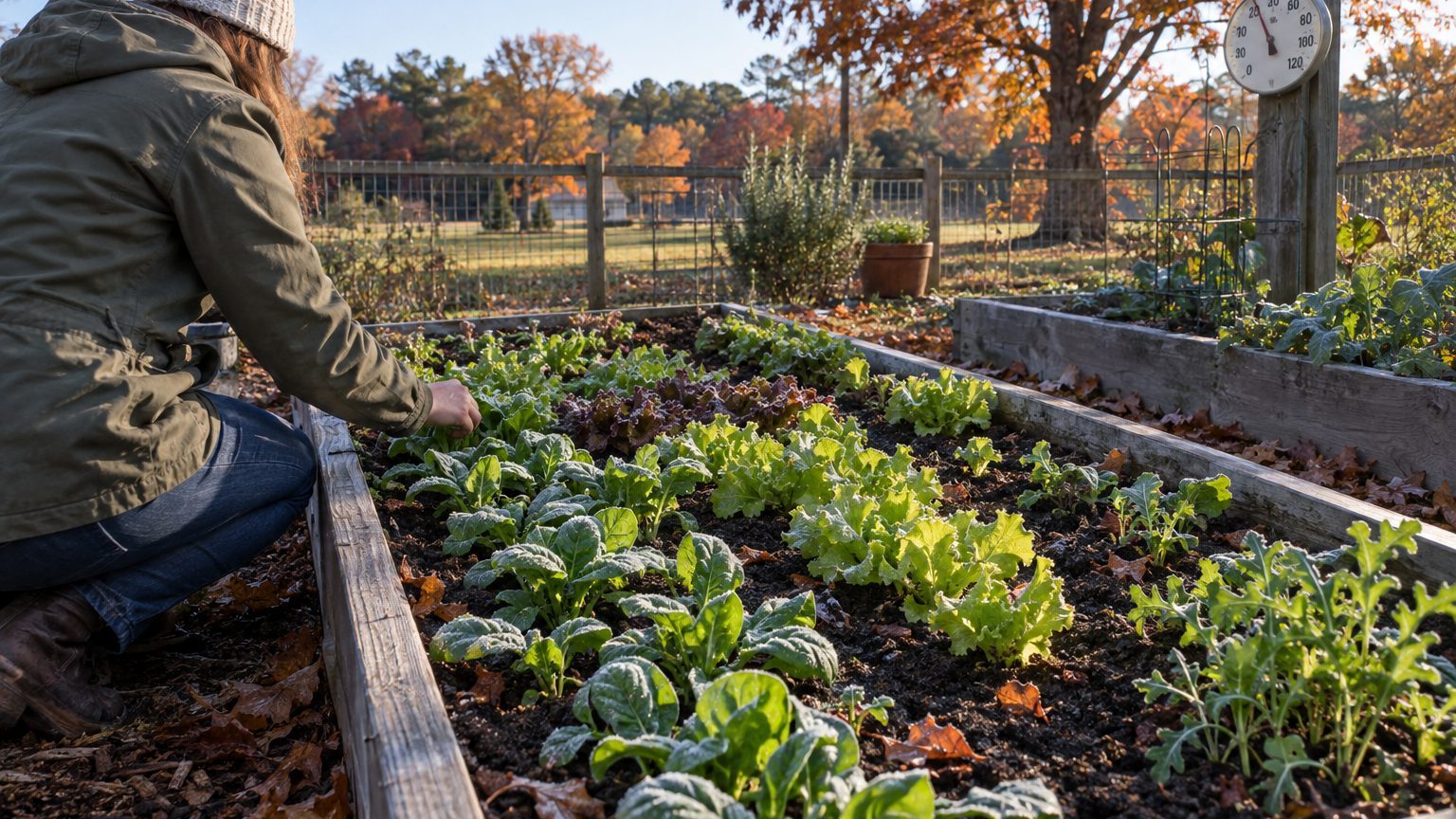

Sow winter salads in late summer, counting backward from your first fall freeze rather than forward from Labor Day. The statewide benchmark for that freeze is October 17 to October 29, though inland southern Wisconsin freezes earlier and the north far earlier. Hardy greens can also go in during spring, once the April 16 to April 29 band has passed. Local dates beat all of these.
The short answer for Wisconsin
Aim to have fall salads at or near harvest size before the first 32°F freeze. In the NOAA NCEI 1991-2020 Climate Normals (station USW00014839), that freeze lands between October 17 and October 29. The last spring freeze falls between April 16 and April 29. Both ranges are the 30 to 70 percent band of probability that a 32°F freeze occurs. They are odds, not promises, so a freeze after April 29 or before October 17 is possible in any given year. You can check the figures in the NOAA normals data.
- Last spring 32°F freeze: April 16 to April 29
- First fall 32°F freeze: October 17 to October 29
- Mean daily minimum of the coldest month: 17.2°F (Milwaukee reference)
Counting back from the fall freeze
The freeze date is a deadline for growth, not for sowing. Hardy greens will stand through cold, but they grow very little once days shorten and the soil chills. What you harvest in November and December is mostly what the plant put on before then. So start with the days to maturity printed on the seed packet and count backward from the freeze band.
Take a hypothetical green listed at 45 days. Counting back from October 17 lands on September 2, and from October 29 on September 14. Then add a cushion of a couple of weeks, because the packet number assumes summer growing speed and fall growth is slower. That puts the real sowing start in late August to early September for a variety like that. A slower variety moves the date earlier, and a faster one lets you wait.
Spring is a second window
Hardy greens tolerate light freezes, so spring sowing can begin when the soil is workable. Tender lettuces should wait until after the April 29 end of the band, since a 32°F freeze stays possible past it. Spring plantings mature before summer heat arrives, which is why they are usually the more forgiving of the two windows. For choosing what to sow in each window, the page on The Best Winter Salads for Wisconsin sorts varieties by type, and the hub page, Winter Salads for Wisconsin Gardens, covers the bigger picture.
What will not work here
Sowing in October. It is the most common mistake, and the numbers explain why. With the first freeze arriving between October 17 and October 29 at the benchmark, and earlier inland and north, a seed sown in October has a few weeks of weak light and falling soil temperatures before growth stalls. You get a seedling frozen in place, not a salad.
Slow varieties and late starts
Anything with a long days-to-maturity number is in trouble in a season this short. Heading lettuces and slow-bulbing types that need the full run of a mild autumn will not finish in most of Wisconsin if sown after about early September. Fast, hardy leaf crops forgive more. If a packet reads 60 days or more, treat it as a spring or early-summer crop here unless you can sow it in August and protect it later.
Borrowing a calendar from the lakeshore is a quieter failure. Lake Michigan delays the first fall freeze near the water, so a sowing date that works for a lakeshore garden can leave an inland southern garden a week or two short, since inland southern Wisconsin typically freezes in early October. The benchmark dates on this page should be read with that in mind: they are not a reason to plan against the October 17 to October 29 band if you live well inland.
Leaving tender salads uncovered all winter
The coldest month averages a daily minimum of 17.2°F (Milwaukee reference). That is an average of the lows, so plenty of nights run colder, and a bed of open lettuce sown in September will not carry through January without protection. Hardy spinach and a few leafy greens can sit through the cold under a cover, and tender lettuce generally cannot. Plan on row cover, a cold frame or a low tunnel from the first hard freeze, and expect to harvest in the milder spells rather than all winter.
One more trap sits at the other end of the calendar. Sowing tender lettuce on April 16 because the garden “feels” like spring invites a freeze, since the band extends to April 29 and the odds don’t fall to zero afterward. Cold-tolerant greens can start early. Lettuce can wait.
What changes across Wisconsin
There is no single answer for the whole state. The USDA Plant Hardiness Zone Map (2023 edition, built on the 1991-2020 normals) runs from 3b to 6a across Wisconsin. That is a wide spread for one state, and it means a gardener in the far north and one near Lake Michigan are growing in genuinely different climates. The dates on this page come from the reference station and from Milwaukee, so other parts of the state differ.
The zone itself rests on one variable: the average annual extreme minimum temperature. It tells you about winter survival, not about when fall freeze arrives, so it cannot give you a sowing date by itself. Two gardens in the same zone can freeze weeks apart. Find your zone on the USDA map by entering your ZIP code. I won’t guess it for you, and neither should a seed catalog.
| Where you garden | First fall freeze | What to shift |
|---|---|---|
| Lakeshore | Delayed by Lake Michigan | A little more room at the end of the window |
| Inland southern Wisconsin | Typically early October | Sow earlier than the October 17 to October 29 band suggests |
| North | Far earlier | Count back from your own local freeze and sow noticeably earlier |
In the north, the practical move is to treat the benchmark as a ceiling. Sow earlier, favor the fastest hardy greens, and lean harder on covers, because the season is short at both ends. On the lakeshore, the benefit is real but modest: the water holds warmth into autumn, then does little to protect against deep winter cold.
Where to check this for your own county
A county recommendation beats a state one, and this page is the state one. Wisconsin’s climate swings too much from the lakeshore to the north woods for a single calendar to be right everywhere. Start with University of Wisconsin Extension and look for your county office.
Two things are worth finding there. The first is a local planting calendar, ideally one built around your county’s own frost dates rather than a statewide table. The second is the list of varieties trialled in your county. A variety that performed in a research plot near you has already faced your frost timing, your soil and your pests, which no catalog photo can claim.
This page does not have a Wisconsin extension calendar to cite for winter salads, and I’d rather say so than point to another state’s. Calendars from other extension services are written for their own crops and climates (many are organized by species, not by state), so they do not transfer. If your county office has nothing specific on winter salads, ask them about fall-sown greens and cold-frame crops, and take their frost dates as the starting point for counting back.
Checking this against your own garden
Your own observations outrank every date above. Three are worth watching, and none needs a gadget.
Soil warmth, by feel. In late August, push your hand a few inches into the bed in the morning. If it feels distinctly warm, lettuce seed may germinate poorly, and shade or a wet burlap cover can help. A bed that stays warm longest in fall is a pocket that will hold growth longer, which is worth knowing when deciding what goes there.
The first true leaves. Seedlings first show rounded seed leaves, then the first true leaves with the shape of the real plant. If your sowings reach that stage within a couple of weeks of emerging, you are growing fast enough. If they are still stuck at seed leaves in early October, they are behind and need cover or a spring-harvest plan.
Where frost shows up first. On the first white morning, walk the yard. The spots with frost first are your cold pockets, and the spots still green are your sheltered ones, near a south wall, under an eave or on a rise. Put your hardiest crops in the cold pockets and your tender ones in the sheltered spots, and note the date.
Common questions
Can I sow winter salads in spring in Wisconsin?
Yes, with hardy greens. Sow them as soon as the soil is workable. Tender lettuce should wait until after the April 16 to April 29 band, since a 32°F freeze remains possible beyond it.
Is my hardiness zone enough to pick a sowing date?
No. The USDA zone is built on the average annual extreme minimum temperature and describes winter survival. Sowing dates depend on fall freeze timing, so use your local first-freeze date and count back from it.
Does Lake Michigan change these dates?
Near the lakeshore, yes. The lake delays the first fall freeze, while inland southern Wisconsin typically freezes in early October and the north far earlier. If you are inland, plan earlier than the October 17 to October 29 band.
What if I miss the window?
Late sowings that stay small can still be useful under a cover as a spring-harvest experiment, though they will not make a winter salad. Write down the sowing date, the first true leaf date and your first freeze. After two seasons, those notes will serve you better than any statewide calendar.