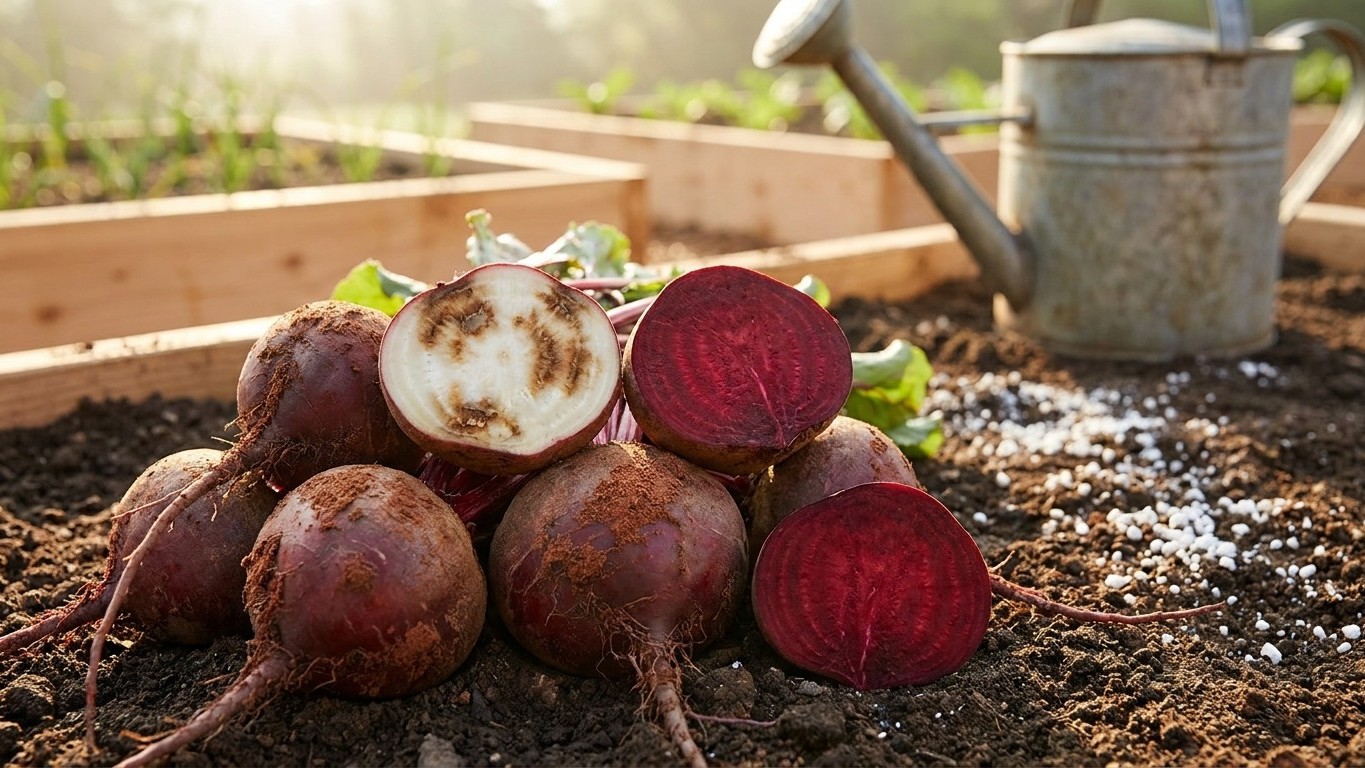

Three things eat into a beet crop in Oregon, and none of them is an insect. Thirst in the first six weeks sends plants to flower instead of building a root. Heat above 85 F, combined with water stress, makes the root woody. Cellar air that is too cold brings black spot and rot after harvest. Pest damage isn’t covered by the sources behind this page, so it isn’t covered here. Timing for eating matters too: small roots go first, big ones go into storage.
The short answer
Start with the ground. Oregon’s official state soil is the Jory series, an Ultisol, which is an old, heavily weathered and leached soil that is naturally acid and low in nutrients. USDA NRCS records its surface layer as 14 percent sand, 34 percent clay and 52 percent silt, with about 5.0 percent organic matter and a pH near 5.6 (slightly acid). It is classed as well drained. On the USDA texture triangle, that mix of clay and silt falls in the silty clay loam range. The figures are representative values for the surface horizon of the series as mapped (119 components), not a reading from anyone’s worked garden bed.
Utah State University Extension describes the beet’s ideal as deep, sandy, well-drained soil rich in organic matter. Jory gives a beet two of those: it drains, and it holds a fair amount of organic matter. It is not sandy at all, since 14 percent sand is a long way from the sandy ground the extension guidance describes. The root will push through heavier, silkier ground than the textbook picture, and it will lean on you for steady watering because silt and clay swell, crust and set up when they dry out. The same source caps compost at no more than 1 inch of composted organic matter per 100 sq ft, so piling it on to fix texture is not the answer.
A caution before going further. A state spans hundreds of soil series, and Jory is a starting point rather than a diagnosis. River bottoms, hill country and any lot a builder has scraped or filled can differ completely from it. A soil test on your own bed gives you the pH and nutrient numbers that matter; our page on Beet Soil in Oregon: What the Root Will Meet goes deeper on what to do with the results.
Then there is heat. The same extension source says water stress in the first 6 weeks causes premature flowering, and heat above 85 F with water stress makes the root woody. How many days a year Portland, the reference city here, passes 90 F is not published in the figures behind this page, so I won’t offer a count. What matters is the comparison: 90 F sits above the 85 F line, so any such afternoon in a bed that has gone dry lands in woody-root territory. Portland also sits west of the Cascades. Central and eastern Oregon are high desert with a far shorter season, and nothing on this page should be carried over the mountains. For the wider picture of the crop, see Growing Beets in Oregon.
The six weeks that decide it here
Beets are sown in place, so the clock starts the day the seed goes into the row, not at some transplant date. The usual advice is to sow 2 to 3 weeks before the last spring frost. For Portland, NOAA NCEI’s U.S. Climate Normals put that frost between March 6 and March 21. Specifically, that is the band where the chance of a 32 F freeze falls between 30 and 70 percent (NOAA NCEI normals data for Portland). Counting back two to three weeks from that window puts seeding between mid-February and early March. That is arithmetic, not a published sowing date, and When to Sow Beets in Oregon covers the timing in full.
Six weeks from those sowing dates runs to roughly late March through mid-April. In western Oregon, that stretch leans cool and wet, which works in the beet’s favor. Rain does the watering, and the Jory type of ground drains rather than sitting soggy. But wet is the usual pattern, not a promise. Spring here swings. A run of dry, breezy days in late March or April can dry a seedbed quickly, and a young beet does not care that it rained two weeks ago.
That is where the bolting risk sits. Bolting here is a failure of the early weeks: a seedling that goes thirsty during that first stretch can flower prematurely, and no amount of watering later undoes it. The mistake is to treat the wet forecast as a reason to stop checking. During the first six weeks, push a finger an inch or two into the soil. If it is dry, water.
The later sowings carry a different problem. A row seeded in May has its six weeks running straight into the start of Oregon’s dry season, so the bolting risk climbs and the heat risk follows right behind it. Count the days to harvest and the picture sharpens. At 60 to 80 days from seeding, a mid-February to early-March sowing is ready roughly mid-April to late May, before summer heat gets going. A sowing that is late enough to size up its root in July is a sowing that will meet 85 F afternoons, and then woodiness becomes the issue, not bolting. Those are two separate failures with two separate causes, and watering through the first six weeks does not protect against the second.
What goes wrong here
Most of the trouble in an Oregon beet bed traces back to the soil texture, the timing of the weather, or the way the roots are handled after harvest. These are the failures to plan around.
- Bolting after an early dry spell. Water stress in the first 6 weeks triggers premature flowering. Remedy: water by touch, not by the calendar, during those weeks, even when spring has been wet overall.
- Woody roots from later heat. Heat above 85 F combined with water stress makes the root woody. This is a separate problem from bolting. Remedy: time the sowing so the root finishes sizing up before summer, and keep water steady through any hot stretch.
- Crusting and compaction in heavy ground. With a clayey, silty surface like Jory’s, a seedbed can seal over and slow germination, and a dense bed makes the root work harder. Remedy: loosen the bed deeply before sowing, and keep the surface evenly moist until seedlings emerge.
- Overdoing the compost. More organic matter feels like the fix for clay, but the extension limit is no more than 1 inch of composted organic matter per 100 sq ft. Remedy: stay under that, and let a soil test decide the rest.
- Guessing at an acid, low-nutrient bed. Jory is naturally acid and low in nutrients, and your bed may or may not match. Remedy: test the soil, then amend to the result, and never assume the mapped pH of 5.6 is yours.
- Storing roots too cold. Most root crops want the coldest spot you have, but beets do not. USDA Agricultural Handbook 66 reports more black spot and rot at 32 to 34 F than at slightly warmer temperatures. Remedy: aim for 33 to 36 F at 98 percent relative humidity for topped roots, and keep a pit or cellar between 31 F and 41 F (USDA Handbook 66).
- Leaving the tops on. Bunched beets with leaves keep only about 10 to 14 days at 32 F and above 98 percent relative humidity. Remedy: top them first if you want to store them for longer.
- Storing the small ones. Small roots lose water and shrivel faster than large ones. Remedy: eat the small roots first and put the big ones away.
Common questions
What is the biggest threat to beets in Oregon?
Water stress, which shows up two ways. Early thirst during the first 6 weeks causes bolting, and later heat above 85 F with water stress makes roots woody. Storage that is too cold is a third threat after harvest. Insect pests are not covered by the sources behind this page.
Is Oregon’s state soil good for beets?
Partly. The Jory series drains well and holds about 5.0 percent organic matter, but it is clayey and silty (14 percent sand, 34 percent clay, 52 percent silt), not sandy. It is also naturally acid. Treat it as a starting point and get your own soil tested, because your garden may be on a different series entirely.
Do these dates work in Bend or eastern Oregon?
No. The March 6 to March 21 window is for Portland, west of the Cascades. Central and eastern Oregon are high desert with a far shorter growing season, and the frost window there is not published on this page.
How cold should I store beets?
Colder is not better. Topped roots do best at 33 to 36 F and 98 percent relative humidity, because black spot and rot increase at 32 to 34 F. Bunched beets with leaves last only about 10 to 14 days. Save the large roots for storage, since they keep better, and eat the small ones first.