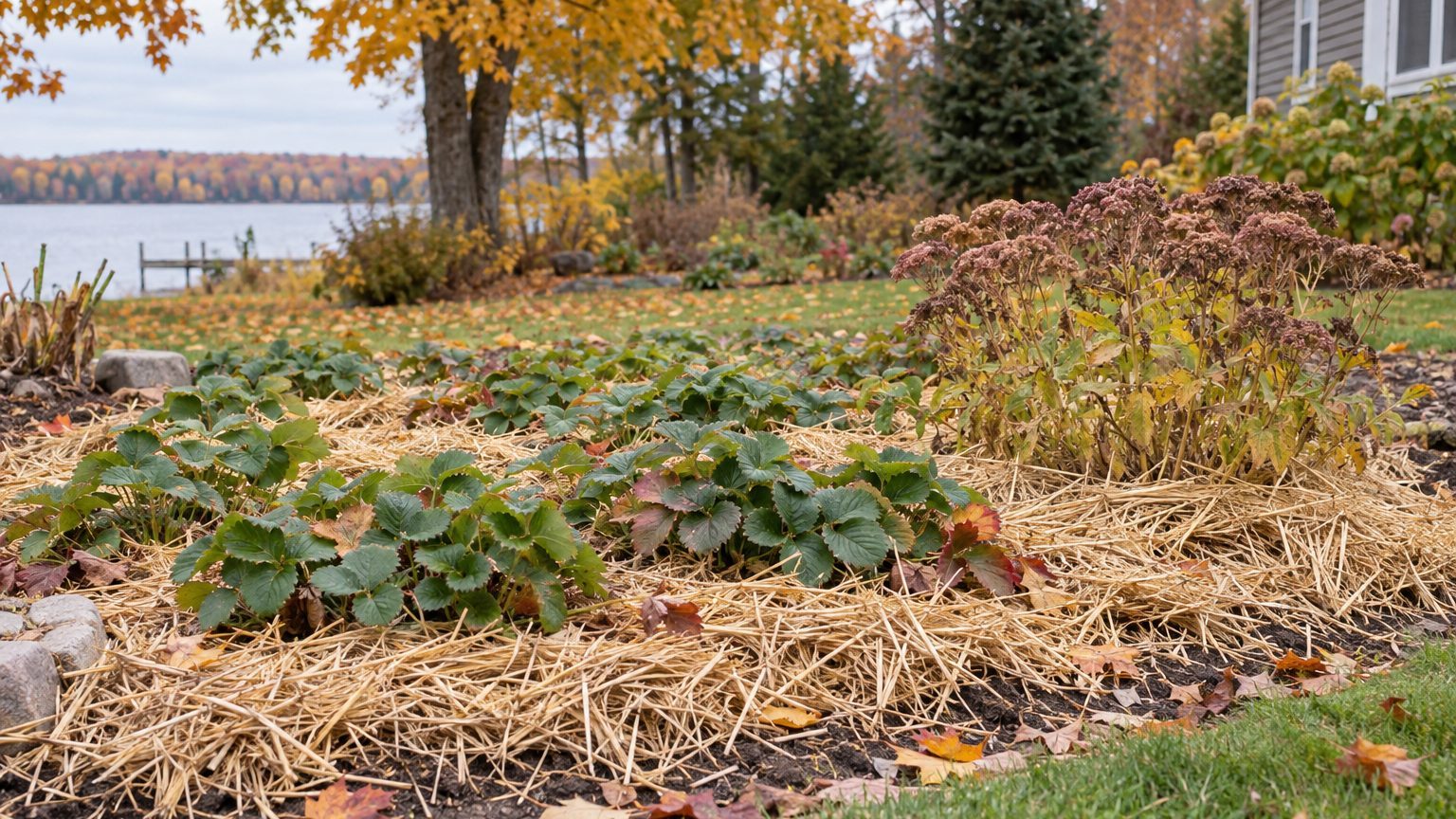

In Delaware, winter mulch goes on after the ground begins to freeze, not at the first frost. NOAA’s 1991-2020 Climate Normals put the first fall 32°F freeze at Wilmington’s airport station between October 26 and November 7. Strawberries and borderline perennials get their mulch after that window closes and the soil surface starts to stiffen. Gardens outside the city often freeze one to two weeks sooner, so your own yard’s thermometer outranks the calendar.
When to put winter mulch down in Delaware
The rule that surprises people
Most gardeners treat winter mulch as a blanket, something to tuck plants in before the cold arrives. It works closer to the opposite. A layer of straw or shredded leaves insulates the soil, and the benefit is that the soil stays frozen once it freezes. The damage to crowns and roots comes from the swing: freeze, thaw, freeze again. Each cycle expands and contracts the soil and can push shallow roots up toward the surface.
Mulch laid over warm, damp October soil does the reverse. It holds heat and moisture against the crown, which invites rot, and it gives mice and voles a cozy place to settle in before the weather even turns. So the sequence is frost first, hard freezes second, mulch third.
For Wilmington, the NOAA NCEI 1991-2020 Climate Normals (station USW00013781, 30-70% freeze probability band) place the first fall frost between October 26 and November 7. Wait until that window has passed and the top of the soil has started to freeze, then mulch. In practice that means some weeks after the first frost, once a few hard freezes have left the surface crusty in the morning and slow to thaw in shady spots. If the first frost arrives and then a warm spell follows, hold off. Plants are still hardening off, and the mulch can wait.
Adjusting the window for your own yard
That reference figure comes from an airport weather station, and the airport is not your garden. Suburban and rural beds, and anything on higher ground, typically see the first fall frost earlier than the station does, often by one to two weeks. Since colder spots freeze earlier, the mulching window moves earlier with them. A garden on a cold, open slope in the northern part of the state may be ready to mulch before a sheltered city lot is. You can look up the typical dates for your county in First and Last Frost Dates in Delaware, then use the local dates the same way: mulch after them, once the soil is actually freezing.
Is winter mulch needed here at all? For strawberries, yes. The coldest month at Wilmington has a mean daily minimum of 25.6°F (NOAA NCEI Climate Normals 1991-2020), so freezing nights are routine through the winter, and so are thaws in between. That pattern is what heaves shallow crowns. The USDA Plant Hardiness Zone Map (2023) lists Delaware at 7a-8a, a range rather than one number, which means the right call differs from the colder northern corner to the milder parts of the state. For established, well-rooted perennials, mulch is a bonus rather than a requirement, a point the perennials section below picks up.
Strawberries
Why crowns need the cover
A strawberry plant is a short, shallow crown with roots in the top layer of soil. That makes it an easy target for frost heave: the soil lifts as it freezes and settles unevenly as it thaws, and over a winter of repeated cycles the crown can end up perched above ground with roots exposed. Bare cold does its own damage too, since dry winter wind and sharp temperature drops hit unprotected crowns and leaves directly. Delaware’s average coldest-month low of 25.6°F (NOAA NCEI, Wilmington reference station) is not extreme, but the repeated freeze and thaw is enough to cost you plants in a bare bed.
The timing follows the logic above. Strawberries want a cold snap or two to harden off, so mulch after the first-frost window of October 26 to November 7 has passed and the soil has begun to freeze. Gardeners in colder, higher or more rural spots should read that window as earlier for their yard. More on variety choices and spring care is in Growing Strawberries.
What to use and how deep
Clean straw is the standard material. It is light, it sheds water better than leaves, and it lets air move through. Look for straw rather than hay, because hay carries seed heads that will sprout in the bed come spring. Pine needles work as a second choice. Whole, wet leaves are a poor option because they mat into a soggy sheet over the crowns.
On depth, the NC State Extension Gardener Handbook (chapter 11, Woody Ornamentals) says: “A 2-inch to 3-inch layer of mulch suppresses most annual weed seeds and makes it easy to hand-pull any that do germinate.” That passage is about weeds in ornamental beds, but it gives the right order of depth for a strawberry bed too. Straw fluffs up when spread, then settles, so aim for that 2-inch to 3-inch range once it has settled, and cover the crowns and the gaps between plants. More is not better. A thick pile holds moisture against the crowns and gives rodents a deeper nest. You can read the full handbook chapter at NC State Extension.
Taking it off in spring
Spring is where many beds go wrong. Pull the straw back off the crowns as soon as new growth starts in early spring, and keep it handy between the rows. Leaves that grow up pale and yellowed beneath the straw are the signal. Do not wait for the last frost to pass, since smothered crowns weaken and flower late. Leave the loose straw in the aisles, where it keeps berries clean and weeds down, and pull it back over the plants on any night when frost is forecast once blossoms appear.
Perennials and borderline plants
Delaware sits in USDA zones 7a-8a, according to the 2023 USDA Plant Hardiness Zone Map. That map is built on one variable, the average annual extreme minimum temperature, and it is a territory-wide range, so a Wilmington-area yard and a lower, milder bed elsewhere in the state will not behave identically. For most established perennials rated for this region, such as daylilies, hostas, coneflowers and sedum, winter mulch is optional. They have deep roots and take the freeze and thaw cycle in stride.
Mulch earns its place with three groups. First are perennials planted in the fall, whose roots have not yet knit into the surrounding soil and which can be pushed out of the ground by heaving. Second are shallow-rooted plants such as heuchera and garden mums, which are famous for lifting out of the soil in late winter. Third are the borderline plants, those whose label rating barely reaches the zone you garden in. Rosemary and lavender are common examples, and Getting Perennial Herbs Through the Winter covers them in detail.
A ring, not a pile
Shape matters as much as depth. Spread the mulch in a ring around the plant and keep it clear of the crown itself, so stems and buds stay dry and can breathe. Mulch heaped against the crown holds moisture there, and rot follows. For depth, stay with NC State Extension’s figures: the same handbook says “A 2-inch to 3-inch layer of mulch suppresses most annual weed seeds and makes it easy to hand-pull any that do germinate,” and for trees, “Provide a 3-inch layer of mulch to reduce water loss and maintain uniform soil moisture and temperature around roots.” Both point to the same order of depth, and neither suggests going deeper. Apply a ring 2 to 3 inches deep after the ground has begun to freeze, and leave a gap around each crown.
Material depends on the plant. Shredded leaves or bark mulch suit most perennials, and chopped leaves break down enough to avoid matting. Whole oak leaves can pack down in wet weather. Evergreen perennials that hold their foliage all winter should not be buried, because the leaves rot under a smothering layer. For those, mulch around the base and leave the foliage clear. The broader principles on spreading mulch without harming the plant are in Mulching Without Killing the Plant.
What goes wrong
Four mistakes account for most winter mulch failures in Delaware yards, and each has a recognizable look.
- Mulching too early. Soft, mushy crowns in spring, or plants that never hardened off, usually trace back to mulch laid over warm soil in October. Prevention is simple: wait until after the first-frost window of October 26 to November 7, then until the surface soil has started to freeze.
- Mulch that mats and rots. Wet, whole leaves form a slimy mat that smothers foliage and crowns. Use clean straw on strawberries, shred leaves before using them on perennials, and keep the layer within the 2-inch to 3-inch range.
- Voles and mice nesting. Chewed crowns and shallow tunnels running through the mulch mean rodents moved in. A thick, early layer gives them shelter before the cold arrives, and a pile against the crown gives them cover while they feed. Thin layers, laid late and kept off the crown, discourage them.
- Forgetting to uncover. Pale, leggy growth and delayed flowering in spring mean the mulch stayed on too long. Pull it back from the crowns as soon as growth begins.
The common thread is timing and thickness. Winter in Delaware swings between freezing nights and mild days, so no single date is safe for every yard. Where mulch goes down late and comes up on time, problems are rare.
Common questions
Should I mulch strawberries right after the first frost?
No. The first frost at Wilmington typically arrives between October 26 and November 7 (NOAA NCEI 1991-2020 Climate Normals), but one frost does not mean the ground is freezing. Mulch after several hard freezes, when the soil surface is staying stiff. In colder, rural or higher spots, the window shifts earlier by about one to two weeks.
Is straw or shredded leaves better?
Clean straw suits strawberries because it stays loose and sheds water. Shredded leaves work well around perennials. Avoid whole, wet leaves over crowns, and avoid hay, which brings weed seed with it.
Do established perennials in Delaware need winter mulch?
Usually not. With Delaware listed at USDA zones 7a-8a, well-rooted perennials rated for the region tolerate winter. Mulch pays off for fall-planted perennials, shallow-rooted plants, and borderline plants like rosemary and lavender.
When do I take winter mulch off?
When new growth begins in early spring. For strawberries, pull the straw back from the crowns and keep it between rows to re-cover plants if a frost is forecast once blossoms appear. Your county’s last spring frost tends to come later than the airport’s figure, so keep that straw close at hand.