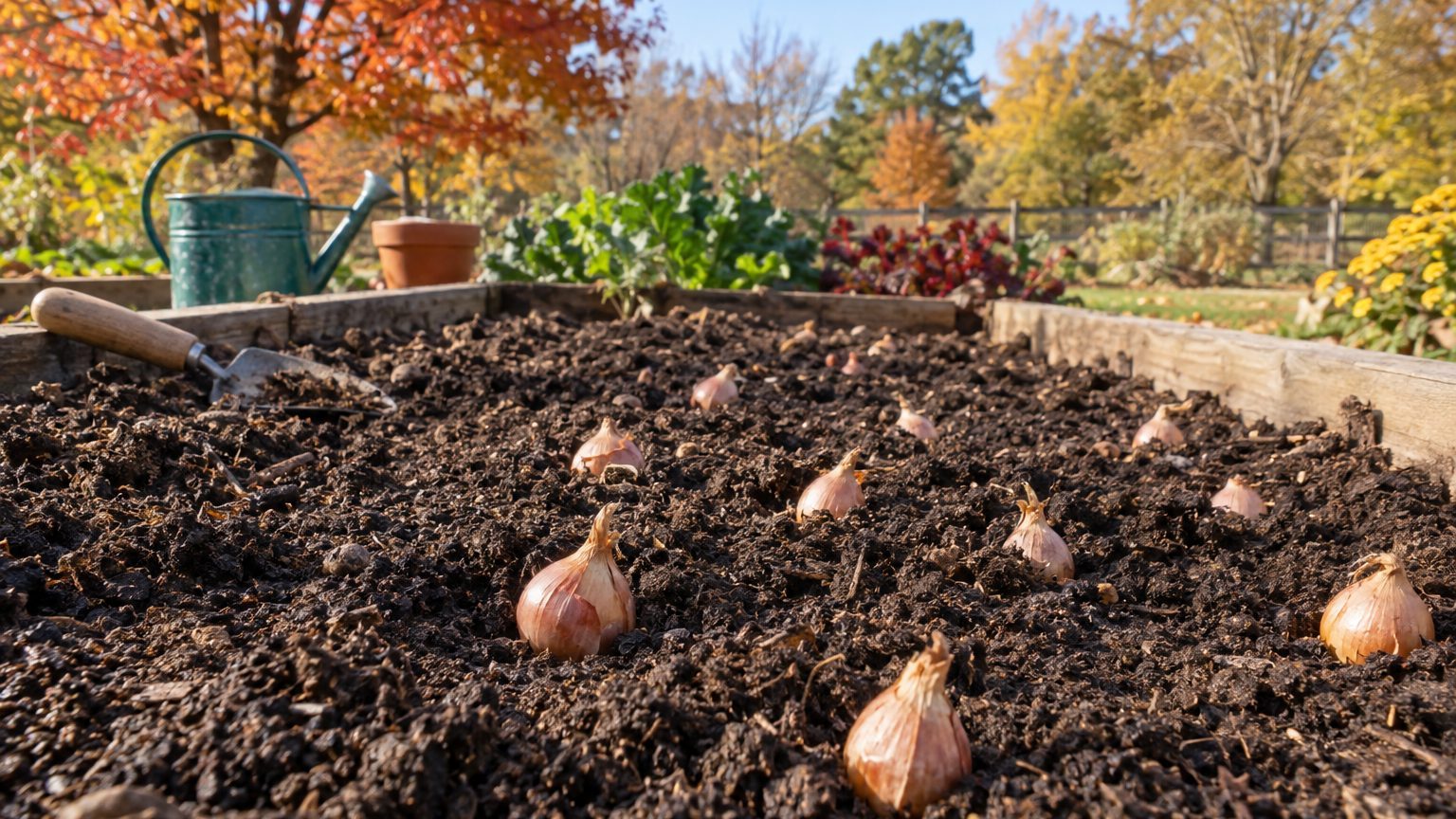

Plant shallots in Georgia in fall, once summer’s heat breaks and before the first hard freeze, then harvest them the following late spring or early summer. Spring planting works as a backup, but it hands the crop to the heat. The right week shifts by several weeks between the mountains and the coast, so treat the dates below as a starting frame, not a verdict for your yard.
The short answer for Georgia
Get shallot sets in the ground before the first fall freeze, which NOAA places between November 13 and December 1 at its Atlanta reference station. The spring counterpart, the last freeze, falls between March 11 and March 29. Both ranges come from the NOAA NCEI 1991-2020 Climate Normals, and both are probabilities of a 32°F freeze, not calendar promises.
What those frost dates actually measure
The dates mark the 30 to 70 percent probability band for a 32°F freeze. In spring, March 11 to March 29 is the stretch when the odds that a freeze is still ahead of you are somewhere between “unlikely” and “likely.” In fall, November 13 to December 1 is the same band running the other way: the odds that the first freeze has arrived climb from 30 to 70 percent. Outside those dates a freeze can still happen. It is just less probable.
One caution is built into the data. The station is Atlanta’s airport, an urban heat island. Its numbers run warmer than the surrounding countryside, so a rural plot north of the city can see a freeze earlier in fall than the band suggests.
A working window
Fall planting is the main calendar. The target is the weeks leading up to the earliest edge of the fall band, November 13 in Atlanta, starting once the summer-warmed soil has cooled and finishing before freezes become likely. That gives roots time to establish while the tops stay modest. The bulbs then grow slowly through winter and put on size as spring warms.
Winter will not stop them. The mean daily minimum of Atlanta’s coldest month is 35.6°F, a figure that decides whether a plant survives the season at all, and it sits above freezing. That is an average of nightly lows, not a record low, so individual nights will dip under 32°F. But the typical winter night here leaves the roots working.
Spring planting follows the other band. Sets can go in as soon as the soil is workable, around the March 11 to March 29 stretch, but they have less time to size up before heat arrives. If you are new to the crop, Growing Shallots in Georgia covers the full season, and this page sticks to timing. This page does not carry a county-tested planting date for shallots, which is why the last two sections send you to local sources.
What will not work here
Northern advice is the first casualty. Many guides tell gardeners to plant after the first frost and pile on straw mulch to carry bulbs through a hard winter. With a coldest-month mean minimum of 35.6°F, Georgia winters rarely need that insulation, and a thick, wet mulch against the necks of young plants in a mild, damp winter invites rot instead.
Waiting for spring is the second mistake. Because the last-freeze band ends March 29, there is no reason to hold sets back until April. Every cool week you skip is a week of root and leaf growth lost before heat sets the bulb-forming clock running. A shallot planted in April is racing summer, and summer wins.
Planting too early in fall fails too. The first freeze is not likely until mid-November at the reference station, which leaves a long stretch of warm soil in September and early October. Sets planted into that warmth tend to push top growth before winter and sit in damp ground longer, which raises the odds of rot and weak plants. Patience in early fall costs nothing.
The long season changes which risks matter. Short-season gardens worry about slow shallots not finishing before frost. Georgia has the reverse problem: plenty of time, but a hot, humid end to it. Tightly packed rows trap moisture around the leaves in humid late spring and favor foliar disease, so give each bulb room and let air move. A rigid weekly soaking schedule is also a poor fit for a climate where rain arrives unpredictably. Check the soil first, since bulbs sitting in wet ground in a mild winter are more at risk than dry ones.
Variety choice matters as well. Heat tolerance and storage behavior differ by type, which The Best Shallots to Grow in Georgia sorts through in detail.
What changes across Georgia
Georgia is not one garden. The USDA hardiness zone range for the state runs from 6a to 9b, a spread of several full zones. That system is built on a single variable, the average annual extreme minimum temperature, so it tells you about the coldest night of a typical year, not about how long your fall lasts or how hot your June gets. There is no single zone answer for the state, and no single planting date.
Use the Atlanta band as a reference point and move from there. The one directional fact on file is that north Georgia and the mountains freeze several weeks earlier in fall than the airport station, while the coastal plain runs milder.
| Area | Fall freeze compared with Atlanta | What to shift |
|---|---|---|
| North Georgia and mountains | Several weeks earlier | Plant earlier in fall so roots establish before the freeze |
| Atlanta reference station | November 13 to December 1 | Finish before November 13 |
| Coastal plain | Milder | Planting can run later in fall |
A mountain gardener should treat November 13 as a ceiling, not a target, and count back from their own first freeze. The page does not have a spring freeze band for the mountains, so do not assume March 11 to March 29 applies there. It likely runs later, but that is an inference, not a measured figure.
Which zone you live in is not something this page can tell you. The USDA Plant Hardiness Zone Map lets you search by ZIP code, and that lookup is the right place to start before you adjust any date.
Where to check this for your own county
Your state extension service is the next stop. In Georgia that is University of Georgia Extension, which runs offices in the counties and publishes planting guidance written for local conditions. Two things are worth looking for there: a local planting calendar covering onions and their relatives, and any varieties trialled in your county.
Trial results are the part most gardeners skip, and they are the part that saves a season. A variety that does well at a research plot in your region has already survived your soil, your disease pressure and your summers. A variety that merely looks good in a catalog has not. Ask the county office which shallot or onion-family types have been grown locally and how they performed.
A county recommendation beats a state one, and this page is the state one. It draws on a single Atlanta station and a statewide zone range, which is a rough tool for a state that stretches from mountain ridges to coastal flats. If your county office gives a planting window that differs from the dates here, follow the county.
When you call or browse, bring specific questions. What is the usual first freeze in your county? When do local growers set out onion-family crops? Has anyone trialled shallots there? The answers will be more useful than any statewide table, and the staff have usually seen the local failures too.
Checking this against your own garden
Your own observations outrank every date on this page. Three are worth tracking, and none needs equipment beyond your hands and eyes.
- Soil warmth by feel. In early fall, push your hand a few inches into the bed. Soil that still feels warm like a sun-heated car seat is not ready for sets. Soil that feels cool and comfortable is. If your beds cool earlier than a neighbor’s, you sit on the cooler side of the state’s spread.
- The first male flowers. In late winter, watch for the dangling male catkins on oaks and maples near you. Note the week they appear. Compared with other years, an early showing says your yard is running ahead of the calendar, and a late one says you are behind.
- The first true leaves. After planting, watch for green shoots to break the surface. Fast emergence says the soil was warm enough to get roots going. Slow emergence suggests a cold or shaded spot.
Write the dates down in a notebook or on a phone. Two or three seasons of notes will tell you more about your microclimate than a single frost table from an airport.
Common questions
Can I plant shallots in spring in Georgia?
Yes, as soon as the soil is workable, around the March 11 to March 29 band for the last freeze at the Atlanta reference station. Expect less time to size up before summer heat than fall plantings get.
Is it too late to plant after December 1?
December 1 is the end of the 30 to 70 percent band for the first 32°F freeze at the reference station, not a hard cutoff. Late sets have less time to root before winter, so earlier is better, but the page has no tested figure for how late is too late.
Will a freeze kill fall-planted shallots?
The coldest-month mean minimum at Atlanta is 35.6°F, so a typical winter night stays above freezing. Individual nights will fall below it. The page does not have a measured survival threshold, so check your county extension office for local experience.
Do north Georgia gardeners plant on the same dates?
No. North Georgia and the mountains freeze several weeks earlier in fall than the Atlanta reference station, so plant earlier there. The coastal plain runs milder, which allows later planting.