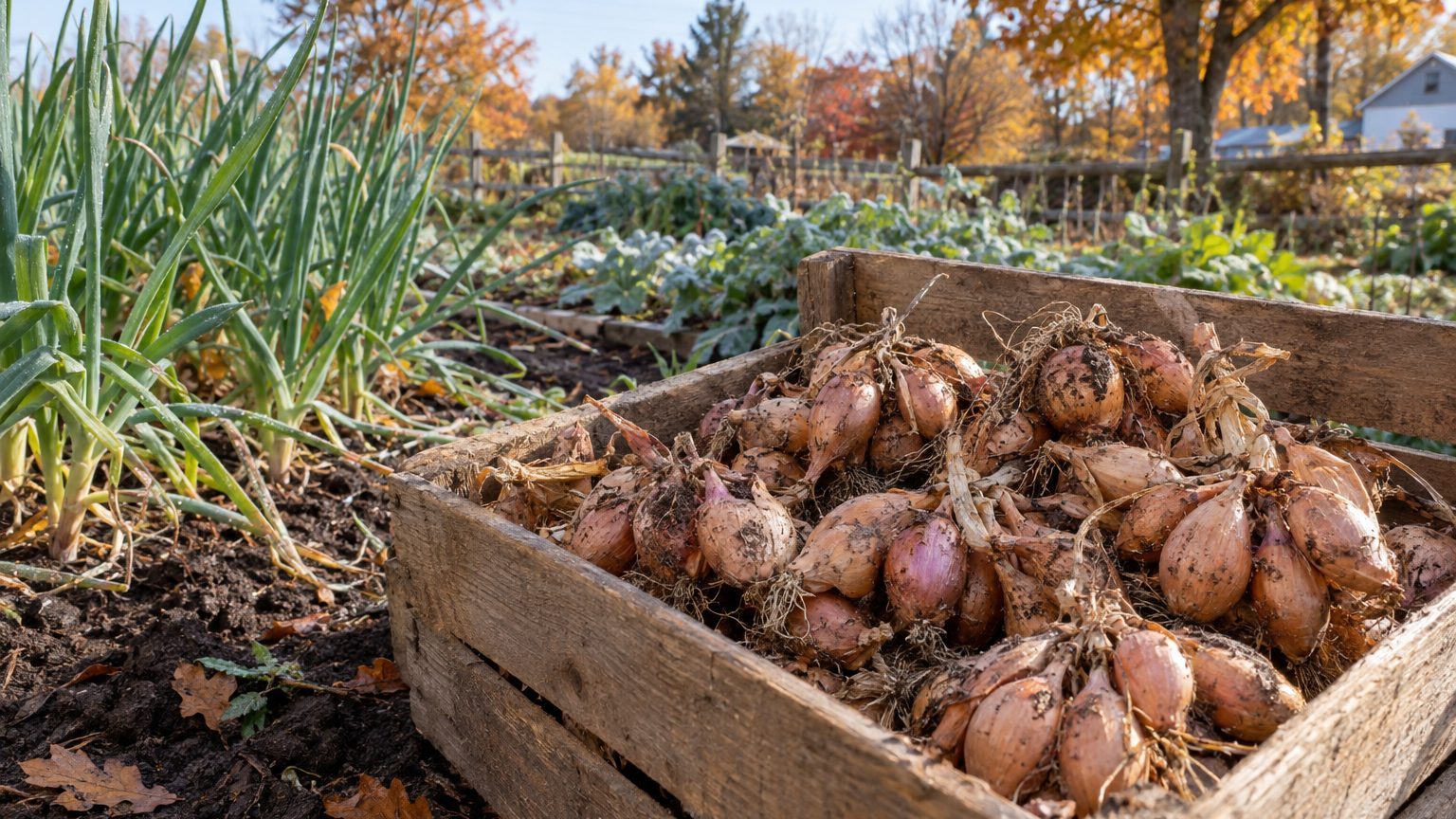

Spring-planted multiplier shallots grown from sets are the safest choice in the Northwest Territories. Seed-grown shallots can work if you start them indoors. Fall planting is a gamble, and slow, long-season types are a poor match for a frost-free stretch that averages about 116 days at Yellowknife. This page has no variety trial data for the territory, so it reasons by type instead of by name.
The short answer for Northwest Territories
Choose by type, not by cultivar name: early-maturing multiplier shallots, planted as sets or small bulbs in spring, are the best fit. Seed-grown shallots started indoors come second, and everything slower or fussier falls behind them.
The numbers explain why. At the Yellowknife A station, Environment and Climate Change Canada’s 1981-2010 normals put the last spring frost on average on May 25 and the first fall frost on average on September 18. Those are mean dates, the midpoint of a window. In one year out of two, frost arrives after May 25 in spring, and in the other half of years the first fall frost lands before September 18. The roughly 116 days between the two dates is an average gap, not a promise. A bad year can hand you far less.
Winter matters too. The mean daily minimum of the coldest month at Yellowknife is -29.5 °C (-21.1 °F), and Natural Resources Canada places the city in Canadian hardiness zone 1b. That is the Canadian system, not a USDA zone, and the two do not convert. Bulbs left in the ground face a hard winter, which pushes the decision toward spring planting.
| Type | Fit for the territory | Reason |
|---|---|---|
| Multiplier sets, planted in spring | Best | A head start underground; ready well inside the frost-free gap |
| Seed-grown, started indoors | Workable | Needs indoor space and a careful transplant, but avoids the cost of buying sets each year |
| Fall-planted cloves | Gamble | Depends on snow cover and mulch against deep cold |
| Seed sown directly outdoors | Poor | Too slow for a season this short |
On a seed packet or set listing, look for the earliest maturity the seller states and for smaller bulbs, which finish faster than big ones. Days-to-maturity figures in catalogs are usually written for warmer places, so treat them as a best case here. For a deeper look at the crop overall, see Growing Shallots in Northwest Territories.
What will not work here

Direct-sown seed is the first casualty. A shallot grown from seed needs a long run from germination to a cured bulb, and a frost-free window that can shrink below 116 days leaves no margin. Sown outside after the soil thaws, it would still be sizing up when September frost arrives.
Planting on May 25 and calling it safe fails for a different reason. That date is a midpoint, so in half of years a hard frost still comes after it. Shallot sets tolerate a light frost better than tender crops do, but a seedling transplant with soft indoor-grown leaves does not. Hold seed-grown transplants back, harden them off slowly, and keep a sheet of row cover ready.
Fall planting without protection is the quiet failure. A coldest-month mean minimum of -29.5 °C means the air is brutal for weeks. Snow is a good insulator, but it is not guaranteed to arrive before the deep cold does. A bed that sits bare through a cold, snowless stretch loses its sets. A thick mulch layer improves the odds, though I would not rely on it for the only bulbs you own. Try a small test row beside a spring planting before committing the whole stock.
Storage-type shallots bred for long keeping also tend to be the late ones. They need a warm, dry spell to cure, and in a territory where the first fall frost averages September 18, that spell is short. Bulbs pulled in cool, damp weather cure poorly and rot in storage. Plan to finish curing indoors, spread on a screen in a dry, airy room, rather than counting on September sun.
Cold, wet soil in spring is the last trap. Sets pushed into ground that has just thawed can sit and rot. Raised beds drain and warm sooner than native ground, and they matter more in a region where many soils are thin and cold. Skip heavy watering until the shoots are up. The classic hot-summer problem, a bed that needs daily watering, is not the concern at this latitude. Cold, short and wet in spring is.
What changes across Northwest Territories
The zone 1b figure belongs to Yellowknife, the reference city, and not to the territory. The Northwest Territories covers an enormous span of latitude and landscape, from the Mackenzie valley to the Arctic coast, so there is no single answer. Every number on this page, including the frost dates and the -29.5 °C winter minimum, comes from one station. This page does not hold a zone range for other communities, and I will not borrow one from a neighbor.
The direction of the shift is clear, though. Northern communities and higher ground run weeks behind the Yellowknife dates, which means a shorter gap between frosts and an even stronger case for sets over seed. A gardener there should plant the earliest-maturing type available, use a raised bed or low tunnel to warm the soil sooner, and treat seed-grown shallots as an experiment. Readers in the south of the territory may have more room, but again, this page has no figure to offer for them.
Local conditions inside any one town also vary. A south-facing wall, a sheltered yard, or a bed near a lake can shift conditions by days. A frost pocket at the foot of a slope can cost you the same number of days in the other direction.
Look up your own zone rather than inferring it from this page. Natural Resources Canada’s Canada’s Plant Hardiness Site publishes zones by municipality using 1991-2020 normals. Keep in mind that the frost dates here come from 1981-2010 normals, so the two datasets cover different decades. Warming over the intervening years may have nudged things, but this page cannot say by how much.
Where to check this for your own county
The territory does not have counties, so the closest equivalent is your own community or region. The best local source is the Government of the Northwest Territories Department of Industry, Tourism and Investment agriculture services. This page is a territory-level summary, and anything specific to your community from that office should outrank it.
When you get in touch or browse, look for two things. First, a planting calendar for your community or the nearest one, with dates for sowing and transplanting alliums or other hardy crops. Second, any record of varieties that have been grown locally, because a shallot that has finished in your area is worth more than any catalog claim. If the office has no shallot-specific information, ask about onions and garlic, which face the same season limits.
A local recommendation beats a territorial one every time, and this page is the territorial one. It works from one weather station and one reference city. Treat it as a starting frame, then adjust to what your community’s own records and your neighbors’ gardens show. If your question is about timing, When to Plant Shallots in Northwest Territories goes through the calendar side in more detail.
Checking this against your own garden
Your own observations outrank every date here. Three are worth tracking each spring, and none needs equipment.
- Soil warmth by feel. Push a trowel in a few inches. If you hit frost, or the soil feels cold and sticky, wait. Soil that crumbles and feels cool rather than icy is ready for sets. A bed that reaches this point early is a warm microclimate, and it tells you that you can plant sooner than your neighbor.
- Willow catkins and birch buds. The first flush of male catkins on wild willows, and birch leaves breaking open, mark the local turn of the season. Note the date each year. If your own yard runs ahead of the roadside, the yard is the warmer spot.
- First true leaves on your shallots. Green shoots from sets or the first true leaf on seedlings show how the bed is actually behaving. Slow, yellowing growth points to cold or waterlogged soil, and strong green growth tells you the site suits the crop.
Write the dates in a notebook. Three or four years of your own notes will tell you more about your plot than a single station average ever will.
Common questions
Can I plant shallots in fall in the Northwest Territories?
You can try, but it is a gamble. The coldest-month mean daily minimum at Yellowknife is -29.5 °C, and a bed without reliable snow cover or deep mulch can lose its bulbs. Plant a small test row and keep spring-planted sets as your main crop.
Is May 25 a safe planting date?
No. It is the average last spring frost at the Yellowknife A station, and in one year out of two the frost falls later. Sets can go in around it, but seed-grown transplants need protection and slow hardening.
Should I grow shallots from seed or from sets?
Sets are the safer route, because the bulb already has a head start. Seed-grown shallots are workable if you start them indoors and transplant carefully. Seed sown directly outdoors is too slow for the season.
Does zone 1b mean the same thing as a USDA zone?
No. Zone 1b is Natural Resources Canada’s system, built on seven climate variables, and it does not convert to a USDA zone. It also describes Yellowknife, not the whole territory.