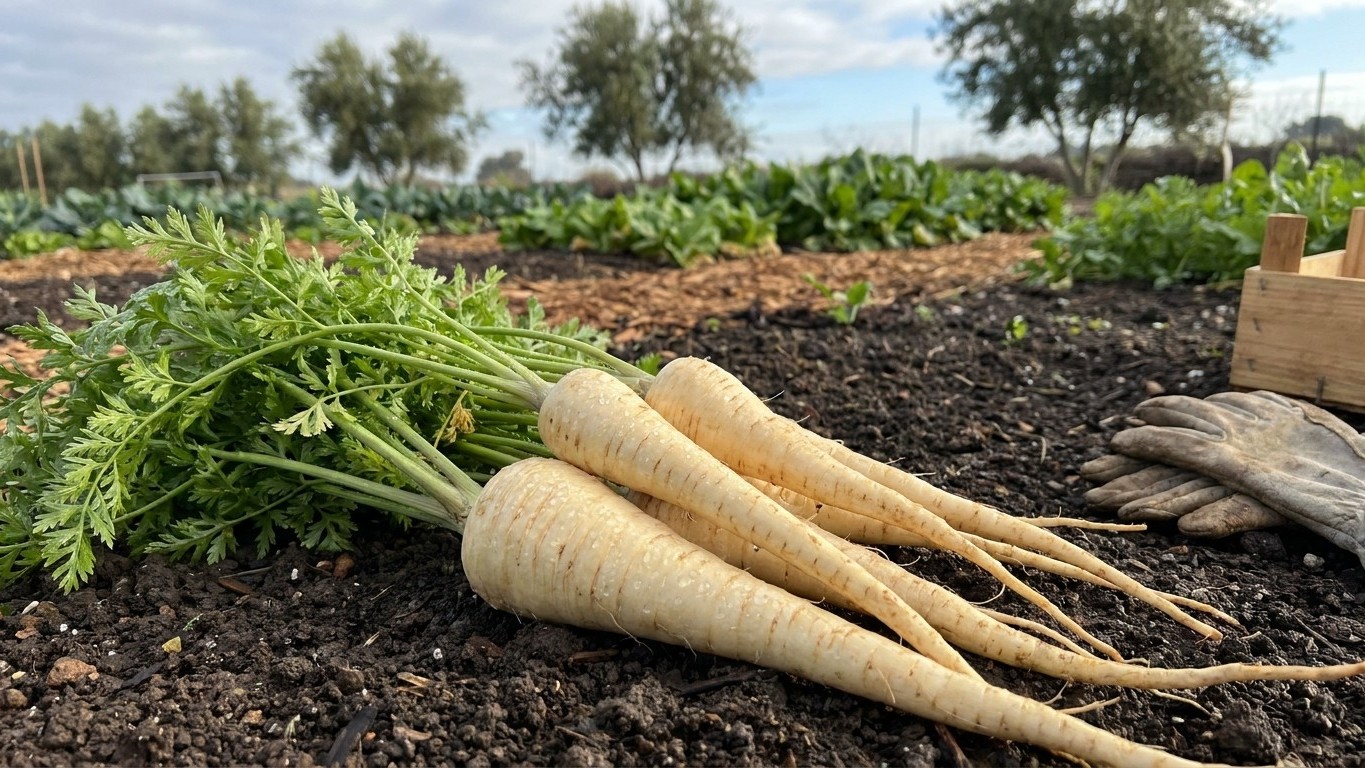

North Florida parsnips come out of the ground from late November into winter, once the shoulder of the root, the wide top just below the tops, measures 1 to 3 inches across. Dig one test root at the end of a row before pulling the whole bed, since size varies with soil even in the same planting.
When to lift parsnips in Florida
Lift parsnips once the shoulder reads 1 to 3 inches across. That test-root check matters more than the calendar, since two rows sown the same day can mature at different rates depending on how compacted or sandy the ground is underneath them.
Parsnip is a slow crop, needing 100 to 120 days from seeding according to Utah State University Extension, and the seed itself takes 14 to 21 days just to germinate. Mark the row when you sow it, because a bare patch of soil three weeks in doesn’t mean the sowing failed, it likely means the seed is still working.
Why the window stretches into winter
Near Jacksonville, NOAA NCEI’s 1991-2020 climate normals put the first fall frost between November 26 and December 13. Counting back 100 to 120 days from that window lands the seeding date somewhere from late July to early September, a several-week range rather than a single date, since both figures feeding the calculation are themselves ranges. Sowing on that schedule brings root maturity right around the season’s first frosty nights, which is also when this crop’s flavor starts to shift (the mechanism behind that is its own subject, covered at Will Parsnips Sweeten in Florida?).
These dates come from the Jacksonville area specifically. Farther south, in central and south Florida, frost grows rare enough that the whole growing calendar flips, running mainly through winter instead of around it, so this fall-lift schedule doesn’t carry south of roughly the Jacksonville region.
NOAA’s 1991-2020 normals also put the mean daily minimum of Jacksonville’s coldest month at 42.9°F, well above freezing. The ground here rarely locks up hard enough to trap roots the way it does farther north, so there’s no race against a frozen bed. Roots can generally stay in place and be lifted a few at a time through the winter, as long as the bed itself isn’t sitting in standing water from winter rain.
Once lifted, twist or cut the tops off close to the crown and stop there. Storage life depends on that crown staying intact, and cutting into it opens a wound that invites rot long before cold or time would otherwise spoil the root. Everything upstream of this point, from bed prep to spacing, is covered in Growing Parsnips in Florida.
Four to six months, if the air is right
USDA Agricultural Handbook 66 credits parsnip roots with a storage life of 4 to 6 months at 0 to 1°C (32 to 34°F) and 98% relative humidity, citing research by van den Berg and Lentz. That’s a long keeper by any vegetable’s standard, but the figure describes a commercial cold room built to hold both numbers steady at once, not a box on a garage shelf.
What 98% humidity actually looks like
Most home storage spots fail on humidity long before they fail on temperature. A refrigerator crisper drawer, even set cold enough, runs far drier than 98% relative humidity, and a bare parsnip left in that air will go soft and rubbery within weeks as moisture leaves through the skin. Growers get around this by burying roots in damp sand, damp sawdust, or damp peat inside a box, or by bagging them loosely in perforated plastic before refrigerating, so each root sits in its own humid pocket instead of the dry air of the appliance.
| Storage setup | Temperature achieved | Humidity achieved | Realistic duration |
|---|---|---|---|
| Bare roots in fridge crisper | Close to 32-34°F | Low, dries the root | A few weeks |
| Perforated bag in fridge | Close to 32-34°F | Moderate to high | Two to three months |
| Damp sand box, unheated space | Depends on the space | High if sand stays moist | Toward the four to six month figure |
Treat the USDA figure as a ceiling reached under steady, ideal conditions, not a guarantee. A root held at the right temperature but let go dry, or one that swings between cold and warm as a door opens and closes all winter, won’t reach six months even if it went into storage sound. Check the sand or bag every few weeks and add moisture back in if it feels dry to the touch.
The mistake that turns parsnips bitter
Parsnips are not chilling sensitive, which means the cold itself isn’t what ruins them in storage. USDA Agricultural Handbook 66 is specific about what does: exposure to even low levels of ethylene in cold storage causes bitterness, tied to a buildup of a compound called xanthotoxin in the root. That’s a chemical reaction, not a cold-damage symptom, and it happens at exactly the temperature you’ve been told to aim for.
Where the ethylene comes from
Parsnips themselves give off almost none, under 0.1 microliters per kilogram per hour at 68°F according to the same USDA source, so the root isn’t the source of its own trouble. Apples, pears, and tomatoes are. Any of those ripening in the same cold space steadily release ethylene into the air around them, and nearby parsnips absorb it with no visible sign until you cut one open and taste it.
Store parsnips in a space with no ripening fruit at all, not just a different shelf inside the same refrigerator or cellar. A separate drawer isn’t enough if the air in the whole unit circulates, and a cellar shared with a bushel of apples will taint every root in it by the end of the season. If a dedicated space isn’t possible, treat keeping parsnips away from fruit as more important than getting the temperature or humidity exactly right, because a taste ruined by ethylene usually isn’t caught until the root is already on the plate, while a root that’s a little too dry or a little too warm can often still be salvaged and eaten sooner.
What goes wrong here
Three failures show up more often in a north Florida storage setup than in the growing bed itself.
A wet autumn rotting damaged roots
Parsnip skin is thin, and a nick from a garden fork during lifting, or a crack from being dropped into a bucket, is an open door for rot once the root sits in storage. North and central Florida autumns bring heavy rain some years, and roots lifted straight out of saturated ground carry extra moisture and soil-borne organisms into the storage box with them. Let lifted roots air-dry for a few hours in a shaded spot before boxing them, and check each one against a short list before it goes in:
- No cuts, cracks, or fork wounds from digging
- No soft or discolored patches
- Tops removed close to the crown, but the crown itself untouched
- Skin dry to the touch, not freshly rinsed
Forked roots from two different causes
A forked or stubby root points to one of two separate problems, and it matters which one you’re dealing with. Heavy, compacted, or stony ground splits the taproot as it pushes down, which is why Utah State University Extension recommends deep, sandy soil, or double digging a heavy bed before sowing. Overwatering is the other cause entirely, encouraging the root to branch sideways instead of driving straight down in search of moisture it already has plenty of near the surface. A gardener who blames the soil and eases up on watering, or the other way around, fixes nothing if the real cause was the opposite one.
A storage space too dry to hold
Only lift and store roots that are fully healthy, since a garage or spare room in Florida, especially one with air conditioning running through a mild winter, holds nowhere near the 98% relative humidity the USDA figure assumes. That gap is exactly why the damp sand or perforated bag matters more here than it would in a naturally damp northern root cellar. Check stored roots monthly regardless, since even a well-packed box run at good humidity can start a slow rot from a single root that went in already bruised.
Common questions
Can I just leave parsnips in the ground all winter instead of storing them?
In north Florida you can leave them longer than a gardener in a colder state could, since NOAA’s 1991-2020 normals put the coldest month’s mean minimum at 42.9°F rather than a hard, ground-locking freeze. Roots left in place keep gaining sweetness from frost exposure and you sidestep the indoor humidity problem entirely, though a heavy wet spell can still start rot on roots left too long in saturated soil.
Do parsnips actually need a frost to taste good?
Yes, several weeks of cool, frosty weather converts stored starch in the root to sugar, not just one chilly night or cold soil on its own. That conversion is driven specifically by frost exposure, not by how mild or harsh the general winter has been, so a season with no real frost can grow a perfectly fine-looking parsnip that never develops much sweetness at all.
What pests should I watch for while parsnips sit in the garden this long?
UF/IFAS Extension documents several pests on Florida vegetable crops broadly, and root-knot nematodes are the one that matters most for a root you’re planning to leave in the ground for months, since nematode damage splits and weakens roots before you ever lift them. See What Eats Parsnip in Florida, and When for how that timing lines up with the rest of the season.
Should I wash parsnips before putting them into storage?
No, brush off loose soil but skip washing them, since wet skin against damp sand or inside a perforated bag encourages the very rot storage is meant to prevent. Let any moisture from lifting dry off in open air first, then handle the roots as little as possible when boxing them, since bruises and nicks are what let rot start early even when temperature and humidity are both right.