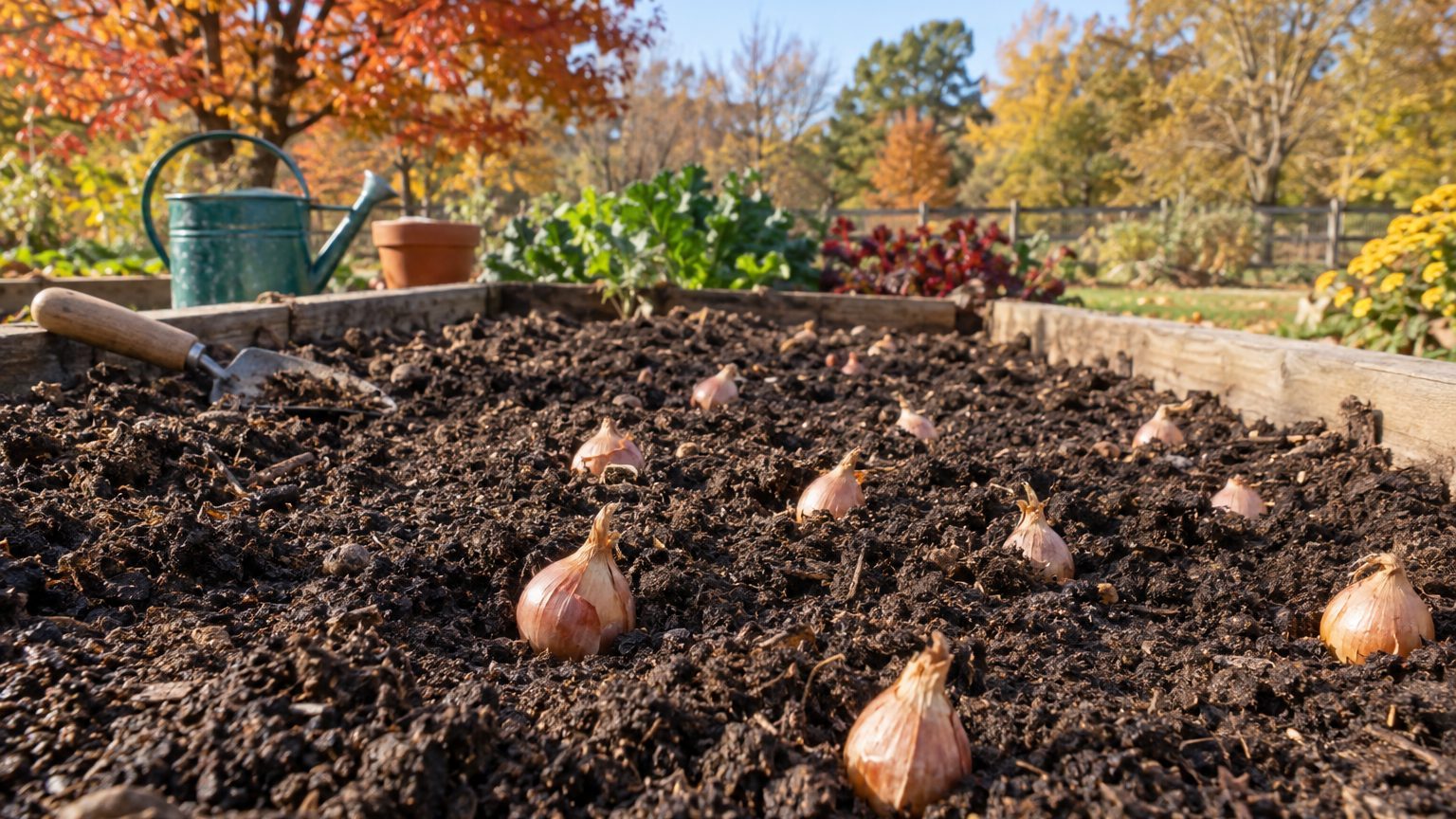

Plant shallots as soon as the bed has thawed enough to dig. For a climate like Rankin Inlet’s, that puts the window around the average last spring frost, June 19. The average first fall frost there is September 13, so roughly 86 days separate the two. Every week of delay comes out of a crop with little room to spare.
The short answer for Nunavut
The planting window opens when the soil is workable, centered loosely on June 19 at Rankin Inlet. That date is the mean last spring frost, not a safe date. In one year out of two, the last frost falls later than June 19. Treat it as the midpoint of a window that stretches a couple of weeks either way, not as a green light.
What the two dates measure
Both figures come from Environment and Climate Change Canada’s Canadian Climate Normals for 1981-2010, read at the Rankin Inlet A station. The mean last spring frost is June 19 and the mean first fall frost is September 13. Neither is a guarantee. They are the middle of a spread, so a coin-flip year puts frost on either side of those dates. They also cover 1981-2010, while the US figures elsewhere on this site cover 1991-2020, so don’t set one directly against the other.
Subtract one date from the other and you get about 86 days between average frosts. That is the outer limit of a frost-free stretch, and it is short next to a typical shallot’s growing time. Seed catalogs commonly list shallots grown from sets at around three to four months to harvest, so the arithmetic is tight even before weather gets involved.
Using the window in practice
Shallot sets tolerate light frost, so you don’t need to wait for the frost-free date to put them in. The real limit is the ground. This page has no verified soil-thaw date for any Nunavut community, and it won’t invent one. Your bed will tell you: if a trowel goes in without hitting ice, you’re in the window.
Many northern gardeners will do better starting sets in pots indoors a few weeks ahead, then moving them to the bed once it thaws. That gets a head start on the 86 days without risking sets in cold ground. When you do plant, set them about an inch deep and roughly 6 inches apart, with the pointed end up. The full growing routine is in Growing Shallots in Nunavut.
What will not work here
Fall planting is the first casualty. The mean daily minimum of the coldest month at Rankin Inlet is -34.3 °C (-29.8 °F). That is an average of the coldest nights, so single nights run colder. A bulb sitting in frozen ground that long, with only whatever snow cover happens to fall, is a gamble rather than a plan. Southern guides that say “plant shallots in October” assume soil that stays workable for weeks and winters that bottom out far higher.
Waiting for the frost-free date is the second mistake. If you hold off until you feel safe, you are waiting past June 19 in half of all years, and the season has already begun to close. Shallots handle a light frost; your calendar can’t handle a month’s delay.
Slow varieties are the third. With about 86 days between average frosts, anything bred for a long, warm season leaves you pulling green, undersized bulbs in September. Starting from seed outdoors fails for the same reason, since seed-grown shallots need more time than sets and more than this season easily gives. If you want to try seed, start it indoors well ahead, and read The Best Shallots to Grow in Nunavut before you buy.
Cold, saturated soil is the fourth problem. Sets pushed into a bed that is only just thawing, with meltwater still sitting underneath, can stall or rot before roots take. Raised beds drain and warm sooner than flat ground, which is a good reason to build them even for a small shallot patch.
Finally, borrowing a calendar from the Lower 48 will mislead you. A US state calendar built on 1991-2020 normals, for places where the ground thaws in March or April, tells you nothing about a territory where the average last frost is deep in June. The mismatch is not a few weeks. It is a different season entirely.
What changes across Nunavut
The figures above describe one station. Natural Resources Canada lists Rankin Inlet in Canadian hardiness zone 0a, using its 1991-2020 normals. That is the Canadian system, built on seven climate variables, and it does not convert to a USDA zone. NRCan itself says there are no simple conversions: Canadian zone 4a, for instance, overlaps nine different USDA zones, from 3a to 7a. So 0a tells you the climate is among the harshest the Canadian scale measures, but it does not say how to plant.
Nunavut also covers an enormous spread of latitude, from the southern shores of Hudson Bay to the High Arctic. There is no single answer for the whole territory. This page has one verified station, Rankin Inlet A, and it does not have frost dates or zone figures for other communities, so it will not guess at them. What it can say is that the Canadian normals note that northern and upland districts run weeks behind this station. If you garden north of Rankin Inlet, expect to start later and finish sooner than the dates here.
If you are in the north, shift everything later and shorten your expectations. Start sets indoors, plan for a bed in the sunniest, most sheltered spot you have, and treat 86 days as a ceiling rather than a target. If you are further south or somewhere sheltered, you may gain a little room, but the page can’t promise how much.
Don’t rely on this page to tell you your zone. Look up your own community on the Natural Resources Canada plant hardiness map, which lists zones by municipality, and compare it to the reference figure for Rankin Inlet.
Where to check this for your own county
Nunavut has no counties, so the closest local unit is your community and its region: Kitikmeot, Kivalliq or Qikiqtaaluk. Unlike a US state, it also has no university extension service publishing shallot calendars by county. The federal department, Agriculture and Agri-Food Canada, is the nearest verified starting point. The territorial department’s own site refused automated checks when this page was prepared, so the federal site is given instead because it could be confirmed to load.
Once there, look for two things. First, a local planting calendar or any frost-date table closer to your community than Rankin Inlet. Second, any record of varieties trialled in your region, since a result from a nearby garden tells you more than a catalog description. This page cannot confirm that the federal site publishes Nunavut-specific shallot trials, so treat that search as an open question.
Community greenhouses and local gardening groups are another place to ask, because their members hold the observations that no database captures. Ask what went into the ground, when it went in, and when it was pulled.
A county recommendation beats a state one, and a community recommendation beats a territorial one. This page is the territorial view, built on one station’s 1981-2010 averages. If a local source gives you different dates, trust the local source.
Checking this against your own garden
Your own observations outrank every date above. You don’t need instruments, just attention, and three things are worth watching.
- Thaw at trowel depth. Push a trowel into the bed each week after the snow goes. The day it slides in without hitting ice is your planting day. A sheltered, south-facing bed that thaws a week before a windswept one has told you something real about your microclimate.
- Days from planting to green tips. Count them. Slow emergence means cold soil; fast emergence means a warm pocket. Next year, you can plant a little earlier or later because of it.
- When the tops start to yellow and flop. In late summer, leaning, yellowing leaves signal that bulbs are finishing. If that happens well before September 13, your spot gives you more room than the average suggests. If frost arrives while tops are still green, you started late or your bed runs cool.
Write all three dates down, even on a calendar by the door. After one season you will have a local number no table can supply. One caution: the normals behind this page end in 2010, so your recent seasons may not match them, and your own log will be the better guide.
Common questions
Can I plant shallots in fall in Nunavut?
It is a gamble. The mean daily minimum of the coldest month at Rankin Inlet is -34.3 °C (-29.8 °F), and ground that stays frozen for months offers little protection. Spring planting, or indoor starting followed by transplanting, is the safer approach.
Is June 19 a safe planting date?
No. It is the average last spring frost at Rankin Inlet, so in one year out of two the last frost comes later. Shallot sets tolerate light frost, so what matters more is whether your bed has thawed enough to work.
Which hardiness zone is Nunavut in?
There is no single zone. Rankin Inlet is Canadian zone 0a, and that is not a USDA zone. Check the Natural Resources Canada map for your own community instead of assuming.
Should I start shallots indoors?
For most gardeners, yes. With about 86 days between average frosts, a few extra weeks indoors gives sets a head start. Move them out as soon as the bed is workable, and harden them off first.