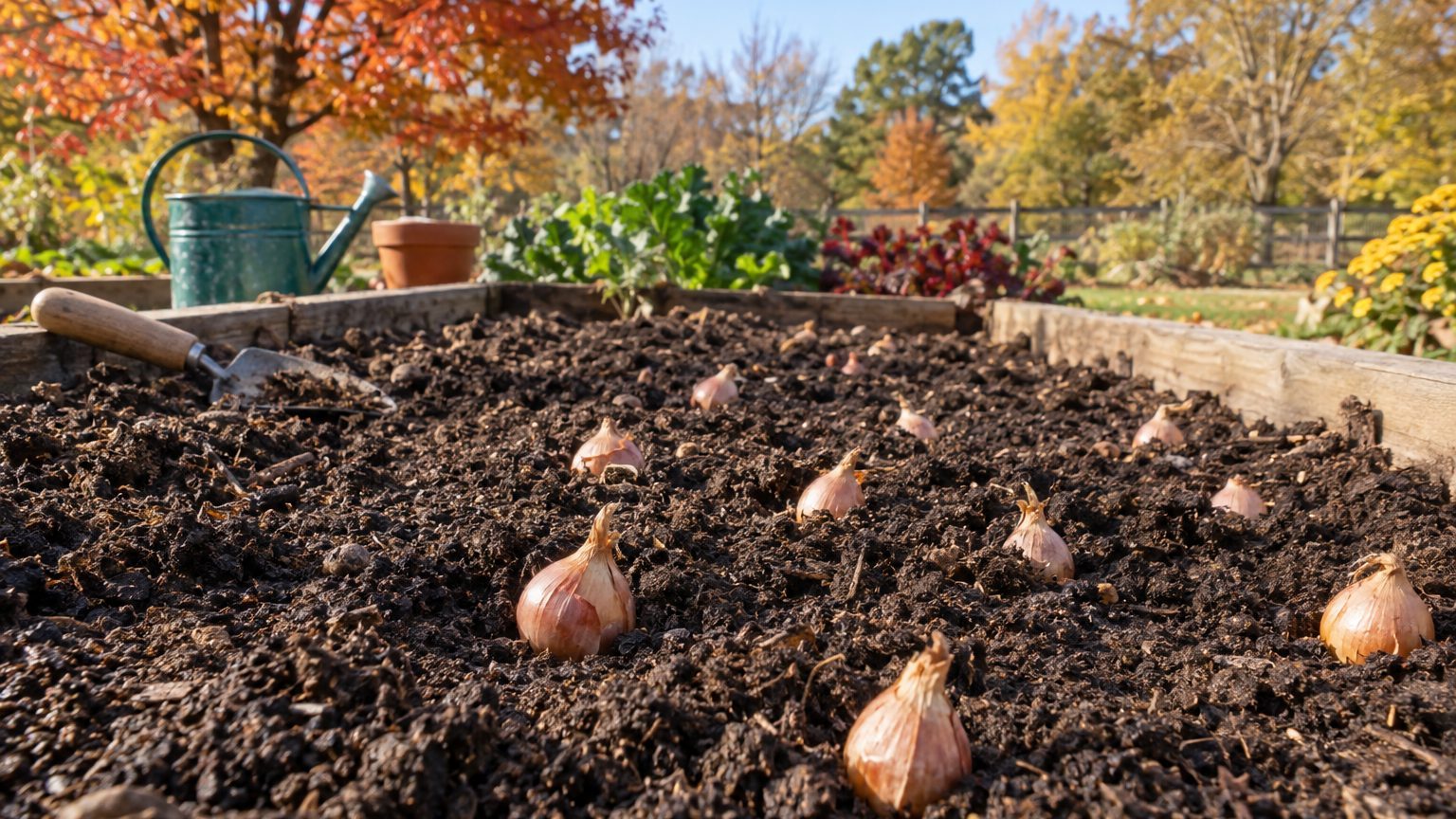

In Ontario, shallots go in the ground at one of two moments. You can plant in fall, a few weeks before the soil freezes hard, or in spring, as soon as the ground can be worked. The reference frost dates are April 30 (average last spring frost) and October 16 (average first fall frost), both from the Toronto Pearson station. Those are midpoints, not guarantees. Farther north or higher up, both dates shift.
The short answer for Ontario
Start with what the two dates actually are. Environment and Climate Change Canada’s 1981-2010 normals, read for the Toronto Lester B. Pearson station (climate ID 6158733), put the average last spring frost on April 30 and the average first fall frost on October 16. Each one is a mean date. It is the center of a spread, which makes it roughly a coin flip. In about half of years, a frost still arrives after April 30. In about half of years, the first fall frost lands before October 16. Treat neither date as a safe line.
Count the days between them and you get about 169 frost-free days on average, a figure that comes from simple arithmetic on those two means. That is a decent stretch for a crop that wants cool weather early and dry warmth to finish.
Fall planting
Fall is the first choice for most Ontario gardeners with a bed that drains well. The goal is a bulb that grows roots but little or no top before winter. Use October 16 as a reference point, not a deadline: the planting window opens around the time frost nights begin to show up and closes when the ground is too hard to work. Plant too early in a warm autumn and the green shoots race ahead and get burned by winter. Plant too late and the bulb has no anchor, so frost heave can push it to the surface. Ontario winters freeze and thaw repeatedly, so a layer of straw or shredded leaves after the soil cools is worth the effort.
Spring planting
Spring planting works on a different trigger. Shallots shrug off light frost, so you do not wait for April 30 to pass. You wait for soil that crumbles instead of smearing, which in much of southern Ontario can come in early April and in colder districts a few weeks later. Get them in early, because bulbing responds to lengthening days and shallots planted late have less time to size up before summer heat.
The full picture, including varieties and bed prep, lives in the parent guide, Growing Shallots in Ontario. This page covers only the calendar.
What will not work here
Planting in fall by the calendar date alone is the most common failure. A date on a page cannot see your October. If a warm spell has kept the soil mild, bulbs planted on the “right” day will sprout, and the first hard freeze will then punish the new growth. The mean first frost of October 16 also means that half of autumns bring frost earlier, which can catch a late-planted bed with no roots at all. Watch the soil, not the date.
Winter itself sets a hard limit. The mean daily minimum of the coldest month at the reference station is -10.2 °C (13.6 °F). That is an average of the nightly lows in the coldest month, not a record, so individual nights go colder. Bare, unmulched soil with that kind of cold and repeated thaws is where fall-planted bulbs get heaved out of the ground. A shallot planted shallow in unprotected soil in Ontario is a bet against the freeze-thaw cycle, and the cycle usually wins.
Anyone hoping to stretch the season will run into the arithmetic as well. About 169 frost-free days between the two mean dates sounds roomy, but those days are not all equally useful. The first weeks are cold and wet, and the last ones shorten and cool. A slow variety, or one grown from true seed rather than sets, needs most of the window to finish. If it starts late, it can run out of season. That is why the choice of type matters here, and why The Best Shallots to Grow in Ontario leans toward reliable, set-grown types for gardeners without a head start.
Waiting for April 30 to pass before planting is the opposite mistake. It treats a mean date as a safe date, and it costs you the cool weeks that shallots like best. Since half of years still see frost after that date, waiting does not even buy certainty.
Last, a caution about what this page cannot tell you. The facts behind it include no rainfall figure, no humidity figure and no summer heat measure for the province, so it will not claim that close spacing fails in a wet July or that weekly watering fails in a dry one. Those are real risks in many places, but this page has no number to anchor them in Ontario. Judge them from your own summers. One more caveat: the frost dates come from 1981-2010 normals, and the climate has moved since. Do not be surprised if your recent years sit earlier or later than the means.
What changes across Ontario
Ontario is not one garden. The frost dates above come from a single station near Toronto, and districts to the north and at higher elevation run weeks behind them in spring and often ahead of them in fall. Lake Ontario and Lake Erie moderate temperatures for the shoreline strips, while the interior gets sharper cold. The same October 16 that suits a bed near the lake is far too late for a garden in a colder district.
The hardiness figure carries the same warning. Natural Resources Canada’s 1991-2020 map puts the reference city, Toronto, in Canadian plant hardiness zone 7a. That is the Canadian system, which blends seven climate variables. It does not convert to a USDA zone, and NRCan itself says there is no simple conversion between the two systems. Do not read “7a” here as a US number.
The spread across the rest of the province is not in the facts this page holds, so it will not invent one. The honest answer is that there is no single zone for Ontario, and the range from the southern lakeshore to the northern districts is wide. Find your own spot on the Canada Plant Hardiness Site, which lets you search by municipality. Your zone is yours to look up, not something this page can tell you.
If you garden north of Toronto or on higher ground, shift the whole calendar. Plant in fall earlier relative to your local first frost, so roots form before the ground locks up, and mulch more heavily than a lakeshore gardener would. In spring, expect to plant later because the soil thaws and dries later, and accept a shorter season for bulbing. Gardeners in the milder pockets can lean the other way, but the shift should be small. A cold hardy type of shallot matters more as you go north, and the cost of a wrong guess rises with it.
Where to check this for your own county
Ontario does not run a US-style cooperative extension system with a county office in every county. The closest official starting point is the provincial government’s Ontario agriculture and food pages. Start there and look for two things: a planting calendar written for your part of the province, and any list of vegetable or allium varieties trialled near you. A trial in your region tells you which types finished the season in your conditions, which no province-wide page can.
If the provincial pages point you to a regional office, a local agricultural society, a master gardener group or a seed grower in your area, those are worth a call. People who grow garlic and shallots commercially or for market in your district know when the ground locks up and when the thaw comes. They are usually generous with timing.
A county recommendation beats a state one, and this page is the state one. It is built on a single reference station and a single hardiness city, so it gives you a sound starting frame and not a final date for your bed. If a local source tells you to plant a week earlier or later than this page suggests, go with the local source. It reflects your soil, your elevation and your recent winters, which these averages cannot.
One practical point: keep the vintage of any dates you collect in mind. Canadian frost normals here cover 1981-2010, while the US figures elsewhere on this site cover 1991-2020. Mixing the two without noticing can quietly move a date by days.
Checking this against your own garden
Your own observations outrank every date on this page. Three are worth watching, and none needs equipment.
- Soil warmth by feel. In spring, squeeze a handful. If it crumbles and does not feel icy, it is ready. In fall, soil that still feels mild at midday means the bulbs may sprout early, so wait. Slow-warming soil also marks a cold pocket.
- The first flush of male flowers. Early catkins on hazel or alder, or maple buds swelling, show your local spring has turned. If they arrive well after the neighbors across town, your garden runs late and your planting should too.
- The first true leaves. Watch when weeds and early perennials leaf out, and when shallot shoots first break the surface. Green showing long before winter means you planted too early. Nothing showing by midspring means your bed is cold or waterlogged.
Write the dates down for one season. A single year of notes, set beside the April 30 and October 16 means, tells you how far your yard sits from the reference station. After two or three years you have a calendar no website can match.
Common questions
Is fall or spring better for shallots in Ontario?
Fall usually gives larger bulbs because roots establish before winter, provided the bed drains well and you mulch. Spring planting is the fallback when you missed fall or have heavy, wet soil. Both work; the real risk is planting in fall too early or too late.
Can I plant on April 30 because it is the last frost date?
Not as a rule. April 30 is a mean date, so in about half of years frost still comes after it. Shallots tolerate light frost anyway, so you can plant as soon as the soil is workable, well before that date in a normal year.
Does the Toronto frost data apply to my town?
Only roughly. The dates come from the Toronto Pearson station, and northern or upland districts run weeks behind it. Use them as a frame and adjust with your local sources and your own observation.
What does Ontario’s zone 7a mean for shallots?
Zone 7a is the Canadian hardiness zone of the reference city, Toronto, and it is not a USDA zone. It describes the reference city, not the whole province. Look up your own municipality on the NRCan map to find where you actually sit.