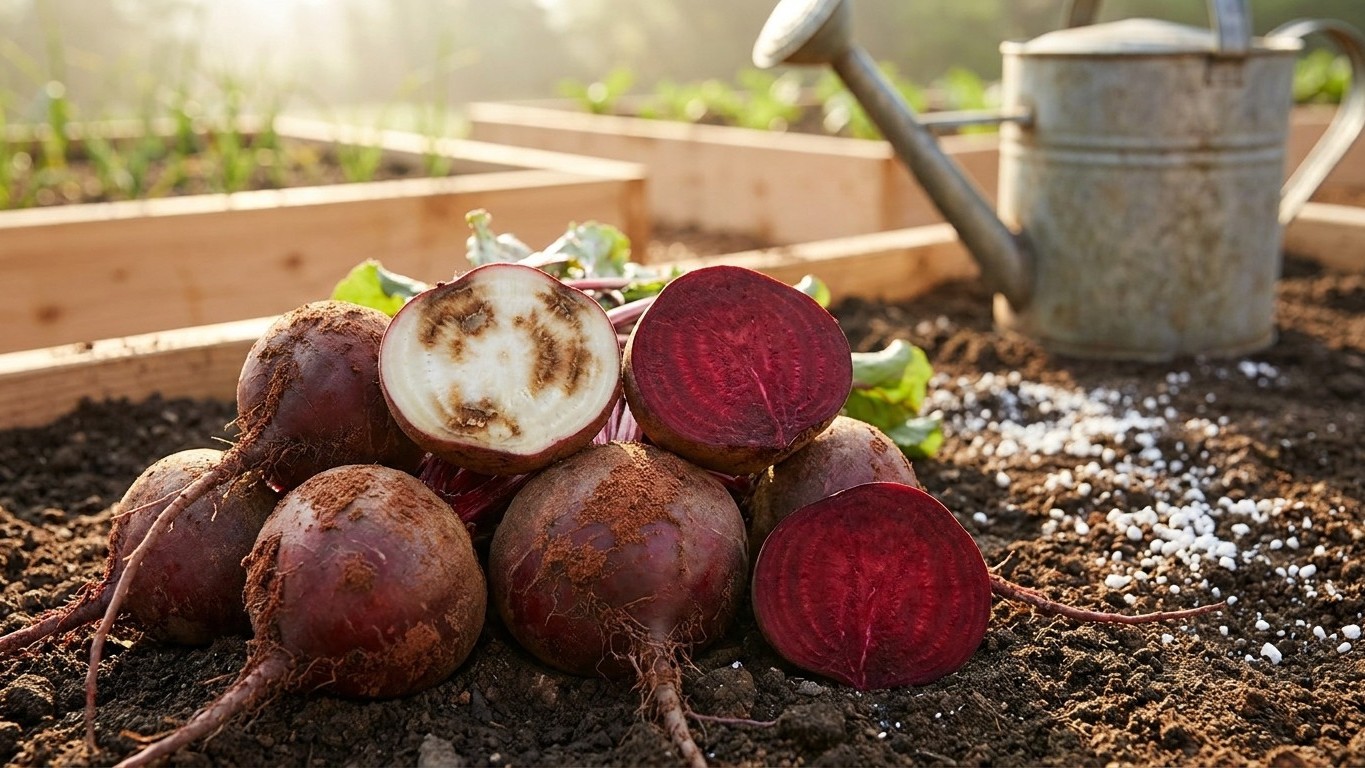

Count 60 to 80 days from the day the seed goes into the ground. Beets are sown in place and never transplanted, so the clock starts at seeding. Pull them before the heat turns them woody, and before any freeze if your garden gets one. Then store the topped roots at 33 to 36°F. Colder, the instinct that works for carrots and potatoes, brings more black spot and rot.
The short answer
What the state soil says to a beet
California’s official state soil is the San Joaquin series, an Alfisol, a forest-type soil of moderate fertility that holds nutrients reasonably well. USDA records its surface horizon as loam to silt, at 51 percent sand, 18 percent clay and 32 percent silt. Surface pH runs about 6.1, slightly acid. Organic matter sits around 0.8 percent, and the drainage class is moderately well drained. Those figures are representative values for the mapped series, not a reading from a worked garden bed.
Utah State University Extension describes the beet’s ideal as deep, sandy, well-drained soil rich in organic matter, amended with no more than 1 inch of composted organic matter per 100 sq ft. Set against that, this soil does well on texture (half sand, modest clay, so a root can swell without fighting a brick) and on drainage. It falls short on organic matter. At 0.8 percent, the ground tends to hold little water in reserve, so the dry spell between irrigations arrives sooner than it would in richer soil. The Beet Soil in California: What the Root Will Meet page goes deeper on what amending does and does not fix.
One caution matters more than any number above. A state spans hundreds of soil series, and this one is a starting point, not a diagnosis. River bottoms, hill country and any lot a builder has scraped or filled will behave differently. A soil test on your own bed is the only way to get your own pH and texture.
Heat is the clock on the back end
Utah State University Extension ties woodiness to a specific pairing: heat above 85 F combined with water stress. The number of days a year Los Angeles passes 90 F is not published in the figures behind this page, so I won’t guess at it. The 85 F line sits below 90 F, though, which means every day the thermometer clears 90 is already inside the danger zone for a thirsty root. Across much of inland and southern California, a late harvest is a woody harvest.
That is why the pull date here is set by the calendar of heat, not frost. Los Angeles records no freeze in an average year. NOAA’s climate normals and daily records show zero days at or below 32 F in 30 years, with a frost-free season listed as 365 days (NOAA NCEI data for the Los Angeles station). Coastal and southern California is frost-free. Northern California, the Central Valley and the Sierra do freeze, and a gardener there has a different calculation.
The six weeks that decide it here
The usual advice is to sow beets two to three weeks before the last spring frost. That rule needs a frost date, and in the frost-free parts of California there isn’t one. A Los Angeles gardener has nothing to count back from. A gardener in the Central Valley, the northern part of the state or the foothills does have a last freeze, but the figures behind this page do not publish a date for those places, so check a local source for yours.
Why the first six weeks matter most
Water stress in the first six weeks after sowing causes premature flowering, which is bolting. A plant that bolts spends its energy on a flower stalk instead of a fat root. This is a failure of early thirst, and it is separate from the woodiness that comes later from heat. Keeping the seedlings evenly moist protects against the first. It does nothing for the second, which is why the two problems should not be lumped together under “keep it watered.”
Where the risk sits in a California spring
California’s pattern is a wet winter and a dry stretch that begins in spring and runs through summer. Rain is unreliable in the spring months, and warm spells can swing in between cool ones. A sowing made in late winter or early spring may catch the tail of the rains for a couple of weeks, then face a dry gap in weeks three to six. That gap is where the bolting risk sits. In a drought year, or under municipal water restrictions, it widens, because the irrigation you counted on may be capped just when the seedlings need steady moisture.
The practical move is to plan the water before the seed. Drip lines or a soaker hose on a schedule you can keep under restrictions beat hand-watering whenever you remember. A layer of mulch over the low-organic-matter soil slows the drying. Then count forward: 60 to 80 days from your sowing date. If that window lands on weeks of heat above 85 F, move the sowing earlier or later so the roots size up before the hot stretch. The broader Growing Beets in California guide covers sowing windows by region.
What goes wrong here
In the bed
- Bolting from early thirst. A dry gap in the first six weeks sends plants to flower. Remedy: keep the seedbed evenly moist from sowing through week six, using drip or a soaker on a timer, and mulch once seedlings are up.
- Woody roots from later heat. Heat above 85 F paired with water stress toughens the root. Remedy: keep watering steady as temperatures climb, and pull earlier rather than leaving roots to sit through a hot spell. Shade cloth over the row is a reasonable extra, though no figure here backs a specific type.
- Thin, fast-drying ground. San Joaquin-type soil at 0.8 percent organic matter has little water reserve. Remedy: add composted organic matter, never more than 1 inch per 100 sq ft, and get a soil test for your own bed before changing anything else.
- Chewed foliage. A damaged canopy weakens the root underneath. Remedy: scout early and often. What Eats Beet in California, and When lays out who shows up and in which season.
After the pull
- Storing them too cold. Here, cold is not better. USDA Agricultural Handbook 66 reports that storage at 32 to 34°F produces more black spot and rot than a slightly warmer room. The target for topped beets is 33 to 36°F (1 to 2°C) at 98% relative humidity. Remedy: set the refrigerator or cellar a notch above freezing, and in a pit or cellar keep the temperature between 31°F and 41°F.
- Leaving the tops on. Bunched beets with leaves last about 10 to 14 days at 32°F and above 98% humidity, and no longer. Remedy: twist or cut the tops off first, then store the roots.
- Storing the small ones. The same handbook notes that large roots keep much better than small ones because they lose water and shrivel more slowly. Remedy: eat the small roots first and save the big ones for storage. In hot areas that trades against woodiness, so the best storage roots are the largest ones that stayed tender, not the ones left longest in the heat.
Common questions
How long after planting can I pull beets?
Plan on 60 to 80 days, counted from seeding. Beets are sown in place, so there is no transplant date to count from. Where summer heat arrives early, work backward from the first stretch above 85 F and sow so the roots finish before it.
Do I need to worry about frost when pulling beets in California?
It depends where you garden. Los Angeles has no freeze in an average year, with zero days at or below 32 F in 30 years of NOAA records, so coastal and southern California gardeners can ignore frost and watch heat and water instead. Northern California, the Central Valley and the Sierra do freeze. A freeze date for those areas is not published here, so use a local source.
Should I store beets as cold as possible?
No. USDA Agricultural Handbook 66 says storage at 32 to 34°F produces more black spot and rot than slightly warmer conditions. Topped roots belong at 33 to 36°F with about 98% relative humidity. You can read the original text in the USDA commercial storage handbook.
Can I store beets with the greens attached?
Only briefly. Bunched beets with leaves keep for about 10 to 14 days at 32°F and above 98% humidity. For anything longer, top them first and store the roots, keeping the large ones for the long haul.