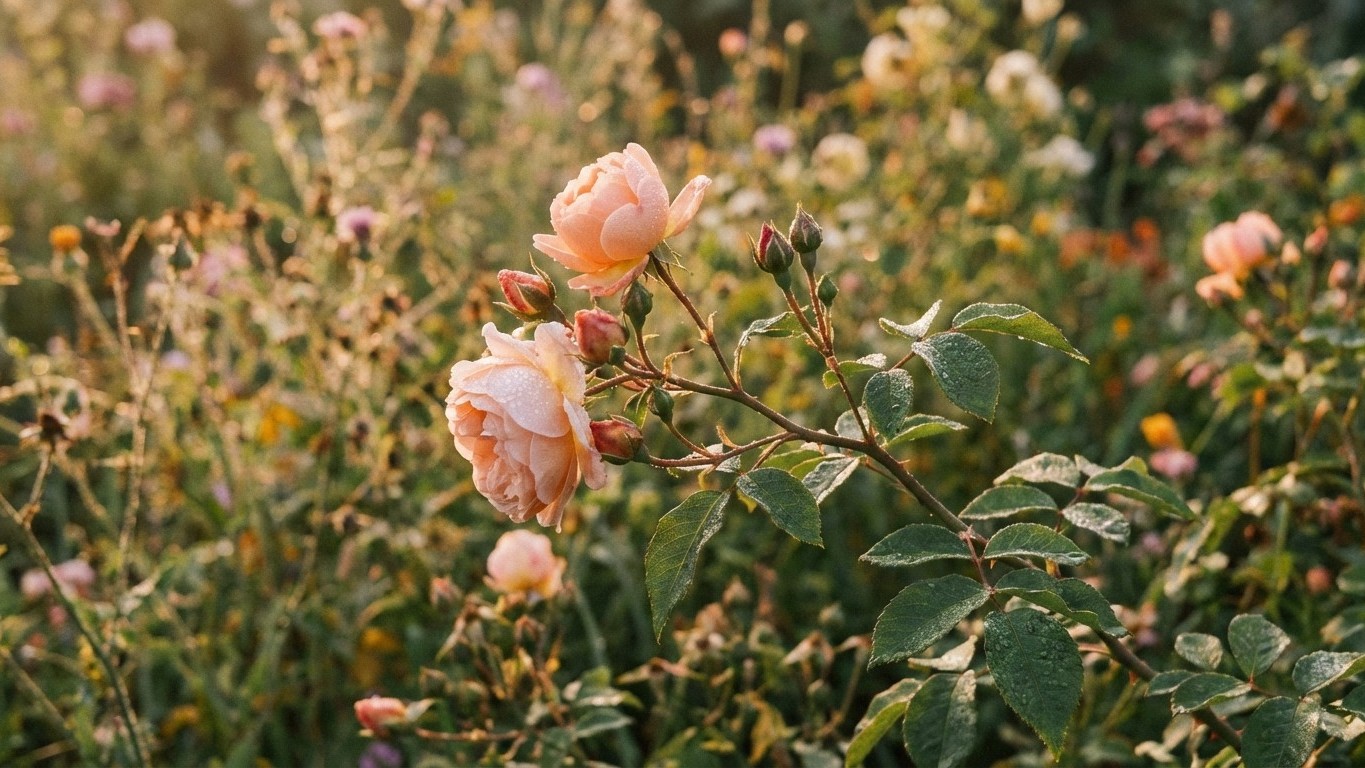

In New York City, roses go into the ground from late March through mid-April, with a second window in early fall. NOAA’s 1991-2020 climate normals for Central Park put the last spring freeze at March 23 to April 3 and the first fall freeze at November 14 to November 27. Those are city dates, not state dates. Upstate and the Adirondacks freeze later in spring and earlier in fall, so treat the numbers below as a template and shift them to match your county. For the broader picture, see How to Grow Roses: The Complete Guide.
When to plant Roses in New York

The dates come from NOAA NCEI U.S. Climate Normals 1991-2020, using the 30-to-70-percent band of 32°F freeze probabilities at Central Park. A band is a window of odds, not a promise. In some years a freeze still shows up after April 3, and in others the last one is long gone by March 23. New York City is a dense urban site that holds heat. Rochester, Syracuse, the Catskills and the Adirondacks all run later in spring and earlier in fall.
Bare-root and container roses
Most gardeners buy roses rather than grow them from seed, and the schedule is simpler. Bare-root roses arrive dormant in late winter or early spring. They can go in as soon as the soil is workable (not frozen, not a swamp), which in New York City means roughly late March into mid-April. Soak the roots overnight in a bucket of water first. Container roses, already leafed out, are safer to plant once the March 23 to April 3 window has closed, because soft new growth is what a late freeze burns.
Fall is the underrated second season. Roots keep growing in cool soil after the tops go quiet, and a rose planted in autumn arrives in spring already settled. The usual rule is to have container roses in the ground about six weeks before the ground freezes. Count back from the November 14 start of the fall freeze window and you land on October 3. Roses planted after that date still usually survive in the city, but they need a thick mulch and more attention to watering. Upstate, subtract weeks from that date, not days.
Starting roses from seed
Seed is the slow route, and it suits species roses and rugosas better than named hybrids, which do not come true from seed. Rose seed needs a cold, damp stretch (stratification) before it will sprout. Gardeners commonly allow 8 to 12 weeks in the refrigerator. Here is the count-back, using ten weeks and a target transplant date of April 10, a week after the end of the city’s freeze window:
- April 10: seedlings go into the garden.
- March 31: start hardening off, ten days of gradually longer outdoor exposure, shade first, then sun, bringing them in on cold nights.
- February 3: sown or sprouted seeds are growing under lights, about eight weeks before hardening off.
- Around November 25: seed goes into damp medium in the refrigerator, ten weeks before February 3.
Germination is erratic, so expect some seedlings to appear weeks after the rest. Upstate, push every date later by the same margin. Seed-grown roses often take a year or two to bloom, which is why most people treat this as a project rather than a plan.
Soil and site preparation
Six hours of direct sun is the minimum, and morning sun is worth more than afternoon sun. Morning light dries dew off the leaves early, which is the single cheapest defense against black spot. A spot with a wall or fence that blocks the wind but doesn’t smother airflow works well. A corner where air sits still all summer does not.
Roses want loamy soil that drains well and holds some moisture, with a pH a little on the acidic side, around 6.0 to 6.5. New York’s soils vary a great deal, from sandy ground on much of Long Island to heavier clay in parts of the Hudson Valley and upstate, and fill soil in city lots. A soil test from your county extension office tells you more than any generalization. Test a few weeks ahead so you can act on the results.
Check drainage before you commit to a spot. Dig a hole about a foot deep, fill it with water, let it drain, then fill it again. If water is still standing after several hours the second time, the site needs a raised bed or a different location. Roses sitting in wet soil rot from the roots up, and no amount of feeding fixes that.
Amendments go in weeks before planting, not on the day. Spread 2 to 3 inches of finished compost over the bed and work it into the top 8 to 12 inches. In clay, compost loosens the structure. In sand, it holds water and nutrients. Skip fresh manure, which burns roots.
Dig each hole roughly twice as wide as the root ball and deep enough that the roots sit without bending. On grafted roses, the graft union (the swollen knuckle where the top meets the rootstock) should sit at or just below soil level in the city, and a few inches below in colder parts of the state, where the extra soil insulates it. Spacing runs about 2 to 3 feet for hybrid teas and floribundas, 3 to 4 feet for shrub roses, and 6 to 8 feet for big climbers. Crowding is the most common mistake, and it leads straight to mildew.
Varieties that suit New York
In New York, the useful traits are cold hardiness, disease resistance and repeat bloom. USDA zones run roughly from 7 in the city to 3 or 4 in the Adirondacks, so a rose rated for zone 6 can be perfectly fine on Long Island and a dead stick in Lake Placid. Humid summers favor black spot and powdery mildew nearly everywhere in the state, which puts disease resistance near the top of any shopping list.
Own-root roses, grown on their own roots rather than grafted, deserve a look for colder zones. If the top freezes to the ground, whatever regrows is still the variety you bought. Grafted roses can revert to the rootstock after a hard winter.
| Variety | Type | Good for | Watch for |
|---|---|---|---|
| Knock Out series | Shrub rose | Repeat bloom, strong disease resistance, low maintenance | Tips may die back in harsh winters; cut back in spring |
| Home Run | Shrub rose | Disease resistance, easy hedges and foundation beds | Little fragrance |
| Hansa, Blanc Double de Coubert | Rugosa | Hardiness, fragrance, hips, tolerance of salt spray near the coast | Can spread by suckers |
| William Baffin, John Cabot | Explorer climbers | Cold hardiness, fences and arbors | Main bloom flush comes early in summer |
| Iceberg | Floribunda | Steady white blooms, widely sold | Black spot in humid summers |
| Peace | Hybrid tea | Classic cut flowers | Needs winter mounding and a black spot plan |
Beginners in the upstate counties should start with rugosas or Explorer climbers, and city gardeners can try almost anything. Hybrid teas are beautiful but demanding, so they work best as a handful in a bed rather than as the whole garden. If you are curious how another climate changes the list, growing roses in Utah (dry, alkaline) and growing roses in Arkansas (hot and humid) make useful contrasts.
What to plant alongside
Companion planting for roses has more folklore than data. The solid part is structure. Low perennials at the base of a rose hide bare lower stems, shade the soil, and give pollinators something to visit. Catmint is a standard choice: it blooms for weeks, tolerates the same sun, and its blue-purple flowers flatter nearly any rose color. Hardy geraniums do a similar job in part shade. Lavender is another popular partner, but it wants lean, dry soil while roses want richer, moister ground. Give it a gap and don’t share a watering schedule.
The neighbors to avoid are the ones that compete. Aggressive spreaders and shallow-rooted groundcovers steal water and nutrients from a rose’s feeder roots, and big trees do the same from farther away. Anything dense enough to block airflow around the canes invites mildew. Don’t plant a new rose in the exact spot where an old one died either. Replant problems, a mix of disease and soil depletion, are well documented, and the fix is a different location or fresh soil replaced across a generous hole.
Watering, feeding and support
Roses want about an inch of water a week during the growing season, delivered slowly and deep. A long soak once or twice a week beats a daily sprinkle, because it pushes roots down where the soil stays cool. Water at the base, in the morning if possible. Wet leaves that stay damp overnight are an open invitation to black spot. Newly planted roses drink more, so check them every few days in their first summer, especially after fall planting.
Mulch is cheap insurance. Two to three inches of shredded bark or wood chips keeps moisture in, holds weeds down and evens out soil temperature. Pull it back a few inches from the canes so it doesn’t hold moisture against the bark. Refresh it in spring after the soil warms.
Feed on a schedule tied to growth, not the calendar alone. Give a balanced rose fertilizer (or compost plus a slow-release product) when new growth is a couple of inches long, and again after the first big flush of bloom. Then stop. Late feeding pushes tender new canes that can’t harden before winter. A sensible cutoff is six to eight weeks before the first fall freeze, which in New York City means about mid-September to early October, counting back from November 14. Upstate, stop earlier.
Pruning is a spring job. In the city, late March to April works, when buds begin to swell. The old rule of waiting for forsythia to bloom is a handy local clock. Remove dead, damaged and crossing wood first. Cut to just above an outward-facing bud so the center stays open. Hybrid teas can be cut hard, to about 12 to 18 inches. Shrub roses need only a light shaping. Once-blooming ramblers and old garden roses flower on last year’s wood, so prune them right after they bloom or you will cut off the show.
Watch for suckers on grafted roses. These are shoots from the rootstock, below the graft union, and they usually have leaves that look different (often seven small leaflets and thinner stems). Follow them to their base and pull them off, rather than clipping them at ground level, or they will return. Climbers need support from the start. Tie canes horizontally or at an angle to a fence or trellis, which encourages flowering along the length of the cane rather than only at the tips.
Common problems

Black spot is the one you will meet. Round black blotches with fringed edges appear on leaves, which then yellow and drop. It is a fungus that thrives on wet foliage and warm, humid weather. Rake and discard fallen leaves, water at the base, give plants room, and choose resistant varieties. A fungicide labeled for roses can slow it, but sprays have to begin early and be repeated.
Powdery mildew looks like white dust on new leaves and buds, and it appears when days are warm and nights are cool and the air is still. Better airflow and morning sun usually reduce it. Leaf distortion, curling or crinkled new growth often points to mildew, herbicide drift from a neighboring lawn, or heavy aphid feeding. Check the undersides of the leaves for clusters of tiny soft-bodied insects, then look for white powder, then think about what was sprayed nearby.
Winter dieback is the classic New York problem. Canes turn brown or black and shrivel after a hard winter. Wait until the plant leafs out in spring, then prune back to green, white-centered wood. If everything died to the ground and the growth that returns is from below the graft, you have lost your variety to the rootstock, which is another argument for hardy, own-root roses.
No blooms usually means too little sun, too much nitrogen (lots of leaves, few flowers), or pruning that removed the buds on a once-blooming rose. Buds that form but never open and turn brown (balling) are common in wet weather on dense, many-petaled varieties. Yellow leaves with green veins suggest an iron or pH problem, which a soil test will confirm.
Unusual red, thorny, distorted growth with a witches’ broom look may be rose rosette disease, which has no cure. If you suspect it, get a diagnosis through your county office before deciding anything.
Pests that actually show up in New York
The Cornell University CALS Insect Diagnostic Laboratory lists ten pests for New York home gardens: apple maggot, Colorado potato beetle, striped cucumber beetle, squash vine borer, cabbage maggot, onion maggot, imported cabbageworm, asparagus beetles, fourlined plant bug and viburnum leaf beetle. That list covers the whole home garden (see Cornell’s insect factsheets), and it is not rose-specific. Most of it belongs to vegetable and fruit beds. Two can reach a rose bed or the yard around it.
Fourlined plant bug. The first thing you notice is small, dark, sunken spots on young leaves, sometimes with a ragged hole where the spot dies and falls out. The culprit is a quick, yellowish-green insect with four black stripes down its back, and the damage is mostly to looks. It feeds on a wide range of garden plants, usually in late spring and early summer. Knock the insects into a bucket of soapy water in the morning, when they are slow, and let the plant regrow.
Striped cucumber beetle. Its reputation comes from squash and cucumbers, but the adults also feed on pollen and petals of other flowering plants, so a rose bed planted near a vegetable patch may get visitors. You see yellow-and-black striped beetles inside open blooms, and chewed, ragged petals. Hand-pick them into soapy water early in the day, before they warm up and fly.
The rest, including apple maggot, Colorado potato beetle, squash vine borer, cabbage maggot, onion maggot, imported cabbageworm and asparagus beetles, are fruit and vegetable problems. Viburnum leaf beetle, which attacks viburnums, is one to watch if your roses share a border with those shrubs. If you can’t tell what is chewing your plants, your county Cooperative Extension office can identify it from a sample or a photo, and pressure varies across the state.
Harvest and end of season
Cut roses in the cool of the morning, when stems are full of water. For long-stemmed varieties, harvest when the bud is showing color and the outer petals are just starting to loosen. Cut at an angle just above a leaf with five leaflets, so the plant sends a new shoot from that point. Put stems straight into a bucket of water, recut them under water, and strip any leaves that would sit below the waterline. Roses don’t ripen after cutting the way fruit does. A bud cut too tight may never open, and a bud cut too late drops its petals quickly in the vase.
Rose hips, the round fruits on rugosas and many species roses, are the one part of the plant that does ripen. Let them turn fully red or orange and pick them after cool nights. They are rich in vitamin C and make decent tea and jelly. To get hips, stop deadheading in late summer.
As fall approaches, stop feeding, ease off on pruning, and clear fallen leaves, especially any with black spot. The first fall freeze in New York City falls between November 14 and November 27, so for the city the main winter job comes right after that. Once the ground begins to freeze, mound 10 to 12 inches of soil or compost over the base of grafted hybrid teas and tender varieties. Leave the canes alone until spring. Upstate and in the Adirondacks the freeze comes earlier, and the mounding should too. Remove the mound gradually in spring as the forsythia begins to bloom.
Local help
Dates and soil vary a lot across New York, from the coast to the Adirondacks. Your county’s Cornell Cooperative Extension office can give you planting dates for your area, identify mystery pests from a sample, and point you toward soil testing. For more state-specific advice, browse our New York guides.
Common questions
Can I plant roses in November in New York?
In New York City, the first fall freeze window runs November 14 to November 27, so November planting is late. Dormant bare-root roses can sometimes go in if the soil is still workable, but container roses do better planted around October 3 or earlier. Upstate, the ground freezes sooner, so skip November.
When should I prune roses in New York?
Late March through April for most roses, when buds begin to swell. In the city, that tracks the March 23 to April 3 freeze window, so watch for hard freezes right after pruning. Prune once-blooming old roses and ramblers right after they flower instead.
Will roses survive upstate New York winters?
Many will, if you pick hardy types. Rugosas and Explorer climbers such as William Baffin and John Cabot are common choices in cold areas. Hybrid teas can survive with winter mounding but may die back. Check your county’s conditions with the extension office.
What is the easiest rose for a beginner?
Disease-resistant shrub roses such as the Knock Out series or Home Run are easy and bloom repeatedly. Rugosas such as Hansa are tough in cold or windy sites. They need less spraying and less fuss than hybrid teas.
How often should I water new roses?
Aim for about an inch a week, applied deeply at the base, and check new plantings every few days during their first summer. Soil that is damp an inch or two down doesn’t need water yet. Soggy soil is as much of a problem as dry soil.