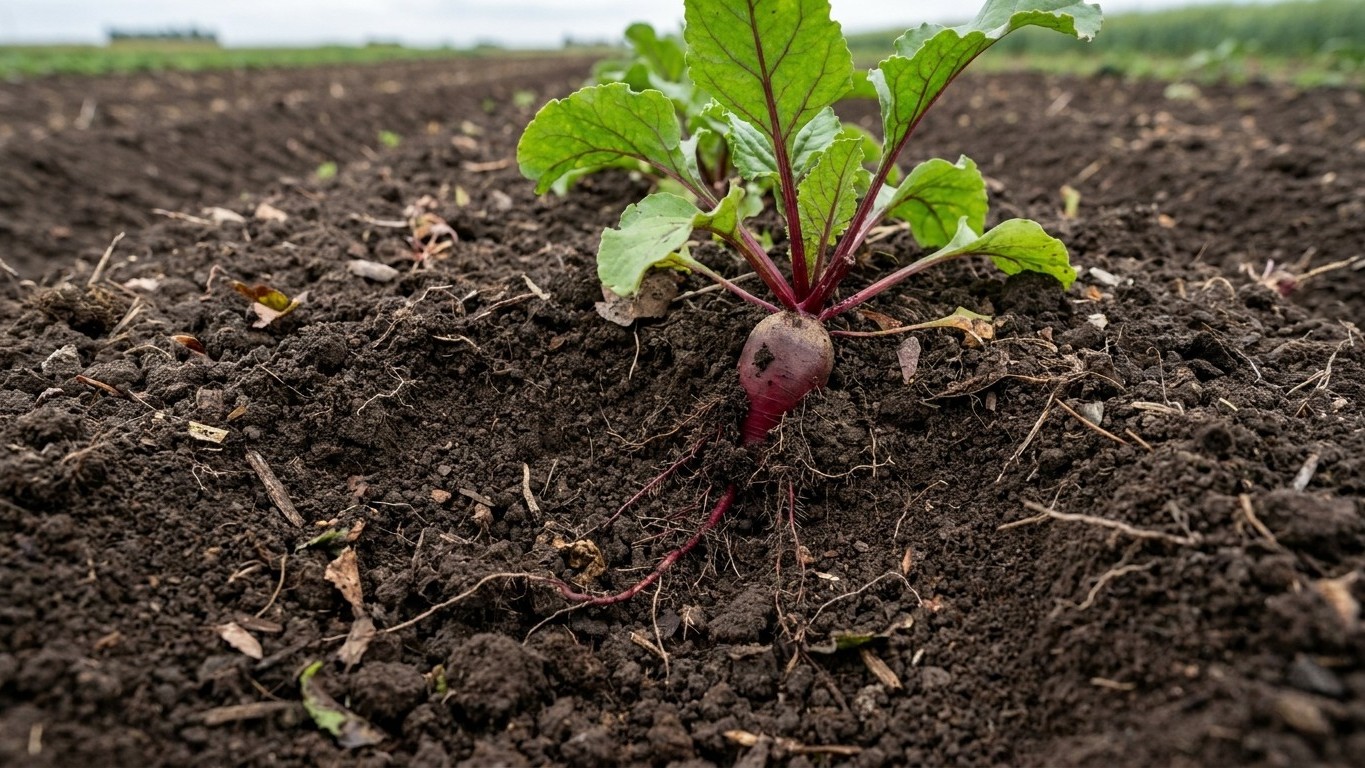

In South Carolina, water and heat do most of the eating, not insects. Thirst in the first six weeks pushes beet plants to flower early. Heat above 85 F combined with water stress makes the root woody. After harvest, black spot and rot take a third cut, and a too-cold refrigerator makes that worse. Insect pests aren’t covered by the verified data behind this page, so it sticks to what soil, weather and storage do to the root. The broader picture lives in Growing Beets in South Carolina.
The short answer
Start with the ground. USDA lists the Bohicket series as South Carolina’s representative soil, and on paper it is nearly the opposite of what a beet asks for. The surface horizon averages 17 percent sand, 35 percent clay and 48 percent silt, which USDA records as heavy clay. It is an Entisol, a very young soil with almost no profile development. It is very poorly drained, with a surface pH of about 7.3 and roughly 15.0 percent organic matter. Those are representative values for the mapped surface of the series (27 components in the USDA NRCS Soil Data Access query). They are not a measurement of a worked garden bed, and they are not your pH.
Utah State University Extension describes the beet’s preference as deep, sandy, well-drained soil rich in organic matter. It also caps compost at no more than 1 inch per 100 square feet. Set that beside 17 percent sand and a very poorly drained rating, and the pattern is clear. Ground like this tends to hold water rather than shed it. A beet root needs to swell evenly, and soggy, dense soil works against that. The near-neutral pH is the one friendly note, and only if your own soil resembles it.
A caution matters here. A state spans hundreds of soil series, and Bohicket is a starting point, not a diagnosis. River bottoms, Piedmont hill country, sandy Coastal Plain lots and any yard a builder has scraped or filled will behave differently. Use the series to understand what the region’s ground tends to do, then take a soil test for your own number. The companion page, Beet Soil in South Carolina: What the Root Will Meet, goes deeper on that.
Heat is the second half of the answer. Charleston is the reference city, using NOAA NCEI climate normals from station USW00013880. How many days a year it passes 90 F is not a figure published in the data behind this page, so I won’t guess at one. What the Extension source does give is a lower threshold: heat above 85 F with water stress makes the root woody. Any day over 90 F clears that bar. So a beet that is still sizing up when the first real warm spell arrives is exposed to woodiness, and in a coastal summer that spell is never far off.
Woodiness and early flowering are separate failures, with different causes and different timing. One comes from thirst in the first six weeks. The other comes from heat later on. The next two sections take them one at a time.
The six weeks that decide it here
Beets are sown in place, so the clock starts at seeding. Harvest comes 60 to 80 days later, and nothing is transplanted. The standard advice is to sow 2 to 3 weeks before the last spring frost. At the Charleston station, the last 32 F freeze falls between February 28 and March 17 (the 30 to 70 percent probability band). That puts sowing roughly between early February and early March, and it puts the first six weeks of the crop’s life in late winter and early spring.
That stretch is where Extension places the bolting risk. Water stress in the first six weeks causes premature flowering, and a beet that flowers early has spent its energy on a seed stalk instead of a root. Spring weather in the state tends to swing. Warm, dry spells can arrive early, rain can come in bursts, and cold snaps can still show up behind them. Those swings matter because the soil does the opposite of what the weather does. A heavy, poorly drained clay holds a downpour, then can set up hard in a dry week. Seedlings in the middle of that cycle get uneven moisture, which is its own kind of stress.
Where you garden shifts all of this. Peninsular Charleston is milder than the airport station. The Upstate runs several weeks tighter at both ends of the season, so a Greenville-area gardener who copies Charleston’s dates will be sowing into frozen ground. Count the six weeks from your own sowing date, not the state’s. The page When to Sow Beets in South Carolina covers that adjustment.
The other failure sits at the back of the schedule. Count 60 to 80 days forward from a late-winter or early-spring seeding, and harvest lands between roughly early April and late May, depending on when you sowed and which end of the range your beets take. That is when heat begins to build. A root that is still in the ground as afternoons pass 85 F, and that is also short of water, is the one that turns woody. Early thirst and late heat are two different problems, and watering well in March does not cancel out a dry, hot May.
What goes wrong here
- Early flowering. This comes from water stress in the first six weeks. Keep the seedbed evenly moist from sowing through week six, and check after any stretch of dry, windy days. A mulch layer helps hold the moisture steady.
- Woody roots. Heat above 85 F paired with water stress is the trigger. Plan to pull beets before the warm stretch, sow so the crop sizes up in cooler weather, and water deeply if heat does arrive. This is a different problem from flowering, so don’t treat the two as one.
- Standing water. A very poorly drained, heavy clay surface keeps beets wet and dense. If a test or the shovel says your bed resembles that, build it up with a raised bed of loose, well-drained mix rather than trying to dig the clay into submission.
- Over-amending. The Extension ceiling is no more than 1 inch of composted organic matter per 100 sq ft. More is not better, and the mapped 15.0 percent organic matter in the state soil is a natural surface layer that a cultivated bed will not have.
- Storing too cold. USDA Handbook 66 says beets held at 32 to 34 F develop more black spot and rot than beets kept a little warmer. The target for topped roots is 33 to 36 F at 98 percent humidity. Colder is not better here, which runs against the advice for most other root crops, so aim for the warmer end of that range.
- Storing them with the tops on. Bunched beets with leaves keep for about 10 to 14 days at 32 F and above 98 percent humidity, and no longer. For longer storage, cut the tops off first.
- Saving the wrong roots. Large roots keep much better than small ones, because they lose water and shrivel more slowly. Eat the small ones first and store the big ones. In a pit or cellar, stay between 31 F and 41 F.
The storage numbers come from USDA Agricultural Handbook 66. It is written for commercial storage, so treat a home refrigerator as an approximation, not a match.
Common questions
Is the Bohicket series the soil in my garden?
Probably not. It is the soil USDA lists as representative of South Carolina, and a state spans hundreds of soil series. Use it as a clue to how the region’s ground tends to behave, then take a soil test for your own bed.
How long from sowing to harvest?
Beets run 60 to 80 days from seeding. They are sown in place, so the count never starts from a transplant. Sowing 2 to 3 weeks before the last frost puts that harvest window in spring, ahead of the worst heat.
Are bolting and woody roots the same problem?
No. Bolting (premature flowering) comes from water stress in the first six weeks. Woodiness comes later, when heat above 85 F combines with water stress. Each needs its own fix, so don’t fold them together as “keep it watered.”
Should I keep beets in the coldest part of the fridge?
No. USDA Handbook 66 gives 33 to 36 F at 98 percent humidity for topped roots and notes more black spot and rot at 32 to 34 F than a little warmer. Top the beets first, keep the big roots for storage, and eat the small ones sooner.