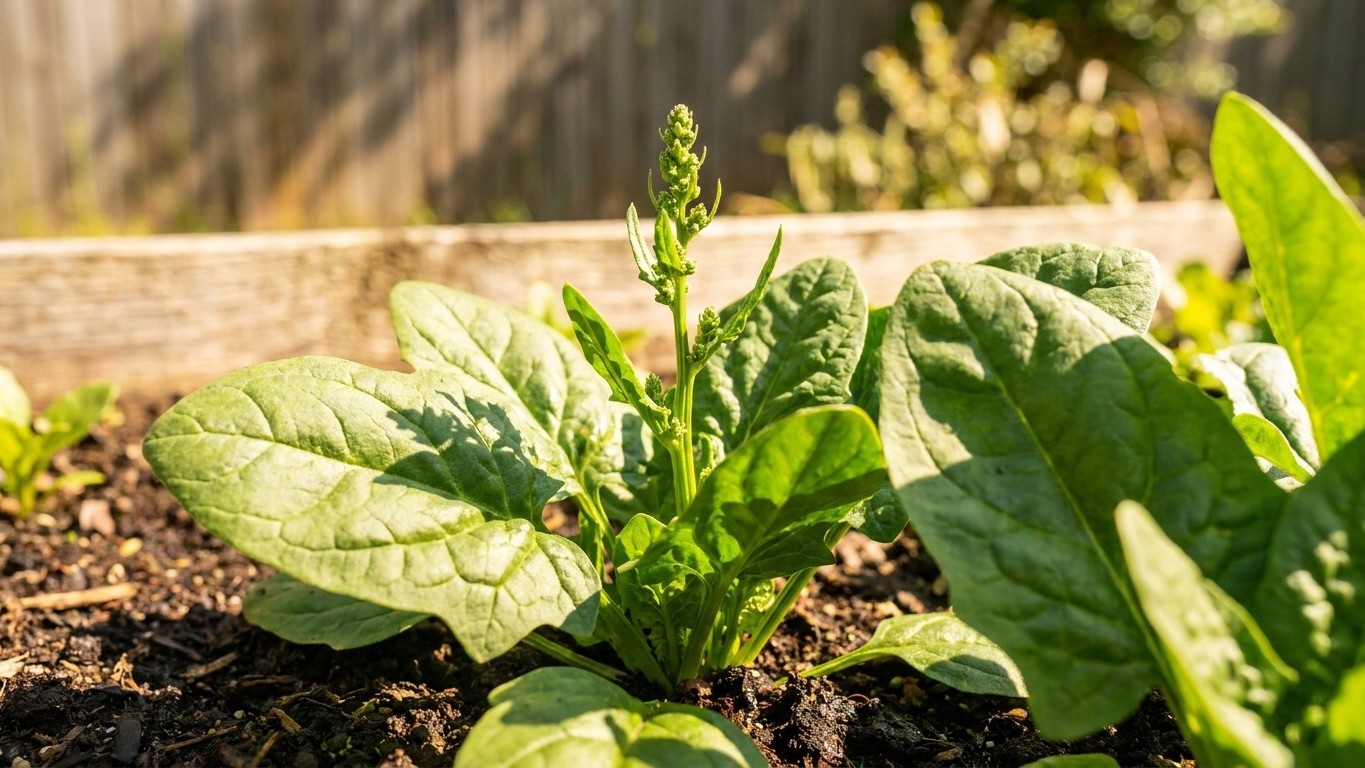

In Massachusetts, the thing that most reliably ends a spinach crop is the calendar, not a critter. The longest day brings 15 h 06 of daylight, long days alone push spinach to flower, and warmth above 75 F stalls growth and turns leaves bitter. That leaves two workable seasons: a short spring run and an autumn crop sown once the soil drops below 80 F. This page covers the timing of both. The verified data behind it carries no pest dates.
The short answer
15 h 06. That is the daylight Boston gets on the longest day of the year, worked out from the latitude of the weather station behind the climate normals. (The figure uses the geometric horizon, so atmospheric refraction adds roughly seven minutes of real light on top.) Spinach reads those long days as a cue to flower. Utah State University Extension is plain about it: spinach bolts during long days and warm temperatures. Long days alone are enough, which means a mild New England summer does not stretch the harvest. A cool July buys nothing, because the plant is counting hours of light, and Massachusetts supplies them generously.
Heat is the second pressure, and it works on a different mechanism. Spinach grows best where temperatures stay at or below 75 F. That same number marks where leaves turn bitter, so one threshold carries two consequences. Boston averages 10.2 days a year at 90 F or more, which sounds like a mild summer heat load. But the ceiling sits 15 degrees lower, so a great many more days cross 75 F than ever touch 90 F. Anyone who has watched a May heat wave turn a bed of tender leaves into a bed of flower stalks has seen the combination at work.
So the limit here is both. Day length sets the point past which the plant wants to reproduce, and heat speeds that along while spoiling the leaves. Day length is fixed by the sky and the same every year. Heat is the variable, and it decides whether a given spring ends gently or abruptly. The practical result is that midsummer is closed to spinach whatever the weather does, and the crop lives in two windows, one in spring and one in autumn. The full picture for the state is in Growing Spinach in Massachusetts, and the flowering mechanism is covered in Will Spinach Bolt Early in Massachusetts?
One more thing to settle early. The extension source names four varieties, Bloomsdale, Melody, Teton and Olympia, and publishes no data on any of them. No claim here about which one holds out longest, because the numbers do not exist in the material this page relies on. And no variety can change the length of a June day.
How long the spring window really is
Spinach is sown 2 to 3 weeks before the last spring frost, and growth stops being good above 75 F. Between those two markers lies the spring crop. Here is how to work out its length in plain steps.
- Find the last frost. At the Boston reference station (Logan, a waterfront urban site), the 30-70% freeze probability band for 32 F runs from April 1 to April 8. Logan is the mildest spot in the state, so inland suburbs and the Berkshires frost later in spring.
- Subtract two to three weeks. On the coast, that puts sowing from about March 11 at the earliest to about March 25 at the latest. Inland, shift the whole range later by however much your own last frost slips past early April.
- Let the crop grow through the cool stretch. The plant is happy while air temperatures stay at or below 75 F. Afternoons in March and April mostly sit under that line.
- Stop counting when afternoons hold above 75 F. The ceiling is a temperature, not a date. The verified figures here give no calendar day for when Boston crosses it, so a thermometer and a forecast are the only reliable guide.
Where does that leave the usable window? The sowing period itself is only about two weeks wide on the coast. The harvest that follows lasts as long as the cool weather does, and that is weeks, not months. The source publishes no days-to-maturity for spinach, so there is no honest way to say how many days from seed to leaf. What can be said is that the runway starts in mid-to-late March and ends with the first run of 75 F afternoons, with the lengthening days pressing on the plant the whole way.
That is why timing beats technique in spring. A gardener who sows in the first week of the window gets the full stretch of cool weather. A gardener who waits for the soil to feel comfortable in mid-April has already spent a good share of the runway, and the plants will be racing the heat from the start. Inland and in the hills, the window is shifted later but squeezed from the same end, since warmth and long days arrive on roughly the same schedule everywhere in the state.
The autumn crop, and when the soil lets you sow
Autumn is the kinder season for spinach in Massachusetts, because days are shortening instead of lengthening. Getting it started is the hard part, and two obstacles stand in the way.
Warm soil blocks the seed
Late summer soil is still hot. Seed germination is reduced when soil is above 80 F, so the window opens when the soil falls, not when the calendar says September. This is the opposite of what most gardeners expect: the autumn sowing is blocked by warmth, not by cold. Seed pressed into a bed that is still baking may sit there or sprout poorly, and the gardener sees thin rows weeks later and blames the seed. A soil thermometer pushed a couple of inches down in the morning tells you more than the date does. Shaded beds and ones watered the day before cool sooner than bare, sun-struck ground. The dates for sowing are worked out in more detail in When to Sow Autumn Spinach in Massachusetts.
Frost ends the season
The other end of the window is the first fall frost. At the Boston reference station, the 30-70% band for 32 F runs from November 3 to November 14. The source advises planting 50 to 75 days before the date you want to harvest, so count back from a realistic harvest date. If you want leaves by November 3, sow between August 20 (75 days) and September 14 (50 days). If the harvest target is November 14, the sowing range becomes August 31 to September 25.
Two cautions on those numbers. First, they come from a waterfront station, and the first frost arrives earlier in inland suburbs and the Berkshires, which pulls the entire sowing range earlier and shrinks it. The verified data here does not include inland frost dates, so use your own local figure and subtract the same 50 to 75 days. Second, the early end of the range, late August, overlaps with the period when soil may still sit above 80 F. In practice, the usable window is the stretch where the count-back dates and cooling soil finally agree, and in a warm year that means the later half of the range, where the days are fewer but the seeds actually come up.
Common questions
What eats spinach in Massachusetts?
The most dependable culprit is the calendar: long days that trigger flowering and heat above 75 F that stalls growth. The verified data behind this page does not include dates or thresholds for insects or animals, so no pest timeline is offered here.
Does a cool summer give me extra weeks of spinach?
No. With 15 h 06 of daylight on the longest day, long days alone are enough to make spinach flower. Cool weather helps leaf quality, but it does not cancel the signal from the light.
Which spinach variety should I choose?
The extension source names Bloomsdale, Melody, Teton and Olympia and publishes no data about any of them. Any claim about bolt resistance or flavor would be invented, so there is no ranking here.
How long does harvested spinach keep?
UC Davis Postharvest describes spinach as highly perishable, with good quality lasting no more than 2 weeks, and only at 32 F with 95-98% relative humidity. Treat that as a ceiling, not a plan. At the 41 to 50 F that a home refrigerator door actually holds, leaves wilt and yellow within days. The back of the bottom shelf is the coldest, most stable spot, so keep it there, not in the door.