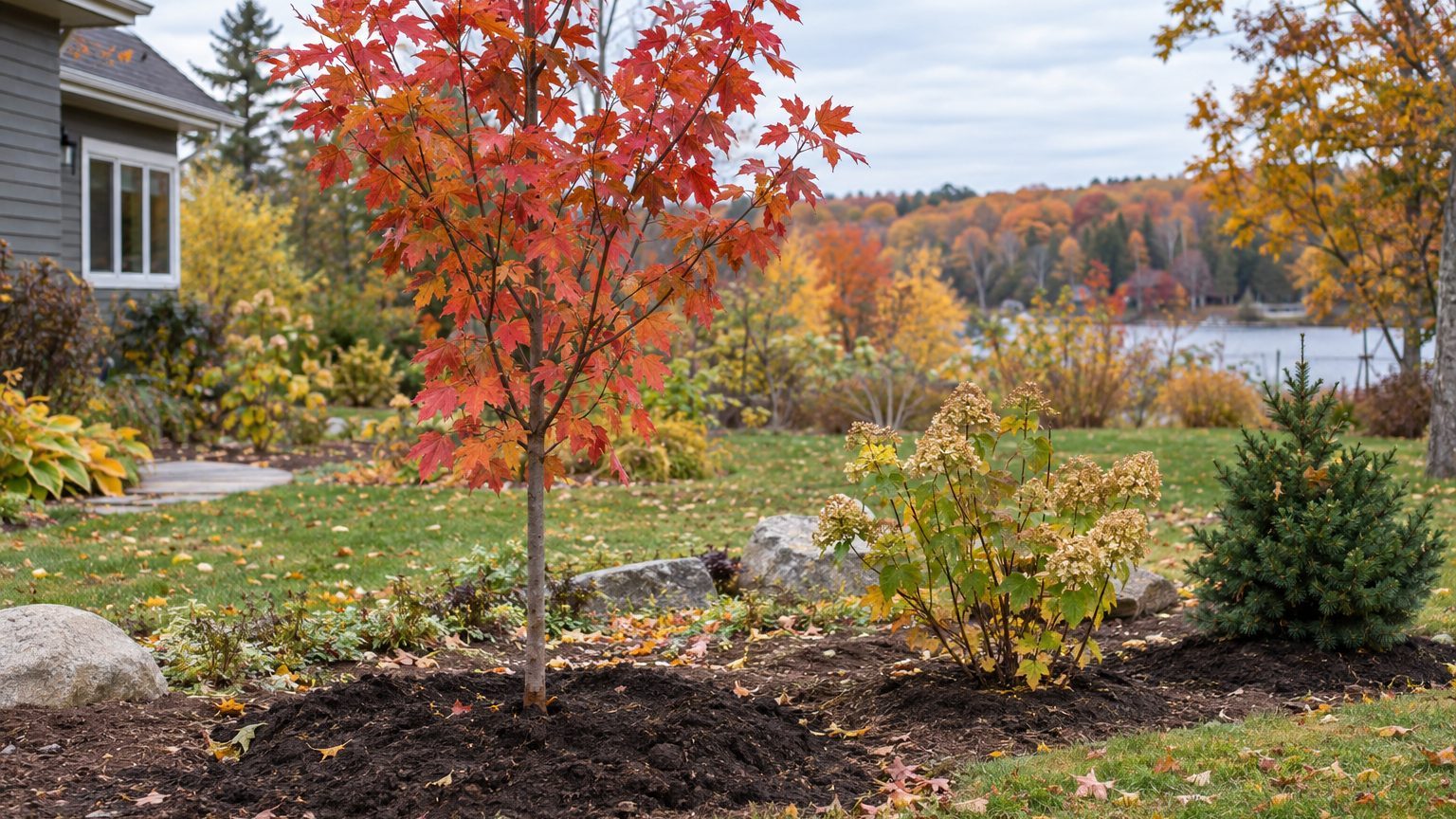

In Houston, the safe target for planting trees and shrubs in fall is October 20 to November 7, which is six weeks before the first fall frost (December 1 to December 19, according to NOAA’s 1991-2020 Climate Normals). After that window the news is still good. The ground there does not freeze, roots keep working through winter, and the cool months are the best planting season. Farther north and in the Panhandle, the first frost comes earlier, and so does your deadline.
The deadline in Texas
Roots do not follow the calendar the way leaves do. They keep growing as long as the soil is workable and above freezing, which is often weeks after the air has turned cold. That lag is why fall planting works at all. While the top of a new tree sits dormant, its roots are pushing into the backfill and the native soil around it. Cornell Cooperative Extension states the rule this way: “Fall is an excellent time for transplanting, provided you get them to their new home at least 6 weeks before the ground freezes, allowing them time to establish roots before winter dormancy.”
That rule counts back from frozen ground, which is a soil condition, not an air temperature. The ground freezes later than the first frost, so counting from first frost builds in a cushion on purpose. For Houston, NOAA’s 1991-2020 Climate Normals at station IAH (Houston Intercontinental) put the first fall frost at December 1 to December 19. Those are the dates when the odds of a 32°F freeze run in the 30 to 70 percent band. Count six weeks back and you get the conservative planting deadline. Write down October 20 to November 7 as the safe target for the Houston area.
| Houston figure | Value | Source |
|---|---|---|
| First fall frost (32°F, 30-70% band) | December 1 to December 19 | NOAA NCEI 1991-2020 Climate Normals, station IAH |
| Conservative fall planting deadline | October 20 to November 7 | Cornell rule counted back from the NOAA frost range |
| Mean daily minimum, coldest month | 43.7°F | NOAA NCEI 1991-2020 Climate Normals, Houston |
The NOAA normals for the IAH station are public if you want to check the numbers yourself.
Where the ground never freezes
The coldest month in Houston has a mean daily minimum of 43.7°F, per NOAA. That is well above 32°F, so the ground in that part of Texas does not freeze. Cornell’s deadline, built around frozen soil, does not apply there. Fall and winter are the best time to plant trees and shrubs on the Gulf end of the state. Roots grow through the mild months, and the plant meets its first summer with a head start instead of a few weeks of settling in. October and November remain the sweet spot because the soil is still warm and the rains tend to return. A tree planted in December or January is not behind schedule.
Everywhere else in Texas
Houston is the mild Gulf end of a very big state. The USDA Plant Hardiness Zone Map 2023 lists Texas as running from zone 6a to zone 10a, and that system is built on a single variable, the average annual extreme minimum temperature. A Houston window is not a Texas planting calendar. The Panhandle freezes far earlier in fall. The Hill Country and North Texas fall somewhere in between, and each differs again. The direction is always the same: the colder your yard, the earlier the first frost and the earlier your deadline.
Look up your own range in First and Last Frost Dates in Texas, count back six weeks, and treat that as your safe target. The true limit, the ground freezing, usually comes later, but there is no reason to gamble on it. More regional detail lives in the Texas guides. Gulf Coast gardeners comparing notes across the state line can read How Late Can You Plant Trees and Shrubs in Fall in Louisiana?
What to plant late, and what to wait on
Hardiness matters more than the date once you are inside the planting window. The 43.7°F coldest-month minimum for Houston is the figure that decides winter survival there, and it is a mild one. Plants rated hardy for the local zone will sail through. The tag on the pot should list a USDA zone (that system, remember, rests on the average annual extreme minimum), and it needs to match or beat your zone. A rating that barely fits is a gamble with a full winter of cold nights ahead.
The safe bets
Container-grown and balled-and-burlapped plants that are fully hardy in your zone are the easiest to establish late. Their root systems come mostly intact, so the plant does not have to rebuild what a bare-root digging would have stripped. Deciduous shade trees, flowering trees, deciduous shrubs and most perennials fit this group. In Houston, where the ground stays workable all winter, they can go in well past the October 20 to November 7 target. In colder parts of Texas, stick to that six-weeks-before-first-frost target for your own area, counted from your local frost range. The basics of digging, backfilling and settling the plant are covered in Planting and Caring for Trees, Shrubs and Perennials.
The plants to hold back
Two groups cause most of the late-planting regrets. The first is borderline plants, the ones rated for the edge of your zone. They need a full growing season of roots before they face a hard night, so hold them until the threat of a freeze has passed. The second is evergreens. They keep their leaves or needles through winter and keep losing water through them, whether on a windy day or during a dry spell. A small root system cannot replace that water fast enough. Broadleaf and needled evergreens are not doomed, but they need more lead time and more watering than a deciduous tree.
| Plant type | Houston area | Colder parts of Texas |
|---|---|---|
| Hardy deciduous trees and shrubs, container or balled | Plant through fall and winter | Plant at least six weeks before the local first fall frost |
| Hardy perennials | Plant through fall and winter | Same six-week target |
| Evergreens | Fine, with steady watering through dry spells | Aim for the early end of the window |
| Borderline-hardy plants | Wait for spring | Wait for spring |
That last row has no exceptions worth the risk. A tender plant that dies in January costs the same as one that dies in July, and a spring planting loses almost nothing.
Watering and mulch until the ground freezes
A new tree in its first winter is not growing, it is building plumbing. Top growth slows or stops while the roots spread, thicken and connect with the surrounding soil. Anything that pushes the plant toward leafy growth, such as heavy fertilizer or hard pruning, works against that. Spend the season on moisture and protection, and let the canopy catch up next year.
Water deeply, then wait
Water slowly enough to soak well below the surface, then let the top of the soil dry a little before the next round. A trowel dug beside the root zone, under the mulch, tells you more than the calendar does. In the colder parts of Texas, keep this up until the ground freezes, because a plant that goes into freeze-up dry is a plant that suffers. In Houston there is no freeze-up, so the routine runs through winter. Fall in Texas is often dry, and rain that does arrive may not reach the roots of a new planting. Check the soil any time a few weeks pass without a soaking rain.
Mulch in a ring, not a volcano
Mulch keeps the soil moisture even and the temperature steadier. The NC State Extension Gardener Handbook (chapter 11, Woody Ornamentals) says: “A 2-inch to 3-inch layer of mulch suppresses most annual weed seeds and makes it easy to hand-pull any that do germinate.” On trees it adds: “Provide a 3-inch layer of mulch to reduce water loss and maintain uniform soil moisture and temperature around roots.” The two sentences have different purposes, weeds and moisture, but they land at the same depth. Spread a 2-inch to 3-inch layer in a wide ring around the planting hole and stop there. More is not better.
Shape matters as much as depth. A ring means the mulch lies flat and wide and leaves a gap around the trunk so the root flare stays visible. A volcano piles mulch against the bark, holds moisture on the trunk and invites rot, along with rodents and insects looking for cover. For the full routine, see Mulching Without Killing the Plant.
What goes wrong
Planting too late for your climate is the first mistake. In colder parts of Texas, a tree planted after the six-week target has less time to root before the ground chills. In Houston the equivalent mistake runs the other way. Waiting until spring leaves the roots only a few weeks before summer heat arrives, and you lose the long, mild stretch that the Gulf Coast offers from October through winter. Both errors come from treating the calendar as a suggestion.
Winter burn is the second. Evergreens lose water through their leaves all winter, and where the ground is frozen the roots cannot take any up. The foliage browns, usually on the windward side. This is a problem for the colder reaches of Texas, such as the Panhandle, where the ground does freeze. It does not describe Houston, where the soil never freezes. The risk there is a dry spell that drains an evergreen with a small root system, so a soaking is the cure.
Heaving is the third. Where soil freezes and thaws repeatedly, a shallow root ball can be pushed upward and exposed to the air. Planting early enough to let roots anchor the tree, plus a steady ring of mulch, prevents most of it. Frost heave is not a Gulf Coast concern at all, since the ground there stays above freezing.
The fourth is drying out in a dry fall. It happens everywhere in Texas and does the most damage because it looks like nothing. The leaves of a dormant tree hide the problem until spring, when buds fail to open. Plant at least six weeks before your local first fall frost, water deeply when rain falls short, and keep a ring of mulch in place.
Common questions
Can I plant trees in Texas in December or January?
In the Houston area, yes. NOAA’s normals show a coldest-month mean daily minimum of 43.7°F, so the ground does not freeze and roots keep growing through winter. In colder parts of the state, the soil may be frozen or too wet to dig, and a tree planted that late has not had its six weeks. If the ground is workable and the plant is fully hardy, a winter planting there is still a calculated risk and not a recommendation.
Does the six-week rule apply across all of Texas?
The logic applies everywhere the ground freezes, but the dates change with the climate. Cornell’s rule counts back from when the ground freezes, and the safe version used here counts six weeks back from the first fall frost, which is the more cautious date. For Houston that produces October 20 to November 7. In the Panhandle, North Texas and the Hill Country, use your local first-frost range and count back from that. Where the ground does not freeze, as in the Houston area, the deadline does not apply.
How deep should mulch be around a newly planted tree?
NC State Extension says to “Provide a 3-inch layer of mulch to reduce water loss and maintain uniform soil moisture and temperature around roots,” and gives a 2-inch to 3-inch layer for weed suppression. Keep it in that range, spread in a ring, and leave a gap at the trunk. Piling it higher or against the bark is how a ring becomes a volcano.
Do the Houston frost dates hold across the whole Houston area?
Not exactly. The December 1 to December 19 range comes from the IAH station, and Hobby airport runs about two weeks milder than IAH. A yard closer to Hobby sits on the warmer side of the range. Treat the IAH dates as the cautious figure, and remember that on that side of the state the planting season is long.