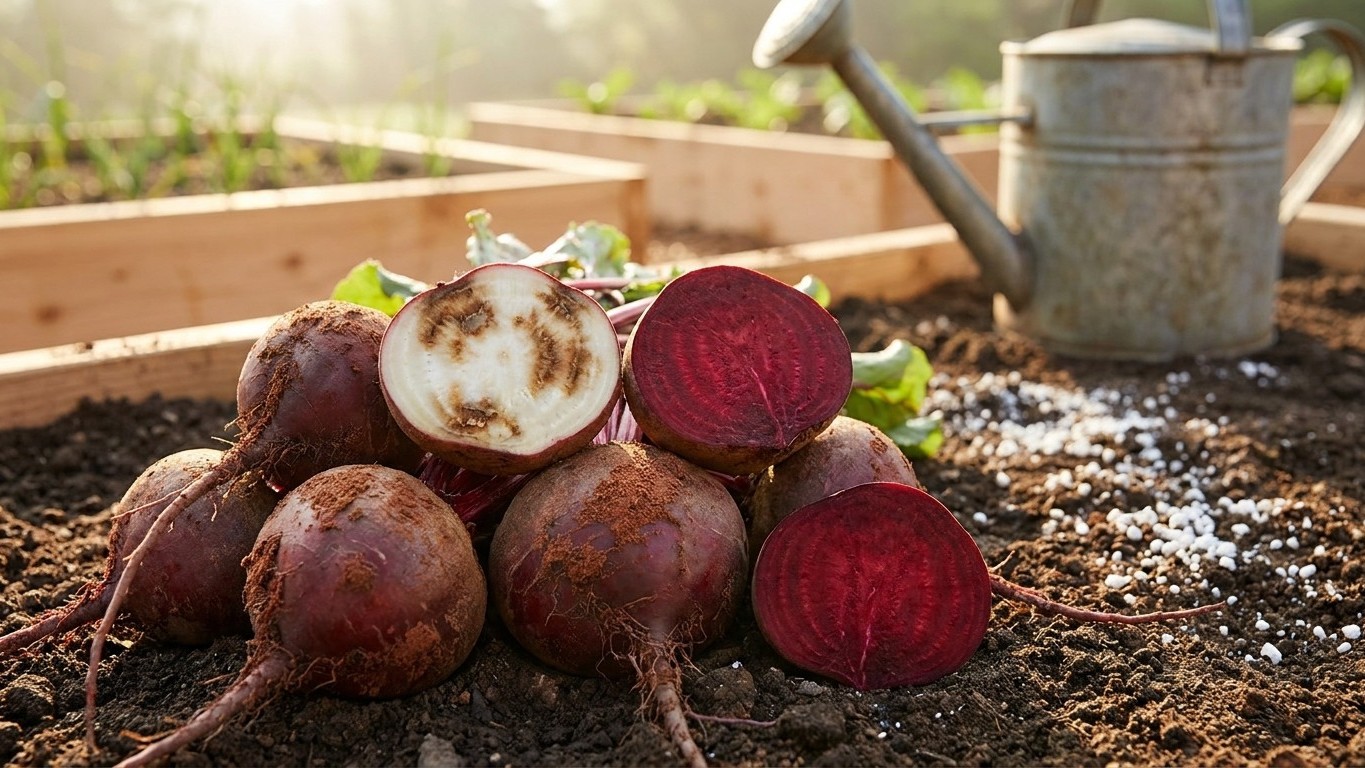

Most of what eats a beet crop in Tennessee isn’t an insect. It’s acid silt that crusts and then holds water, a spring that swings between soggy and dry, and heat that arrives before the roots finish. Two separate failures come out of that weather: bolting from early thirst, and woody roots from later heat. A bug-by-bug calendar isn’t in the verified data behind this page, so none is invented here. What follows is what the ground and the calendar do.
The short answer
Tennessee’s representative soil is the Dickson series, and its numbers read like a list of things beets don’t ask for. USDA records the surface horizon as 11 percent sand, 20 percent clay and 68 percent silt, which makes it a silt loam. Surface pH is about 5.0 (strongly acid), organic matter about 1.5 percent, and drainage is moderately well drained. It’s an Ultisol: an old, heavily weathered, leached soil that is naturally acid and low in nutrients. Those figures are representative surface values from USDA NRCS Soil Data Access, drawn from 115 mapped components of the series.
Now set that against what Utah State University Extension says beets want: deep, sandy, well-drained soil rich in organic matter. Dickson has only 11 percent sand. Its drainage sits a notch below “well.” Its organic matter is thin. Silt packs fine, so a seedbed tends to seal into a crust when a rain is followed by sun, and moderately well drained ground stays wet longer than a sandy bed after a downpour. Low organic matter means little cushion when a dry week lands on a hot one. The same extension source caps compost at no more than 1 inch of composted organic matter per 100 sq ft, so treat that as a ceiling, not a target to chase.
One caution matters more than any number above. A state spans hundreds of soil series, and Dickson is a starting point, not a diagnosis. River bottoms, hill country, and any lot a builder has scraped or filled can differ completely. The figures are USDA’s mapped values for a natural surface layer, not a measurement of a worked garden bed, and the 5.0 is not your pH. Your own number comes from a test, and the Beet Soil in Tennessee: What the Root Will Meet page walks through what the root meets once it goes down.
Then there’s heat. Nashville is the reference city here, and the number of days a year it passes 90 F is not published in the data behind this page, so I won’t guess one. It matters less than it sounds. Utah State’s line for beets is 85 F: heat above that, combined with water stress, makes the root woody. Every 90 F day is already past the line. Woodiness is a late-crop failure, and it has nothing to do with the early-thirst failure described next.
The six weeks that decide it here
Beets are sown in place, so the clock starts at seeding. Utah State’s guidance is that water stress during the first 6 weeks causes premature flowering, which is bolting. Everything about timing in Tennessee follows from where those six weeks land.
The last spring frost, per NOAA NCEI climate normals for the Nashville station, falls between March 31 and April 12. That range is the 30 to 70 percent band for a 32 F freeze, so a freeze after those dates is still possible. Sowing 2 to 3 weeks ahead of that range puts seed in the ground from roughly March 10 to March 29. The first six weeks then run from mid-to-late April into early or mid-May. East Tennessee and the Cumberland Plateau run cooler and later than Nashville, so shift everything there toward April. The When to Sow Beets in Tennessee page works through the dates by region.
What does that stretch of spring usually do? Swing. Tennessee springs tend to alternate between soaking stretches and warm, dry, breezy spells, sometimes within the same fortnight. That swing is the risk. A seedbed on Dickson-type silt that was waterlogged on Monday can be crusted and thirsty by the following weekend, and a seedling that goes dry during those six weeks is the one that bolts. The bolting risk sits in the dry gaps of late April and early May, not in the cold. Rain is no guarantee either, because a crust can shed light showers instead of soaking them up.
Count forward and the heat problem separates itself. At 60 to 80 days from seeding, a mid-March sowing is ready around early May at the soonest, and a late-March sowing could stretch to mid-June. The roots that sized up before the warm weather dodge the woodiness trap. Those still in the ground when days pass 85 F, with the bed drying out, are exposed to it. Early sowing buys time on both ends, and the full picture for the crop is in Growing Beets in Tennessee.
Keep the two failures apart when you plan watering. Early thirst, in the first six weeks, sends the plant to flower. Late heat plus thirst, near harvest, toughens the root. One calls for steady moisture from sowing through mid-May. The other calls for getting roots out of the ground, or keeping them watered, once warm weather settles in.
What goes wrong here
Here is what this soil and this climate tend to do to a beet bed, with the fix for each.
- Crusted seedbed and thin stands. With 68 percent silt, the surface can seal after rain. Keep the top inch evenly moist until seedlings are through, and break up the crust gently if one forms. Don’t bury the bed under compost to fix it: stay within 1 inch per 100 sq ft.
- Bolting. Caused by water stress in the first 6 weeks after seeding. Water on a schedule through late April and early May and don’t wait for a dry spell to announce itself. Sowing earlier does not cure thirst.
- Woody roots. Caused by heat above 85 F combined with water stress, so it shows up late. Time sowing so roots finish before hot weather, and keep the bed evenly watered if they don’t.
- Wet feet in a slow bed. Moderately well drained ground holds water after heavy spring rain. Raise the bed or choose the best-draining spot, and test your own drainage instead of assuming Dickson’s.
- Acid, low-nutrient ground. The representative surface pH is about 5.0 and organic matter about 1.5 percent. A soil test gives your pH and a lime recommendation; the beet pH range isn’t in the verified data here, so follow the test report.
- Storage spoilage. Cold is not better. USDA Handbook 66 reports more black spot and rot at 32 to 34 F than a little warmer, and puts topped roots at 33 to 36 F and 98% relative humidity. Top them first: bunched beets with leaves last only 10 to 14 days.
The storage rule runs against what most root crops want, so it’s worth pausing on. Keep the big roots for the long haul, because large roots lose water and shrivel more slowly. Eat the small ones first. For pits and cellars, the handbook says to stay between 31 F and 41 F, never colder or warmer.
Common questions
Is my garden soil the same as the Dickson series?
Probably not exactly. Tennessee has hundreds of soil series, and Dickson is the one USDA lists as representative. Use it as a hint about how the region’s ground tends to behave (acid, silty, slow to drain) and run a soil test for your real numbers.
How long from sowing to harvest?
Sixty to eighty days, counted from seeding. Beets are sown in place, so no transplant date resets the count. Seed sown 2 to 3 weeks before the last frost, which is roughly March 10 to March 29 around Nashville, finishes between early May and mid-June.
Is colder always better for storing beets?
No. USDA Handbook 66 says 32 to 34 F produces more black spot and rot than slightly warmer storage. Aim for 33 to 36 F at 98% relative humidity for topped roots.
Which beets should I store and which should I eat first?
Store the big roots and eat the small ones first, because small roots shrivel faster. Remove the tops before storing: with leaves attached, beets keep only 10 to 14 days.