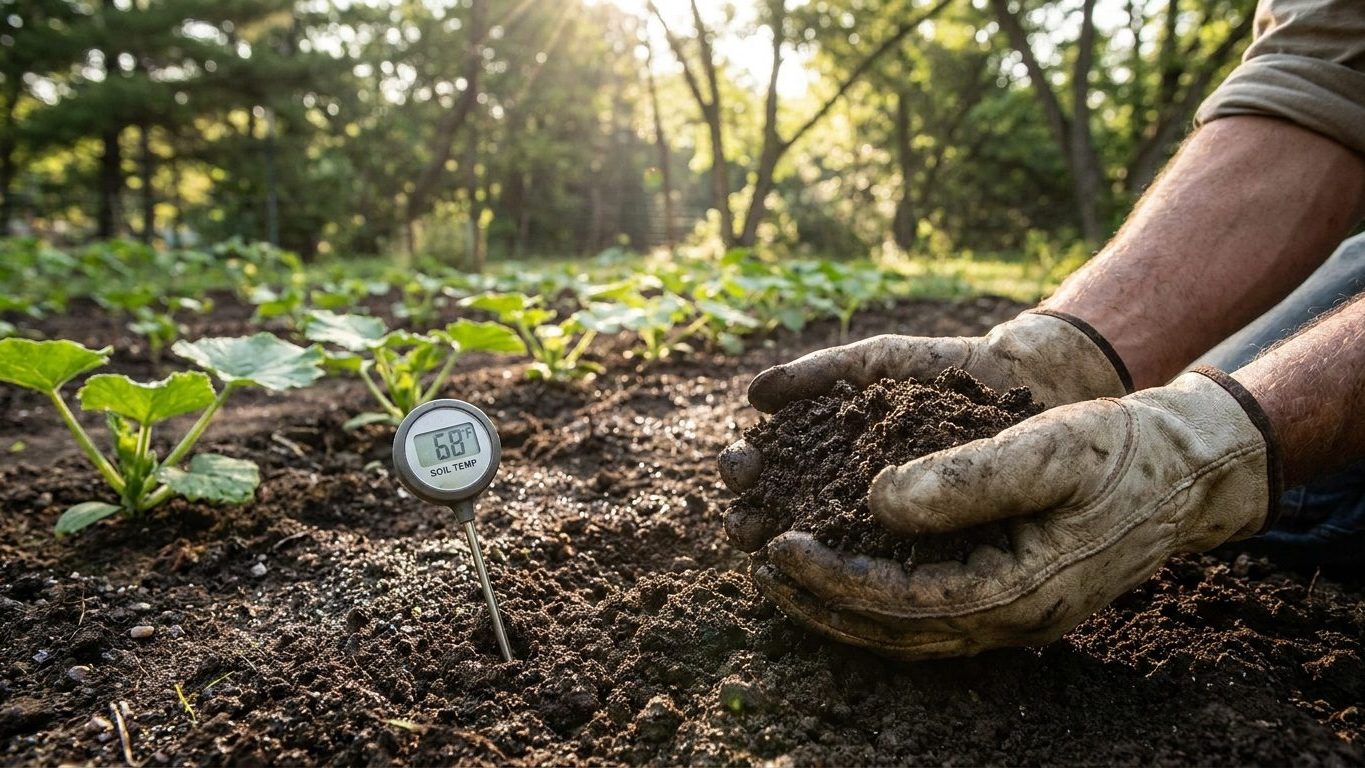

West Virginia’s short answer: sow winter squash directly in the garden between late May and mid-June, after soil has warmed well past the last spring frost window of April 9 to April 23. That start date is not the whole story, though, because the variety you pick and the elevation you garden at both push that window in different directions.
The short answer for West Virginia
The April 9-23 last-frost window comes from NOAA’s 1991-2020 Climate Normals at the Charleston reference station, and it is a probability band, not a guarantee. It marks the 30% to 70% chance of a 32°F freeze on any given day in that stretch. In practice that means gardeners in the Kanawha Valley can reasonably expect to be past frost risk by the end of April, but a cold snap inside that window is still common enough that seed companies and county agents both tell you to wait.
Winter squash seed does not germinate well in cold soil. Soil needs to sit near 60°F before the seed will sprout with any vigor, and that threshold usually arrives two to three weeks after the last frost date, not on it. Counting from an April 23 last frost, that puts realistic direct-seeding starting around mid-May at the earliest, and most West Virginia gardeners land closer to the last week of May through mid-June once they account for a cool spring.
The other half of the calculation runs backward from fall. Charleston’s first fall frost falls between October 18 and November 1. Winter squash needs anywhere from 85 days for an early acorn type to well over 100 days for a large hubbard or a long-storage butternut. Using the earlier end of that fall frost window as the safer target, here is how the math shapes the planting calendar:
| Maturity class | Typical days to maturity | Latest safe sow date (using Oct 18 frost) | Recommended sow window |
|---|---|---|---|
| Early (acorn, delicata types) | ~85 days | Late July | Late May to late June |
| Mid-season (butternut types) | ~95-100 days | Mid-July | Late May to mid-June |
| Long-season (hubbard, large storage types) | ~110+ days | Late June | Late May to first week of June |
That table is math from the facts on hand, not a guarantee for every yard. It does explain why a mid-June planting works fine for an acorn squash but leaves almost no margin for a hubbard.
What will not work here
Planting a long-season type in July is the single most common mistake, and it is a math problem before it is a gardening problem. A 110-day hubbard sown on July 10 needs frost to hold off until late October, and West Virginia’s first fall frost can arrive as early as October 18. That squash is racing a calendar it is likely to lose, especially at elevation where frost tends to come sooner than it does in the river valleys.
August is the other trap, and it is a heat and moisture problem rather than a timing one. The reference station averages just 3.75 inches of rain in August, against 4.72 in June and 5.38 in July. Layer that on top of 16 days a year that hit 90°F or hotter, and you get exactly the stretch when squash vines are setting fruit and need steady soil moisture the most. A gardener watering once a week through August, on the theory that West Virginia summers are humid enough to coast, is watering into a dry month at the worst possible time. Winter squash roots run shallow enough that a week without rain during fruit set can abort blossoms outright.
Tight spacing is the third failure point, and it runs the opposite direction from the heat problem. Total summer rainfall across June, July and August still adds up to about 13.8 inches, and that moisture combined with West Virginia’s humid air keeps foliage damp longer after a rain or a dew than it would in a drier climate. Vining winter squash planted at the tight spacing that works in an arid state holds moisture in the leaf canopy and invites powdery mildew and downy mildew well before the fruit finishes sizing up. Wider spacing than the seed packet suggests, and better airflow between rows, matters more here than it does in a drier state with the same frost dates.
What changes across West Virginia
USDA places West Virginia across hardiness zones 5a to 7a, a two-zone spread built entirely on average annual extreme minimum winter temperature. That is a wide range packed into one state, and it means there is no single planting date that fits both ends of it. A garden at the warmer end of that range behaves close to what the Charleston numbers describe. A garden at the colder end is working with a shorter frost-free season on both sides of summer, an earlier fall frost, and a spring that warms later.
The practical shift for a reader gardening at higher elevation or further from a river valley is to treat every date in this article as an outer edge, not a target. If the Charleston-based window says mid-June for a long-season squash, a colder pocket of the state should be finishing that planting closer to late May, and should lean toward the early-maturing end of the table above rather than the long-season end, simply because there is less season on offer.
This page cannot tell an individual reader which of those zones they garden in, because that depends on the specific county and often the specific hillside. What it can say is that the spread is real, it is documented on the USDA Plant Hardiness Zone Map, and it is worth five minutes to check before locking in a planting date based on Charleston alone.
Where to check this for your own county
West Virginia University’s Extension Service, at extension.wvu.edu, is the source built to close the gap this page cannot close. County agents work from local frost records and local trial results, not a single reference station covering the whole state.
Two things are worth looking for once there. The first is a county-level or regional planting calendar, if one is published for the area in question, since it will reflect local frost timing than the statewide Charleston normals used here. The second is any list of winter squash varieties that WVU or a county office has actually trialled in West Virginia conditions. Variety trial results carry more weight than a maturity-day number printed on a seed packet, because they account for how a squash performs under the state’s actual humidity and rainfall pattern rather than under ideal conditions.
A county recommendation beats a state one every time, for a simple reason: it was built closer to the garden it is meant to serve. This page works from statewide and single-station data because that is what exists at this level. A county extension office often has narrower, more current numbers, and when the two disagree, the county number should win.
Checking this against your own garden
None of the dates above beat what the garden itself is showing on a given year, and three signs are worth checking by hand before trusting a calendar.
Soil warmth by feel is the first and most direct. Push a finger a couple of inches into the planting bed in the morning. If it feels cool rather than cold, roughly the temperature of a basement floor, the soil is likely close to the 60°F mark seed needs to germinate reliably. If it still feels cold to the touch, wait, regardless of what the calendar says.
The first flush of male flowers is the second signal, and it tells you the plant has shifted into reproductive growth. Male flowers open first and in larger numbers, days ahead of the females that will actually set fruit. Their appearance is a sign the plant considers conditions warm enough to commit resources to blooming, which is useful information about the specific microclimate of that bed.
The first true leaves, the ones that follow the two rounded seed leaves and actually look like squash foliage, mark the point where the seedling has moved past its most fragile stage. A garden where true leaves show up quickly after emergence is running warmer and faster than the state averages suggest. One where they lag by a week or more is running cooler, and that is worth factoring into the fall side of the calendar too.