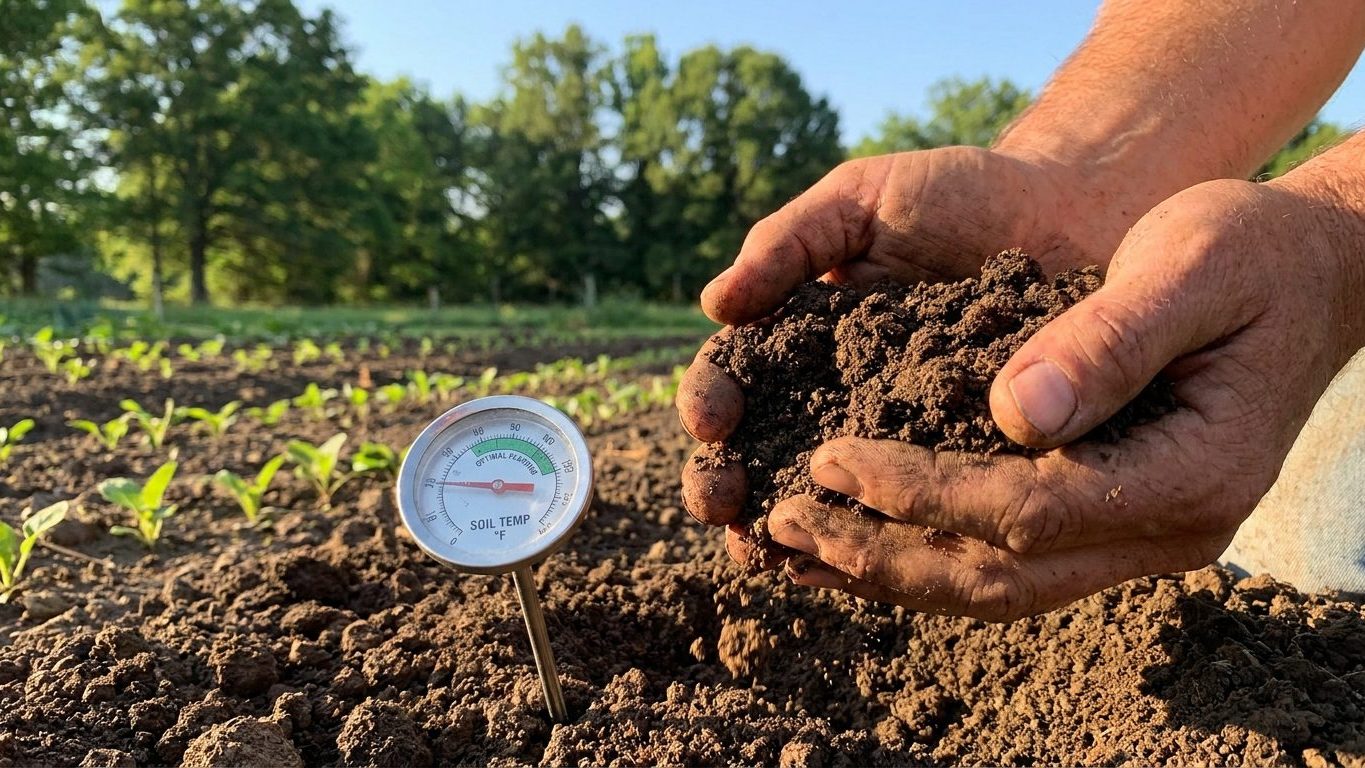

West Virginia gardeners can start winter squash outdoors once the soil has warmed past 60°F, generally through the second half of May at lower elevations and into early June higher up. That’s later than the last frost date because squash roots stall in cold ground even when the air feels safe.
When the soil is warm enough in West Virginia

The number gardeners usually chase first is the last spring frost. For the Charleston reference station (USW00013866), NOAA’s 1991-2020 Climate Normals put the 32°F freeze probability window between April 9 and April 23. That’s a 30-70% probability band, not a guarantee, and it’s worth sitting with that for a second: even at the safest end of the range, there’s still real risk of a freeze slipping past it in a cooler-than-normal spring.
But frost is a proxy, and a rough one at that for winter squash. What actually matters is soil temperature, and soil lags behind air temperature by weeks. A morning with no frost risk can still have ground in the low 50s, and squash seed sown into that kind of cold, damp soil either rots or sits dormant while weeds get a head start. Winter squash wants soil consistently above 60°F, ideally pushing toward 65-70°F, before seed goes in or transplants go out.
That gap between “frost is over” and “soil is warm enough” typically runs two to four weeks past the last frost date in this region. In practice, that means most of the state isn’t planting Winter Squash in early or mid-April even though the frost table might suggest the window is opening. Late April into May, checking soil with a simple probe thermometer rather than trusting the calendar, is the more reliable approach.
Elevation changes the math
The Charleston station sits in a river valley, and the NOAA data explicitly flags that as a caution: valley floors warm faster and stay milder than the ridges and higher plateaus found across much of West Virginia. A garden at 2,500 feet in the eastern highlands can run a week or two behind Charleston’s numbers on both ends of the season, spring and fall. If you’re gardening at elevation, treat the April 9-23 window as an optimistic estimate for your soil, not a working assumption.
The state’s hardiness range, 5a to 7a under the USDA Plant Hardiness Zone Map (built on the 1991-2020 average annual extreme minimum temperature), reflects that same spread. A grower in a 5a pocket is working with a meaningfully shorter frost-free stretch than one in a 7a valley, even though both are technically “West Virginia.” Local knowledge, or a call to the county extension office, closes that gap better than any statewide date range can.
How long the season lasts here
Put the two frost dates together and you get the outline of the growing window. Last spring frost falls between April 9 and April 23; first fall frost falls between October 18 and November 1, both from the same Charleston station and the same NOAA Climate Normals dataset. Taken at their least generous (frost lingers to April 23, returns by October 18) that’s roughly 178 frost-free days. Taken at their most generous (frost clears by April 9, holds off until November 1) it stretches closer to 206 days. Most seasons will land somewhere inside that range.
That’s a genuinely long window by squash standards, and it changes what’s worth attempting. Winter squash types typically need somewhere in the neighborhood of three to three-and-a-half months from seed to a mature, cured fruit, depending on type. Even at the shorter end of West Virginia’s frost-free range, there’s real slack after a single sowing finishes, which opens the door to a second planting for gardeners who want to stagger harvest or hedge against a failed first attempt.
What the extra weeks are actually good for
A second sowing isn’t about squeezing in more total squash so much as insurance and timing control. If early plants get hit by a squash vine borer or a wet stretch encourages disease, a later-started planting gives a second shot at a full harvest before the fall frost dates arrive. It also lets a gardener time the harvest to avoid dumping every squash on the porch in the same two-week stretch.
The tradeoff is root disturbance. Winter squash doesn’t love transplanting, since its roots are sensitive to being disturbed, so a second round is usually better direct-seeded rather than started indoors and moved. Anyone weighing whether to transplant at all, and how to do it with minimal shock when it makes sense, should check the site’s succession sowing guide for the specifics on timing a second round within a frost-free window like this one.
Heat and water in West Virginia

Winter squash is unforgiving about one thing above all else: the fruit has to mature and start curing on the vine before frost shuts things down. An immature squash pulled ahead of schedule won’t cure properly in storage and won’t keep, no matter how carefully it’s handled afterward. That makes season length the single biggest variable in this state, and it’s why the frost-date math above matters more for squash than for a crop you can pick half-grown.
On the heat side, West Virginia isn’t pushing plants hard. The Charleston reference station averages just 16.0 days a year at or above 90°F, per NOAA’s 1991-2020 Climate Normals. That’s a modest heat load compared to the Deep South or the desert Southwest, and it means winter squash here rarely faces the kind of sustained heat stress that stalls pollination or scorches fruit. Irrigation to fight evaporation isn’t the state’s defining challenge the way it would be in a hotter, drier territory.
Water tells a different story, and it’s the one that deserves more attention here. Summer rainfall averages about 13.8 inches across June, July and August at the same station, broken down as 4.72 inches in June, 5.38 in July, and 3.75 in August, the driest of the three months. That’s a fairly wet summer by national standards, and it comes with a real downside for squash: extended leaf wetness and humidity are exactly the conditions that favor powdery mildew and downy mildew, two of the most common problems winter squash growers run into in this part of the country.
The practical response isn’t more water, it’s better airflow and drier foliage. Spacing plants generously, avoiding overhead watering in favor of soil-level irrigation, and watering in the morning so leaves dry by evening all reduce the window of leaf wetness that mildew needs to take hold. August’s lower rainfall (3.75 inches against June’s 4.72) also means the tail end of the season, right when fruit is sizing up and starting to cure, can turn drier than the earlier summer, so a rain gauge on the actual plot is worth more than the seasonal average for deciding whether supplemental watering is needed during fruit fill.
Which winter squash suit West Virginia
None of this points to a single named variety, and that’s deliberate. Cultivar performance shifts year to year and county to county based on local disease pressure, soil, and microclimate, and a name that does well in one part of the state can underperform thirty miles away at a different elevation. What the facts above do support is a way of narrowing the field by type before ever looking at a seed catalog.
The state’s frost-free window, running roughly 178 to 206 days depending on where in the range your local frost dates fall, comfortably covers earlier-maturing squash types and leaves room for slower-maturing ones in the milder valley locations. Gardeners at higher elevations, closer to the 5a end of the state’s 5a-7a hardiness range, are better served leaning toward earlier types, since their effective frost-free window runs shorter than the Charleston reference numbers suggest.
The humidity and summer rainfall covered above make disease resistance, particularly to powdery mildew, the first thing worth checking when comparing squash types, ahead of size or shape. Types and varieties bred or selected for mildew tolerance carry a real advantage in a state that averages nearly 14 inches of summer rain. Airflow-friendly growth habits matter too, since dense, sprawling vines trap the moisture that fuels disease in a humid state like this one.
The one recommendation that actually means something here comes from West Virginia University Extension Service, which trials squash varieties under the state’s own soils, elevations, and disease pressure. That’s information this page simply doesn’t have and can’t responsibly guess at. Reasoning from type, then checking with extension for the specific varieties performing well in your county, beats picking a name off a seed rack every time.