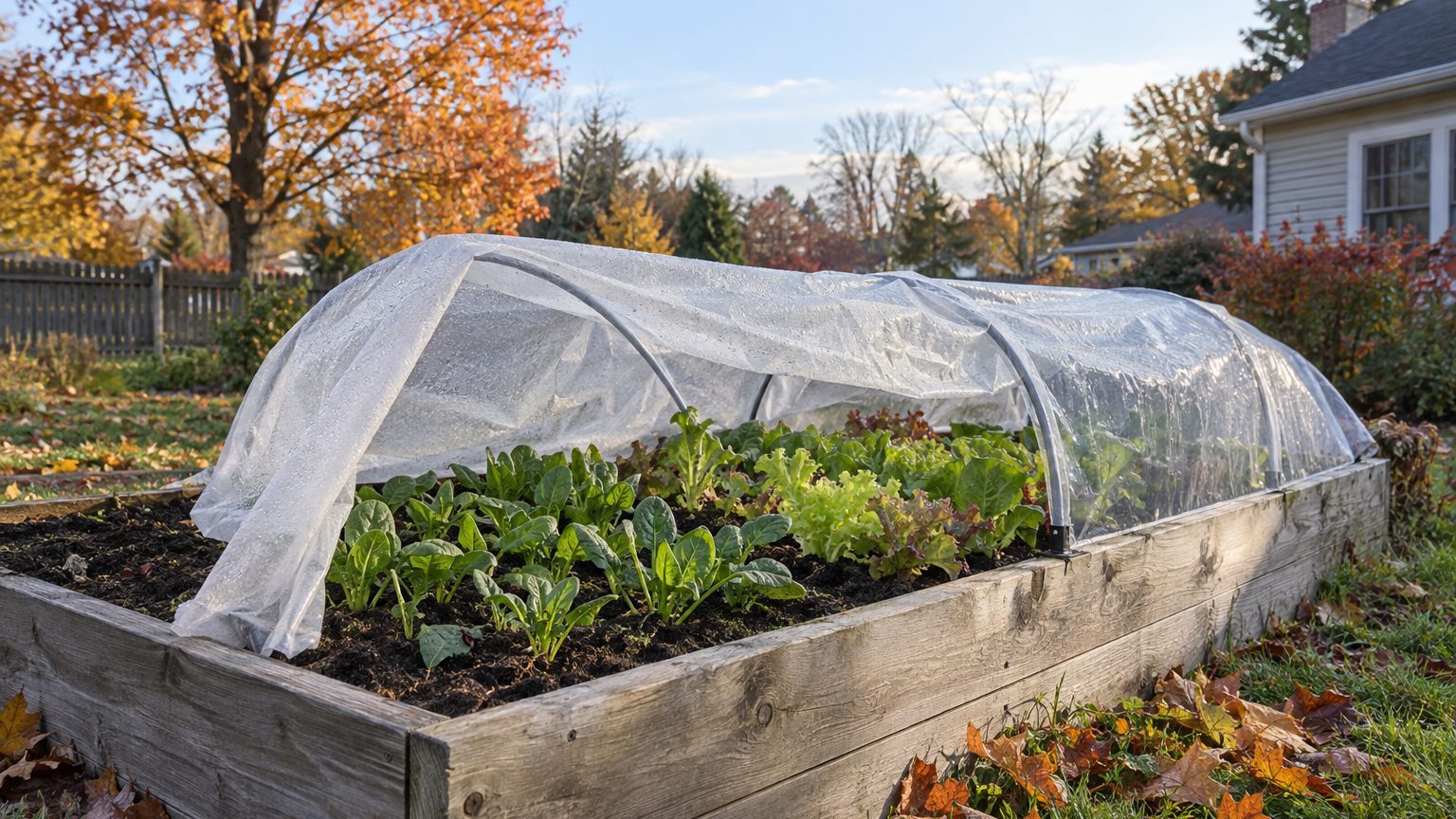

In Houston, the 30-70% probability band for the last 32°F freeze runs from February 4 to March 1, and a cover lets you plant ahead of that band, not through it. Those dates come from the mild Gulf end of a state where USDA zones run from 6a to 10a. Treat this page as a Houston case study, then check your own county before you sow anything.
When the soil is warm enough in Texas
The date most gardeners want is the last spring frost, and for Houston the NOAA NCEI 1991-2020 Climate Normals put it between February 4 and March 1. That range comes from station USW00012960 at Bush Intercontinental (IAH) and covers the 30-70% probability band for a 32°F freeze. A frost date is a probability, not a promise: in any given year the last freeze can land on either side of that window.
Frost is also only a proxy. Warm-season crops such as tomatoes, peppers and beans wait for warm soil, and soil warms after the frost risk ends, not with it. Air can flip from freezing to mild in a day. A bed holding winter’s chill takes weeks to catch up, and seeds sown into cold, wet ground tend to sit, rot or stall. Pushing a transplant into that ground early means its roots stay cold even when the leaves are comfortable.
This is where covers earn their place. During the day, bare soil absorbs sunlight and stores it. At night that heat radiates back out, and a cover over the bed slows its escape by holding still air close to the ground. A second layer, such as fabric laid inside a hoop structure, adds another pocket of trapped air. The gain is real but variable. It depends on the material, the night, the wind, and whether the soil was warm to begin with. A calm, clear night after a sunny day behaves very differently from a windy one after three gray days.
A cover shifts the limit. It does not remove it. Nothing here makes a crop frost-proof, and a gardener who believes otherwise can lose an entire bed on one clear, still night when the temperature drops well below what the forecast suggested. Treat any cover as a margin of safety for a close call, not as permission to ignore the forecast.
Ventilation matters just as much on the other side. A closed cold frame or tunnel in spring sun can cook its contents within an hour, and Texas sun does not need much encouragement. Open it on any sunny morning, even a cool one, and close it again in the late afternoon. Keep everything passive: no heaters, lamps or candles inside a covered structure, because the fire and carbon monoxide risks are real.
One caution on geography. Within Houston itself, Hobby airport runs about two weeks milder than IAH. Move north to the Hill Country or North Texas and the dates shift later, and in the Panhandle they shift a great deal further. If you garden outside the Gulf Coast, do not borrow the Houston dates. Take your local frost dates, then watch the soil, and use a simple soil thermometer rather than the calendar to decide when to plant.
How long the season lasts here
The same NOAA station gives the other end of the window. The first fall freeze falls between December 1 and December 19, again in the 30-70% probability band. With both dates from the same source, the subtraction is honest. The shortest frost-free stretch runs from March 1 to December 1, which is 275 days. The longest runs from February 4 to December 19, which is 318 days.
| Pairing | Last spring freeze | First fall freeze | Frost-free days |
|---|---|---|---|
| Shortest window | March 1 | December 1 | 275 |
| Longest window | February 4 | December 19 | 318 |
Those figures describe Houston IAH, not Texas. Houston is the mild Gulf end of the state, and a gardener in the Panhandle may count a window far shorter than 275 days. Use this table to see how the arithmetic works, then redo it with your own dates.
What does a window that long allow? Mostly a second chance. With roughly nine to ten frost-free months, a first sowing is no longer the only sowing. You can plant beans in spring, pull them, and sow again for fall. You can stagger lettuce and carrots every few weeks instead of betting on one date. You can sow a cool-season crop in autumn and harvest through a winter that rarely stops growth for long. A failed first attempt, whether from a late cold snap or a washed-out seedbed, costs you two weeks rather than a year.
The window also changes the transplanting question. In a short-season climate, transplants are often the only way to get a crop to maturity, so the root disturbance is a price worth paying. Where the window is this generous, direct sowing becomes a real option for crops that dislike root disturbance, such as carrots, beets and beans. A transplant checked at the root takes days to recover, and in a long season you can simply sow again instead of nursing a sulking seedling.
That said, a long window is not a uniform one. Summer heat can close it for cool-season crops long before the frost-free count runs out, a point the next section picks up. For the mechanics of staggering sowings, see the succession sowing guide in this site’s Extending the Season: What a Cover Buys, and What It Cannot section. Readers curious how another Gulf state compares can read Extending the Growing Season in Louisiana, and those who want a mid-Atlantic contrast can try Extending the Growing Season in Maryland.
Heat and water in Texas
This page does not carry a verified count of days above 90°F or a summer rainfall total for the reference station, so it gives you none. A figure from memory would only mislead. What the verified record does show is the cold side, and it is what decides whether a cover is worth building.
The mean daily minimum of the coldest month at the Houston reference station is 43.7°F, from the NOAA NCEI 1991-2020 Climate Normals. That is an average, not a floor. A mean minimum in the mid-40s sits comfortably above freezing, but individual cold fronts push well below the average on single nights, which is exactly why the freeze probabilities above exist. For most winters in Houston, a light fabric laid over the bed is a reasonable match for a typical night. Only on the nights when a hard front arrives does a framed structure, with the fabric supported off the foliage and a second layer inside, become the safer choice. Check the forecast, not the average.
Light is the quieter governing fact. Houston sits at 29.98 degrees north, the latitude of station USW00012960. At that latitude winter daylight stays strong enough that hardy greens keep growing under cover instead of merely surviving. Further north, the date when daylight falls below the growing threshold arrives early in the autumn, and after it a cover only holds a crop alive rather than growing it. Here that pause is shallow and short. Day length also drives bulb crops: onions read the lengthening days as a signal to stop making leaves and start making a bulb, so a variety suited to southern day lengths matters far more than a cover does. That figure belongs to Houston, and a gardener near the northern or southern edge of the state should check their own latitude, because a large state spans several degrees.
Heat still deserves respect, even without a station count to quote. Houston summers are hot and humid, and the same warmth that makes the season long also shortens the cool-season window at both ends. Lettuce bolts, spinach stalls, and brassicas set poor heads once the nights stay warm. A cover in this climate is therefore a spring and fall tool for warm-season crops and a shade tool in summer, not a winter-only one. Humidity adds its own trouble: fungal disease, mildew and rot all travel easily through wet foliage, so airflow and spacing matter as much as warmth. Any closed structure must be opened whenever the sun is out, both to keep the crop from cooking and to keep damp air from sitting on the leaves.
Which season extension suit Texas
Choose by type, not by cultivar. For this territory, the facts point in three directions at once.
- A long season means you do not need the very earliest types. Choose reliable mid-season ones and use the extra months for a second sowing.
- A hot season favors types given airflow and shade at the root, such as mulched beds, open-sided shade cloth and crops that tolerate heat when set.
- A humid season makes disease resistance the first criterion, ahead of yield or flavor, because a susceptible type in wet air can fail before it produces.
On the structure side, a light fabric draped directly over the bed suits the mild nights Houston usually sees. A framed structure suits the cold-front nights, and it must be ventilated every sunny day without exception. A closed frame in spring sun cooks its crop in about an hour. All of it stays passive. No heating device belongs inside, whether a heater, lamp or candle, and no cover makes a crop frost-proof. It shifts the limit by an amount that varies from night to night.
This page names no varieties, on purpose. Texas spans USDA hardiness zones from 6a to 10a, a range built on a single variable, the average annual extreme minimum temperature, according to the USDA Plant Hardiness Zone Map 2023. A tomato that thrives near the Gulf can fail in the Panhandle, and a bulb onion that suits one latitude forms poorly at another. The only recommendation that means anything comes from varieties trialled locally, and this page does not have those results. Refusing to guess is the correct answer, not a gap.
Your best next step is Texas A&M AgriLife Extension, which can point you to your county office, local frost dates and the types that have performed in your soil. Bring your zip code, and ask for trial results rather than catalog claims.
Common questions
When is the last spring frost in Texas?
It depends on where you are. For Houston, measured at station IAH, the 30-70% probability band for the last 32°F freeze is February 4 to March 1. The Panhandle, North Texas and the Hill Country all differ, so use local dates for your county.
How long is the growing season in Houston?
Pairing the freeze dates at station IAH gives 275 frost-free days at the shortest (March 1 to December 1) and 318 at the longest (February 4 to December 19). These are probabilities, not guarantees, and they apply to Houston rather than the whole state.
Can a cover make plants frost-proof?
No. A cover traps heat radiating from the soil and holds still air near the plants, and the gain is real but variable. It shifts the limit without removing it, so a hard freeze can still kill a covered bed.
Do I need to open a cold frame on sunny days?
Yes, every time. A closed frame in spring sun can cook its contents in about an hour, and in humid Texas air a shut structure also encourages disease. Vent it in the morning and close it again in the late afternoon.