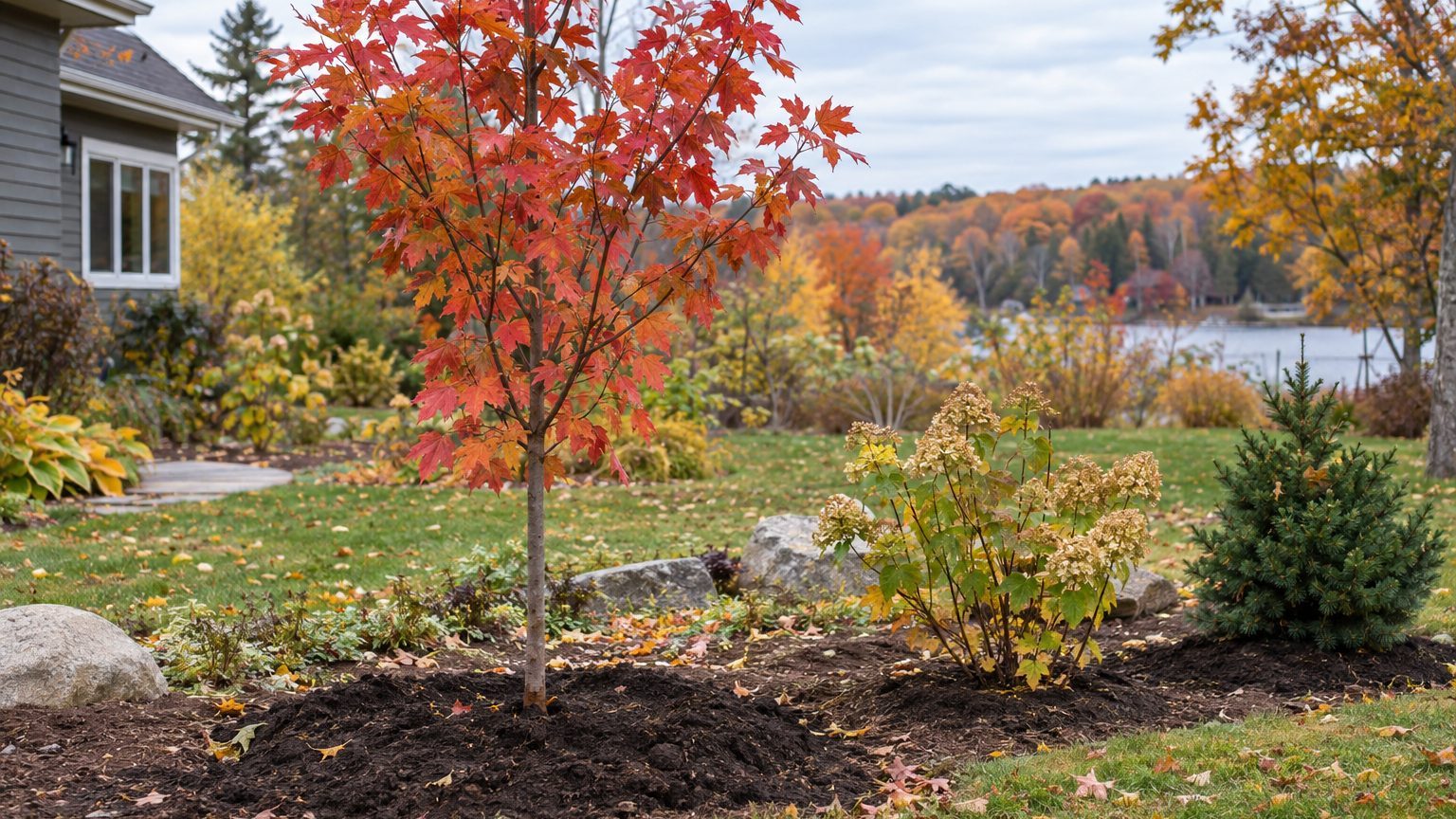

On Prince Edward Island, the conservative deadline for planting trees and shrubs in fall is September 5, six weeks before the first fall frost, which averages October 17 at Charlottetown. Planting after that date isn’t doomed. Roots keep working in cool soil, and hardy container or balled stock can still go in with care. But the margin shrinks week by week, and evergreens and borderline plants deserve the early slot or a spring start.
The deadline in Prince Edward Island
Air temperature gets the attention, but roots follow the soil. A tree or shrub keeps pushing out new roots as long as the ground is workable and above freezing, which can be weeks after the leaves have dropped and the mornings have turned sharp. Cornell Cooperative Extension puts the rule this way: “Fall is an excellent time for transplanting, provided you get them to their new home at least 6 weeks before the ground freezes, allowing them time to establish roots before winter dormancy.”
That rule counts back from frozen ground, not from the first frost. Ground freezes later than the air does, so a calendar built on the first frost errs on the side of caution. For Prince Edward Island, the reading comes from Environment and Climate Change Canada’s Canadian Climate Normals for 1981-2010, station Charlottetown A, which put the first fall frost on average at October 17. Count six weeks back and you land on September 5. For a safe plan, get trees and shrubs in the ground by September 5, and treat that as the target rather than the cutoff.
Reading the frost date as a window
October 17 is a mean, not a promise. In about one year out of two the first frost falls later than that, and in the other years it comes earlier, so the date is the midpoint of a window and never a guaranteed safe day. A gardener who plants on the “average” date is betting on a coin flip. The full spread of dates is laid out in First and Last Frost Dates in Prince Edward Island.
Location shifts the window too. The Charlottetown station describes one climate, and a province is never just one. Northern and upland districts run weeks behind it, which means a later spring and, more to the point here, an earlier first fall frost. A gardener in one of those colder pockets should move the September 5 target earlier, not later.
Why the ground will freeze here
In some milder regions the ground barely freezes, and fall and even winter are the best planting seasons. Prince Edward Island is not one of them. The mean daily minimum of the coldest month at Charlottetown is -12.1 °C (10.3 °F), according to the same Environment and Climate Change Canada normals. That is a hard, lasting freeze. The six-week rule applies in full across the island, and the real limit, the day frost locks the soil, will arrive eventually every winter.
Neighbors on the mainland work with a similar calendar but their own frost dates, so compare notes with How Late Can You Plant Trees and Shrubs in Fall in New Brunswick? if you garden on both sides of the Northumberland Strait.
What to plant late, and what to wait on
Hardiness decides who gets a late slot. Natural Resources Canada’s Plant Hardiness Site places Charlottetown in Canadian hardiness zone 5b (1991-2020 normals). That is a Canadian zone, built from seven climate variables, and it does not convert to a USDA zone. NRCan itself says there are no simple conversions between the two systems. So a nursery tag that gives a USDA number can’t be read straight against a Canadian zone, and it pays to check which system a label uses.
Plants rated fully hardy for zone 5b conditions, and sold in containers or balled and burlapped, are the safest bets after the early-September target has passed. A container plant keeps its root system intact, so it has little to recover from. A balled plant carries a good chunk of its own soil. Both can settle in and push roots through cool soil even as the air drops toward freezing.
| Type of plant | Late-fall planting | Reason |
|---|---|---|
| Deciduous trees and shrubs, container-grown, hardy in zone 5b | Good, with the target date in mind | Roots undisturbed; leaves already shed, so little water loss |
| Balled and burlapped, hardy in zone 5b | Good if planted early enough | Carries its own soil; needs time to anchor before the freeze |
| Needled and broadleaf evergreens | Risky late | Foliage keeps losing water all winter while roots can’t replace it |
| Plants at the edge of their hardiness | Wait for spring | A new, shallow root system has no reserve against a hard winter |
Evergreens are the real trouble. A maple drops its leaves and shuts down. A spruce, boxwood or rhododendron keeps its foliage, and the foliage keeps transpiring on wind and sun, even in January. A newly planted evergreen has a small root system in cold or frozen soil, and the water it loses can’t be replaced. Better to plant them right at the early end of the window, with the target above as the limit.
Borderline plants face the same problem from a different side. A shrub that survives a mild winter at the edge of its range may be killed outright by a winter with a mean coldest-month minimum of -12.1 °C if its roots haven’t had time to settle. For those, wait for spring planting rather than gambling on a late fall. Spring planting is not a consolation prize. It gives the plant a whole growing season to root before its first winter. For the technique itself, from hole width to planting depth, see Planting and Caring for Trees, Shrubs and Perennials.
Watering and mulch until the ground freezes
The first winter is about roots, not growth. A tree planted in fall isn’t expected to put on height or bloom. Its job is to anchor itself and extend roots into the surrounding soil, and the leaves, if it still has any, are mostly a distraction from that work. Everything you do after planting should protect that quiet underground effort.
Water deeply until freeze-up
Roots can only grow into moist soil, and a plant going into winter with dry roots is a plant under stress before the cold even starts. Water slowly and deeply after planting, so moisture reaches the whole root ball and the soil just beyond it, and keep doing it through a dry fall. Light, frequent sprinkles wet only the surface and encourage shallow roots. A slow soak on a schedule that follows the weather is better than a fixed routine. After a long dry spell, a deep watering is worth the effort even in November. Keep it up until the ground actually freezes, which is the same limit that sets the planting deadline.
Mulch: a ring, not a volcano
Mulch is the other half of the job. NC State Extension, in its Extension Gardener Handbook chapter on woody ornamentals, states: “A 2-inch to 3-inch layer of mulch suppresses most annual weed seeds and makes it easy to hand-pull any that do germinate.” And on trees specifically: “Provide a 3-inch layer of mulch to reduce water loss and maintain uniform soil moisture and temperature around roots.” The two sentences have different purposes, weeds and moisture, but they point to the same depth. Keep the mulch to that 2-inch to 3-inch range.
Spread it in a wide ring around the plant, not heaped against the trunk. A volcano of mulch holds moisture against the bark, which invites rot, and it gives rodents a sheltered place to chew. Leave the base of the trunk, where it flares out, visible and clear. More mulch is not better. Past the recommended depth, you are building a volcano, not protecting roots. The details of materials and placement are in Mulching Without Killing the Plant.
What goes wrong
Most late-planting failures come from a short list of causes, and every one of them is avoidable.
Too late for the climate
The most common problem is simple timing. A plant that goes in when the soil is already nearly frozen has no time to anchor. It sits in the ground with a root system built for a nursery pot, and the first cold snap reaches it before it has grown out of the root ball. Once frost has arrived (October 17 on average, earlier in northern and upland districts), treat any new planting as a gamble, and for anything borderline, wait for spring.
Winter burn and heaving
Evergreens that go in too late show winter burn: brown, scorched-looking needles or leaves by late winter. The cause is water loss from foliage while the frozen soil can’t supply any, and open, windy sites make it worse. Shallow root balls can also heave. Repeated freezing and thawing pushes the soil up and can lift a small, new root ball partly out of the ground, exposing roots to air and cold. Planting at the right depth, firming the soil around the root ball, and mulching to even out soil temperature all reduce the risk.
A dry fall
A dry autumn is the quietest failure of all. Nothing looks wrong until spring, when a plant fails to leaf out because its roots went into winter without enough water. Check the soil before the freeze, not just the weather forecast. For more seasonal timing across the province, see the Prince Edward Island guides.
Common questions
Can I still plant trees in October on Prince Edward Island?
You can, but it is a gamble that gets worse as the month goes on. The average first fall frost at Charlottetown is October 17, and in about one year out of two it comes later. A container-grown deciduous tree hardy in Canadian zone 5b has the best chance. Evergreens and borderline plants should wait for spring.
Does the six-week rule count from the first frost or from frozen ground?
Cornell Cooperative Extension counts six weeks back from when the ground freezes. The September 5 target here uses the first fall frost instead, which arrives earlier, so it is the conservative version. The true limit falls later, when the ground actually freezes, and it comes earlier in colder districts.
Does the Charlottetown frost date apply across the whole island?
No. It comes from the Charlottetown A station and describes that climate. Northern and upland districts run weeks behind it, with an earlier first fall frost, so the planting target should move earlier there.
Is Canadian zone 5b the same as USDA zone 5b?
No. Natural Resources Canada says there are no simple conversions between the two systems. The Canadian system uses seven climate variables and the USDA system uses one, and NRCan notes that Canadian zone 4a overlaps nine USDA zones, from 3a to 7a. The two systems also use different periods: Canadian frost normals here cover 1981-2010, and the Canadian zone uses 1991-2020 normals.