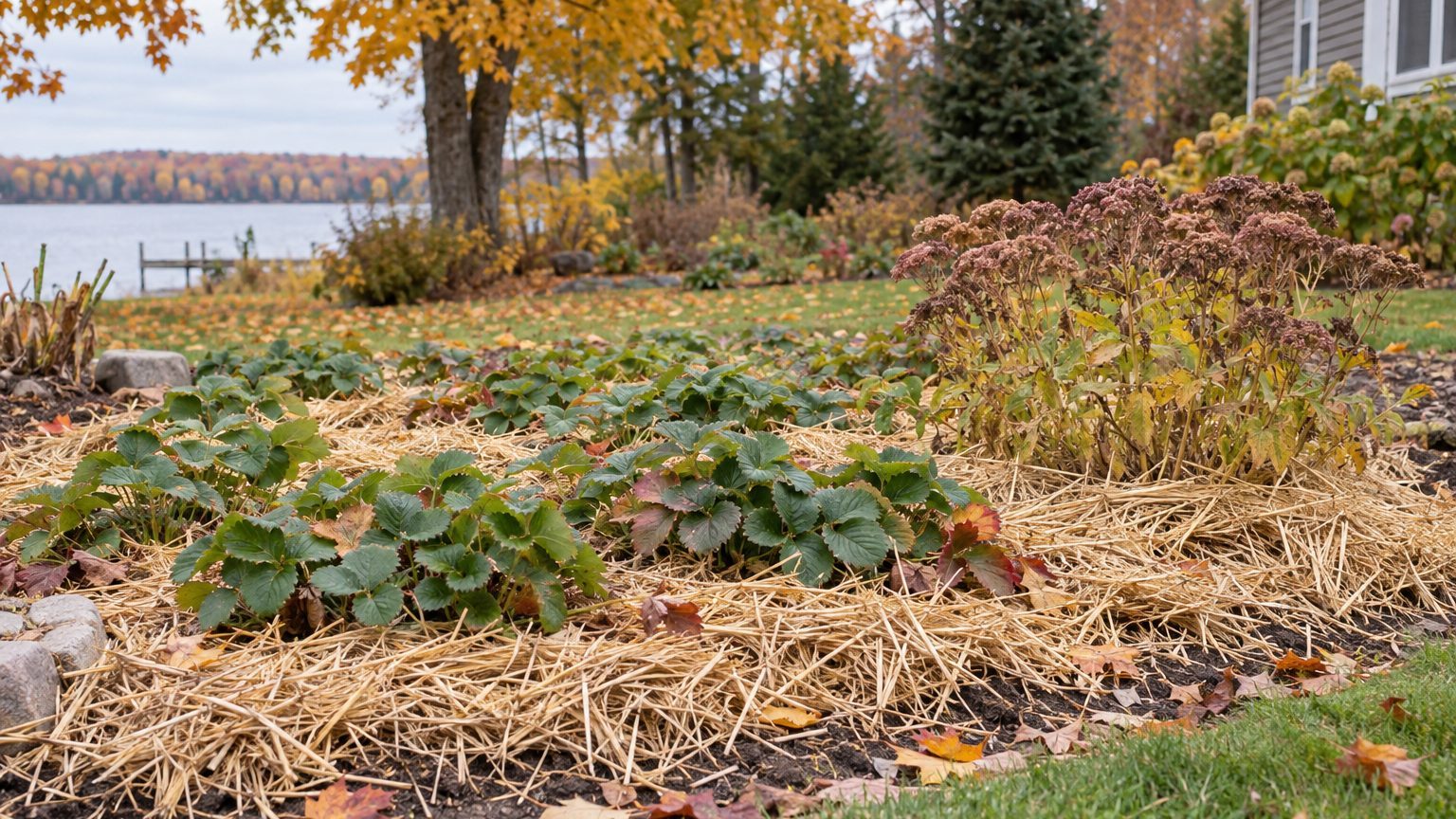

Wait for the freeze. In Bridgeport, NOAA’s 1991-2020 Climate Normals put the first 32°F freeze (the 30-70% probability band) between October 28 and November 10. Winter mulch for strawberries and perennials goes down after the ground starts to freeze, not before. Inland and northwest Connecticut freeze earlier, so the window opens earlier there too. Mulch spread on warm soil protects nothing, and it gives voles a head start and keeps moisture against crowns that are still alive. As of mid-October, nothing needs covering yet.
When to put winter mulch down in Connecticut
Mulch keeps the soil frozen, not warm
Winter mulch does not add heat. A blanket of straw or shredded leaves works the way a cooler works in summer: it slows temperature swings. The real enemy of a strawberry crown or a young perennial is not the deep cold itself. It is the cycle of freeze, thaw, freeze, which expands and contracts the soil and pushes shallow roots up out of the ground. Mulch laid after the soil has frozen holds it that way through the January thaws.
The ground does freeze here, even on the coast. NOAA’s 1991-2020 normals for the Bridgeport station show a mean daily minimum of 24.4°F in the coldest month. Bridgeport sits on Long Island Sound and is the mildest corner of Connecticut, so anything colder than that figure describes the rest of the state. Connecticut spans USDA hardiness zones 6a-7b in the 2023 USDA Plant Hardiness Zone Map. That system is built on the average annual extreme minimum, which is why the coast and the northwest hills end up in such different places.
Reading the date for your own yard
A first frost and a frozen soil are different events. The first 32°F night blackens basil and zinnias, but the soil underneath is still warm and holds summer’s heat for weeks. Strawberry plants use those cool nights to harden off, shifting from growth into dormancy. Covering them during that stretch interrupts the process. At Bridgeport, mulch after the October 28 to November 10 freeze window has passed and the soil surface has started to stiffen, which means a crust that is still hard in the afternoon after a run of hard-freeze nights.
A trowel is the best calendar you own. If it slides in easily and the soil is soft and dark, hold off. If you meet a stiff crust that stays stiff through the day, go ahead.
Move the whole schedule earlier as you go north or uphill. A colder part of the state has an earlier first fall frost, so fall chores like mulching shift earlier there, not later. A gardener in the northwest hills may be spreading straw while a Fairfield County neighbor is still waiting for the ground to firm up. The First and Last Frost Dates in Connecticut page gives the local picture, and the other Connecticut guides cover seasonal timing by region. For the technique itself, Mulching Without Killing the Plant covers the common mistakes.
Strawberries
Why crowns need covering
A strawberry plant carries its growing point, the crown, right at the soil surface. Nothing protects it. Where a shrub has bark and thick wood, the crown has only a short stem and a few buds, and those buds become next June’s flowers. Two things injure it over a Connecticut winter. Frost heave lifts the plant, snapping fine roots and leaving the crown exposed to drying wind. And bare cold, with no snow cover to insulate, can kill buds even when the plant survives. Connecticut winters bring snow and thaws in alternation, a pattern that makes snow an unreliable blanket.
What to use, how deep, and when to pull it back
Clean straw is the standard material. “Clean” means free of weed seed and grain heads, since a bale full of seed will plant a lawn in your berry patch. Straw has air pockets that insulate, it sheds water instead of soaking it up, and it is light enough that crowns can push through it in spring. Whole maple or oak leaves tend to mat into a wet sheet and are a poor substitute. Grass clippings heat up and rot.
On depth, the only figures I can stand behind come from NC State Extension’s Gardener Handbook (chapter 11, Woody Ornamentals): “A 2-inch to 3-inch layer of mulch suppresses most annual weed seeds and makes it easy to hand-pull any that do germinate.” That is written for weeds, not strawberries, but it shows the working order of magnitude. Straw is fluffy and settles after the first snow, so spread it loosely over the plants and between the rows, and resist the urge to bury them. More is not better. Thick, compacted straw invites the rot problems covered below.
Timing in spring matters as much as timing in fall. Check the bed regularly once the snow melts. Rake the straw off the crowns when new growth starts to turn yellow-green under it, and keep the straw close by so you can pull it back over open blossoms on a frost night. Pulled aside, it also works as a clean mat between rows that keeps berries off the soil. The full season, from planting to renovation, is in Growing Strawberries.
Perennials and borderline plants
Most established perennials in the ground for a few years do not need winter mulch at all. A mature hosta or daylily has been through plenty of Connecticut winters, and across USDA zones 6a-7b the established, well-adapted choices handle the cold. Winter mulch earns its keep on three groups.
- Perennials planted this fall or last spring, whose roots have not yet anchored them against heaving
- Shallow-rooted plants like heuchera and garden mums, which are easily pushed out of the ground by thaws
- Borderline plants, meaning anything whose hardiness rating sits at the cold limit of your own zone, a common situation for coastal-leaning plants grown in the hills
The Bridgeport reference is a useful reminder that “Connecticut hardiness” is not one number. A plant that comes through the coastal winters without help may be at real risk in a hollow in the northwest corner, where the cold settles. Check the tag against your own location rather than the state average.
For the amount, NC State Extension offers a second sentence worth quoting, this time for trees and shrubs: “Provide a 3-inch layer of mulch to reduce water loss and maintain uniform soil moisture and temperature around roots.” Together with the 2-inch to 3-inch weed-suppression range quoted earlier, it sets the target. Stay inside that range and don’t extend it upward. Put down a 2-inch to 3-inch ring of mulch, with the crown itself left bare, once the soil has started to freeze.
The ring is the point. Think of a doughnut, not a mound. Piled against the crown, mulch holds moisture on the stem and buds all winter, and that is how crowns rot. Pull the material back from the base so you can see bare soil right around the plant, then spread the rest outward over the root zone. Shredded leaves, bark and pine needles all work, and straw is fine for beds you’ll uncover in spring. Whole leaves from oaks and maples are better shredded first, because they pack into a mat.
Some plants dislike wet mulch even in winter. Lavender, sage and thyme prefer sharp drainage, so keep any covering thin and away from the center of the plant. Getting Perennial Herbs Through the Winter covers which herbs want protection and which are better left alone.
What goes wrong
Winter mulch fails in four predictable ways, and each one traces back to either timing or thickness. The table sums up what you will see and how to avoid it.
| Problem | What it looks like | How to prevent it |
|---|---|---|
| Mulching too early | Soft, dark crowns in spring; rodent tunnels under the straw | Wait for the soil surface to freeze, after the first-freeze window |
| Matted, soggy mulch | A wet, slimy layer; rotted crowns and stems | Use clean straw or shredded material; keep it loose |
| Voles nesting in it | Gnawed crowns, runways, chewed bark at the base | Mulch late, keep it off trunks and crowns, and guard stems of young shrubs with mesh |
| Forgetting to uncover | Pale, leggy, yellow growth; slow flowering | Check under the straw as soon as the snow is gone |
Mulching early is the most common of the four and the hardest to see until spring. Warm soil under a thick blanket stays damp and mild for weeks, the perfect setting for crown rot, and small rodents move in before the cold arrives. The fix is patience, and the fix for the next one is the same: wet material that has packed down holds water against the plant. Fluff the straw when you spread it, and shred leaves rather than dumping them whole.
Voles are a winter problem exactly because the ground freezes in Connecticut. They go looking for shelter, and a deep, insulating layer of mulch against a plant is a warm place to hide, with a food supply (the bark and crown) right next to it. Late mulching, thin mulching and a bare circle around the stem all reduce the risk.
Forgetting to uncover is the quietest mistake. Strawberries buried in straw send up pale, stretched growth with little vigor. Check under the straw every week once the snow is gone, and pull it back the first time you see yellow leaves. A bed that stays smothered into the warm days of spring loses weeks of growth and, with it, part of the berry crop.
Common questions
Is it too early to mulch strawberries in October?
In most of Connecticut, yes. At the Bridgeport station, the first 32°F freeze is most likely between October 28 and November 10 (NOAA NCEI 1991-2020 normals). Mulching should follow that, after the soil has begun to freeze. Inland and northwest areas freeze earlier, so the same task comes earlier there.
Does coastal Connecticut need winter mulch?
Yes, though the window opens later. The coldest-month mean daily minimum at Bridgeport is 24.4°F, so the ground freezes even in the mildest part of the state. Strawberries and young perennials still face heaving, and the mulch goes on later than it does in the hills.
Can I use fall leaves instead of straw?
Shredded leaves work around perennials. For strawberries, whole leaves are a poor choice because they pack into a wet mat that sits on the crowns. If leaves are what you have, shred them first, or save the straw for the strawberries and use the leaves around shrubs and perennials.
What do I do with the straw in spring?
Rake it off the crowns when yellow-green growth appears underneath, then tuck it between the rows. It becomes a clean surface for the fruit to rest on, and it is ready to cover blossoms again if a late frost threatens.