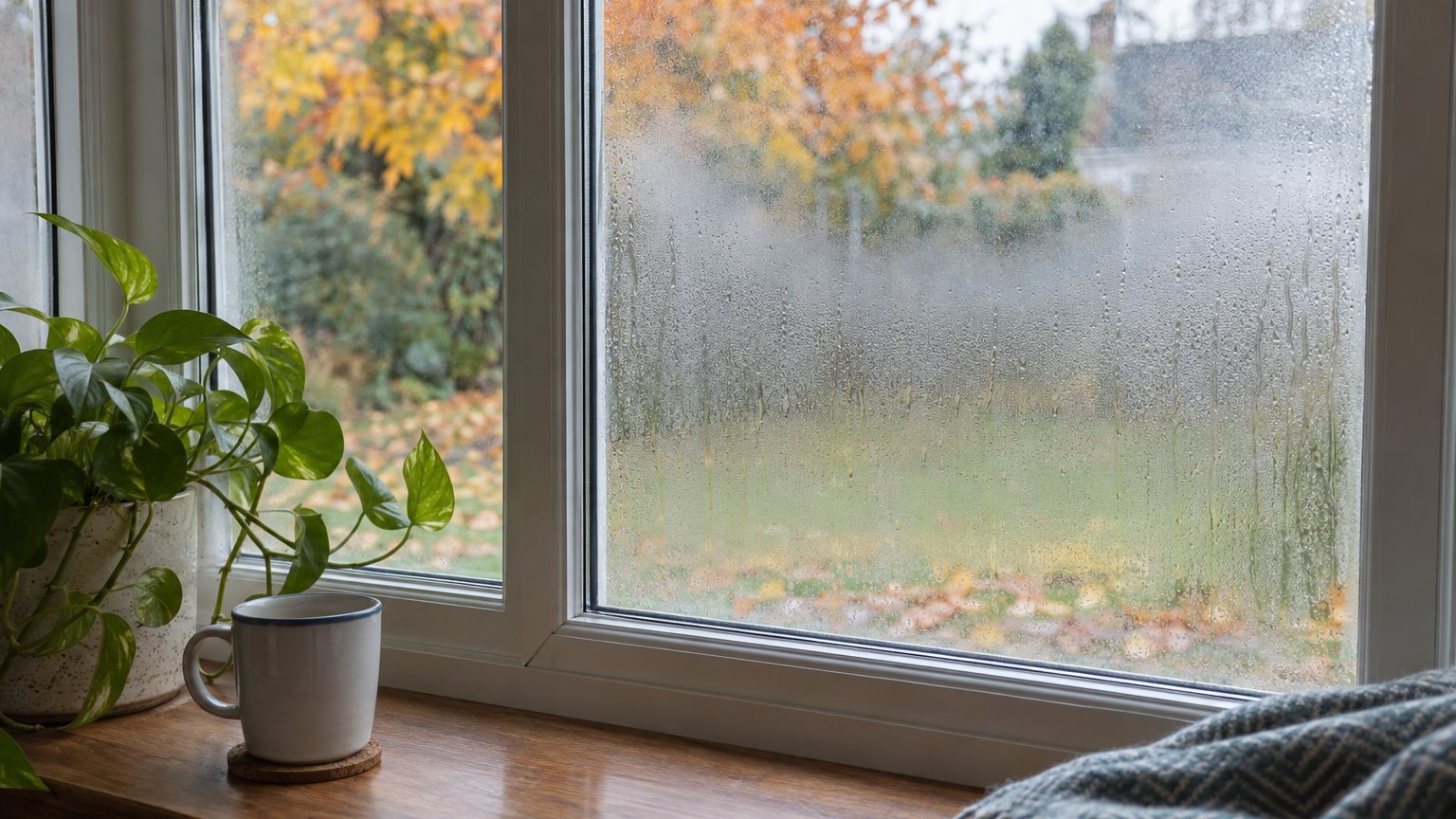

Puddles on a winter window sill are a sign your indoor air is carrying more moisture than the cold glass can stand, and left alone that water can soften the wood beneath it. Lower the moisture and the glass clears. Put a hygrometer, the small humidity gauge sold at any hardware store, in the foggiest room today and read it before you change anything else.
Why windows fog up in winter

Condensation forms when water vapor in warm indoor air meets a cold surface such as a window, as the U.S. EPA puts it in its moisture control guidance for schools. The fix is less moisture in the air, not a different window. Glass is the coldest surface in most rooms, so it is where vapor turns to liquid first.
What is happening on the glass
Warm air holds more water vapor than cold air does. When that air touches a pane chilled by the weather outside, it cools and can no longer carry all of its vapor. The surplus lands on the glass as a haze or as droplets that run down to the sill. Showers, cooking, boiling pots and wet laundry drying indoors all load the air with vapor, and a closed-up house keeps it there.
Fog sealed between two panes of a double-pane unit is a different problem, covered further down.
What to check first
Start with the humidity reading. If your gauge reads above 60 percent, you have found the reason your windows are wet. If it reads inside the range and the glass still fogs, move on to ventilation.
Colder weather chills the glass further, so a reading that is comfortable in a mild spell can still fog windows on the coldest nights. If a manual for your humidifier or ventilation system includes such a table, follow that manual.
Then look at where the moisture goes after it is made:
- Do the bathroom and kitchen fans actually get used, and do they work?
- Are interior doors kept shut so damp air sits in one room?
- Is a humidifier running, or is wet laundry hanging indoors?
What lowers indoor moisture
You cannot dry out a house by wiping glass. The steps that work take moisture out of the air or move it outside, and they are cheap enough to try in one afternoon. Work through them in this order.
- Run the bathroom fan during showers and keep it going until the mirror clears. North Dakota State University Extension advises running vent fans in the bathroom and kitchen to bring moisture levels down.
- Run the kitchen fan whenever you boil, simmer or steam. Check once that the hood or fan duct leads outdoors and not into the room.
- Open doors and windows when practical. The U.S. EPA lists increased ventilation or air movement among its steps for controlling moisture. In deep cold you will not want a window open for long, but a short airing after a steamy hour still lets damp air out.
- Keep air moving between rooms. Open interior doors and do not block vents or push furniture hard against cold exterior walls and window openings.
If you run a humidifier
A humidifier adds moisture to the air, which is the opposite of what a fogged window calls for. If your furnace humidifier is running and the glass is streaming wet, that is the first place to look. Do not dial it to a number you found online. Check the manual for the unit, then judge by the hygrometer reading against the EPA range quoted above and by whether the windows clear.
Take the first steps seriously
It is tempting to start with the windows, wiping, buying sealing film or replacing sashes, when the moisture source may be the shower and the stove. Wiping the sill with a towel does help keep water from pooling on the wood, but it does nothing about the vapor that will be back on the glass tomorrow.
If you are in Canada, use Canadian guidance where it differs from the U.S. sources named here. Ventilation rules and recommended humidity levels can vary with the building code and the climate.
When fogged windows are more than an annoyance
Persistent moisture on and around a window does damage over time. North Dakota State University Extension notes that excess moisture can also be a breeding ground for mold. The U.S. Department of Energy’s Building America Solution Center, in guidance from PNNL on managing humidity in cold weather, says that it can rot window sills and frames. Water that sits on wood week after week is the pattern to break.
If you see dark spots or fuzzy growth near a window, do not assume what it is by eye. Your county extension office can tell you how to have it assessed, and the EPA’s brief guide to mold, moisture and your home explains how to handle moisture problems at their source.
Is it the window, the wall or the basement?
Not every wet patch in a house is window condensation. Sort what you are seeing into one of three kinds:
- Moisture on the room-side surface of the glass, worst on cold days.
- Dampness on a basement wall or floor, which may be vapor or may be water coming in.
- Fog sealed inside a double-pane unit, where wiping the glass changes nothing.
If the wet is on lower walls or floors, read about telling condensation or seepage apart before you spend money on windows. If your basement feels clammy while upstairs glass is fogging, the whole house may be carrying too much moisture, and our page on basement humidity covers that side of it.
Fog between the panes
Fog that appears between the panes of a double-pane window is a different problem from the condensation described above. Lowering your indoor humidity is aimed at the room side of the glass, not at what happens inside a sealed unit. To tell the two apart, wipe the room-side glass with a dry cloth. If the haze wipes away, it was on the surface. If it stays, check your window paperwork or ask the manufacturer or a window professional.
What to do next
Read the hygrometer, run the fans, and air the house when you can. If the glass still runs wet after that, cold air leaking around the sash may be chilling the frame, and sealing it is a separate job. Our page on weatherstripping doors and windows shows how to find and close those gaps.
Moisture problems come back every cold season, so make the checks part of your routine for the heating season. Guidance and building rules change, so confirm current recommendations with the EPA, your county extension office or, in Canada, your national or provincial housing authority before you act.
Common questions
Why are only my bathroom windows fogged?
Showers put a large load of vapor into a small room, and the window is the coldest surface in it. Run the bathroom fan during and after showers, as North Dakota State University Extension advises. If the fan never seems to clear the room, check that it is actually pulling air.
My hygrometer reads inside the EPA range and the windows still fog. Why?
The EPA range is a guide to keep moisture under control, not a guarantee of clear glass on the coldest nights. Cold glass can fog even when the room is within range. Check that the gauge sits away from steamy rooms and that fans and airing are in use. A cheap gauge may also read off, so compare it with a second one if you can.
Should I just wipe the condensation off?
Wipe it if water is pooling on the sill, since standing water is what threatens the wood. It only treats the symptom, though. The moisture will return until you lower what the air is carrying.
Does fog between the panes mean I need new windows?
Not necessarily, but it is a separate problem from room-side condensation, and lowering indoor humidity is not the fix for it. Check your warranty or paperwork and contact the manufacturer or a window professional for an assessment.