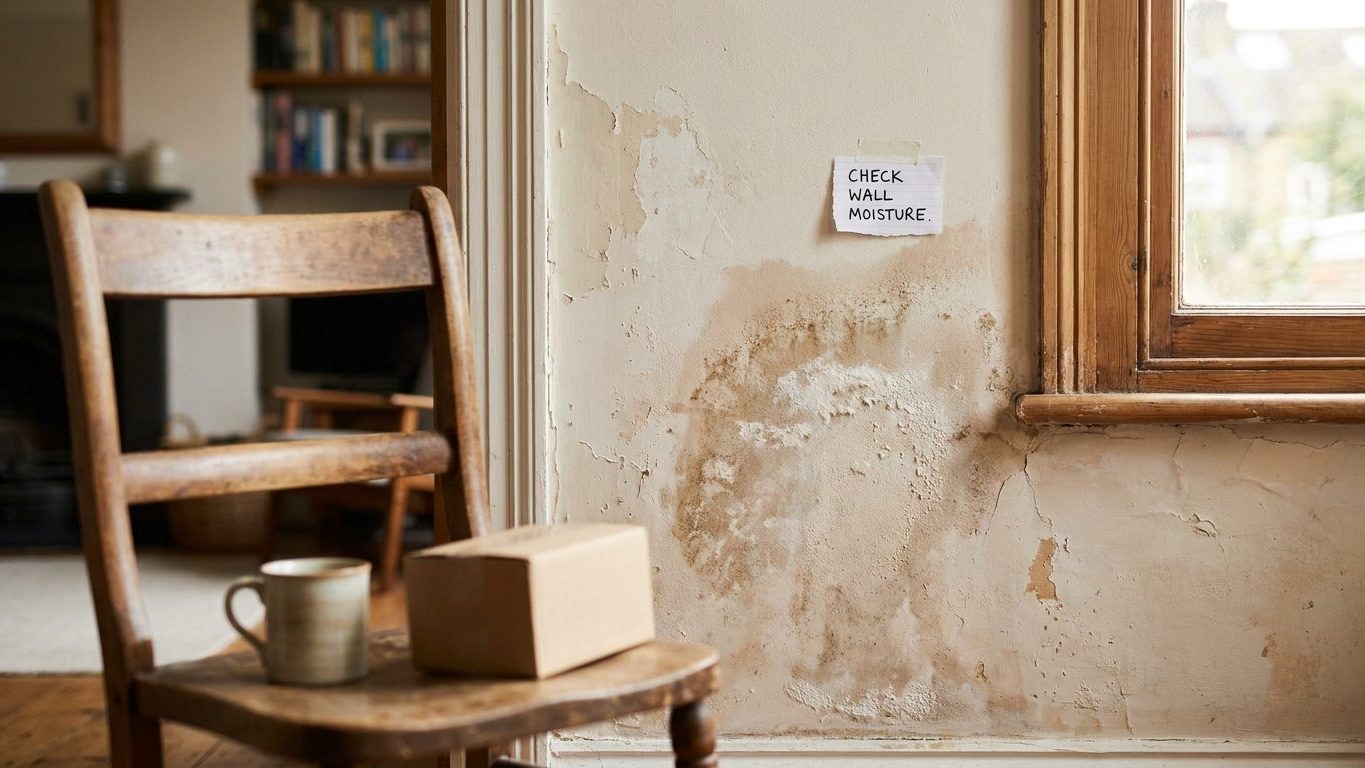

Guess wrong on a damp basement wall and you’ll spend a weekend caulking hairline cracks while groundwater keeps finding its way in from outside, or you’ll call a waterproofing crew for a problem a dehumidifier would have fixed in a day. The stain alone won’t tell you which one you’ve got. Tape a square of plastic sheeting flat against the wall, leave it a full day, then check which side the moisture landed on.
What is actually going on

Everything about this problem comes down to one question: which side of the wall the water started on. Condensation forms on the surface, out of the room’s own air. Warm, moist air meets a concrete or block wall that’s cooler than the air’s dew point, and the water vapor gives up and turns to liquid right there on the surface you can see. It happens on cold water pipes in summer for the same reason. Nothing has come through the wall at all. The moisture was already in the room.
Seepage is the opposite direction entirely. Water that starts outside the foundation works its way through the concrete or block itself and shows up on the inside face. It can travel through the porous body of the material by capillary action, seep through a mortar joint, or push through under hydrostatic pressure when the soil outside is saturated and has nowhere else to go. Either way, the water was outside the house before it was inside.
Why the direction changes everything
A wall sweating from room-air condensation needs less moisture in the air, better air movement, or a warmer surface. None of that touches a wall that’s letting outside water through. And a wall letting water through from outside needs the water managed before it reaches the foundation at all, which is a drainage and grading question, not a paint-and-caulk question.
This is where a lot of money gets wasted. An interior sealant, a waterproofing paint, a peel-and-stick membrane on the inside face all do the same thing: they manage humidity on the room side and hide the staining that’s already there. None of them stop water that’s arriving from behind under pressure. That water doesn’t disappear because you’ve blocked its usual exit. It finds another path, often lower down or through the slab, and now the sign of the problem is gone while the problem itself is still there. Drainage outside comes first. Anything applied to the inside face is a finish, not a fix, until the outside water has somewhere else to go.
What to look at, and in what order
Start with the plastic sheet test because it costs nothing and takes a day, and work outward from there only if you need more information. Each check either confirms what the sheet told you or narrows down where the water outside is coming from.
| Check | What it shows | Rules out | Suggests |
|---|---|---|---|
| Plastic sheet, taped flat, left one full day | Which face the moisture forms on | The other mechanism entirely | Condensation if the room-side face is wet and dry underneath, seepage if the wall-side face is wet |
| Timing against weather | Whether dampness tracks rainfall or tracks humid, still air | A source unrelated to either weather pattern | Seepage if it follows rain by a day or so, condensation if it follows humid weather with little air movement |
| Texture of the deposit | Whether there’s a white, powdery mineral crust (efflorescence) or just a wet film | A plumbing leak, if there’s no crust and no weather pattern at all | Efflorescence means water has moved through the material and left dissolved minerals behind on evaporating, which points to seepage even on a wall that looks dry right now |
| Downspouts and grade at that spot | Whether roof water or surface water is aimed at that section of wall | An interior humidity source | A specific, fixable outside cause if the ground slopes toward the house or a downspout dumps right there |
| Whole-basement humidity, measured with a hygrometer over a week | Whether the air itself is carrying enough moisture to condense on any cool surface | A localized outside leak, if humidity is high everywhere and the wet spot isn’t unique | Condensation if high readings match wet walls generally, not just at one spot |
Notice that the mineral crust check and the downspout check both point the same direction the plastic sheet already pointed, which is the point. You’re not running five separate diagnoses. You’re building confidence in one answer before you spend money on either a dehumidifier or a drainage fix. If the wall by the downspout is the one that stays damp and the sheet came back wet on the wall side, the grading question comes before anything else, and that’s exactly the ground-level work covered in “/foundations/grading-and-drainage/”>The Ground Around the House Is the First Fix.
Watch it, or get someone in
A homeowner can reasonably track and manage a fair amount of this without calling anyone. Damp air, a musty smell, and a wall that fogs the plastic sheet on the room side are things you address with dehumidification, better air circulation, and keeping vents and doors open enough for air to move. Watching, not calling, is the right response to a stable, seasonal, surface-only pattern that a hygrometer confirms is a humidity problem and nothing more.
Three things change that. A crack that’s visibly wider at one end than the other, or wider than it was a season ago. A wall that bows inward anywhere along its height. Water that shows up after rain even where there’s no visible crack at all, which means it’s moving through the material itself under pressure rather than through one identifiable gap.
Which professional, for which problem
These are three different calls, and mixing them up wastes a site visit. A structural engineer assesses movement, bowing, and cracking for what they mean about the wall’s condition, and does it without a repair to sell, which matters because the diagnosis and the fix come from two different people with two different incentives. A drainage contractor deals with grading, gutters, downspout extensions, and the soil and drainage systems around the foundation, the outside-first half of the equation. A waterproofing company sells interior systems, coatings, and membranes, useful once the outside water is genuinely under control, but not the first call for a wall that’s still taking on water from outside, since fixing the inside of a wall that’s still under pressure from outside just hides the evidence.
If you’re not sure which of the three you need, the engineer is the safer first call precisely because there’s no repair riding on the answer. A drainage contractor or a waterproofing salesman both have a reason to tell you the job is bigger than it is.
What has to happen first
The order of operations is where most of the money in this subject gets wasted, and it only runs one way. Outside drainage gets addressed before anything touches the inside face of the wall. Water gets managed before any finish goes on. Diagnosis, meaning the plastic sheet and the checks that follow it, happens before either.
Gutters that dump water at the foundation, downspouts that end right at the wall instead of carrying water away, and grade that slopes toward the house instead of away from it are the most common outside causes, and they’re the cheapest to fix relative to what they cause. The roofing side of that, keeping gutters clear and downspouts intact, is worth checking before assuming the problem starts underground at all.
Inside the basement, a sump pump handling groundwater that’s already made it past the footing is a plumbing fix, not a wall fix, and belongs in that part of the house’s systems rather than in a caulk tube. Once the water side is actually settled, insulating or finishing a basement wall is safe to plan, and worth reading up on before you build anything against a wall that might still be damp behind the new surface. That’s covered in full in What to Settle Before Finishing a Basement. A slab with a moisture problem underneath it needs the same sequence respected before flooring goes down on top of it. For the whole picture of how foundation moisture, grading, and the rest of the house connect, the overview at Foundations and Basements: Almost Everything Here Is Water is the place to start before narrowing in on any one fix.
Common questions
Can condensation and seepage happen on the same wall?
Yes, and it’s more common than people expect in a humid basement with any outside water problem at all. Run the plastic sheet test in a few spots rather than just once, because a wall can sweat from room air in one section and take on outside water lower down or near a crack.
How long do I need to leave the plastic taped up?
A full day covers a normal daily cycle of temperature and humidity swings, which is usually enough to get a clear answer. If the weather that day was unusually dry or unusually still, repeat the test on a more typical day before you trust the result.
The wall is dry right now, does that mean there’s no problem?
Not necessarily. Seepage often tracks rainfall, so a wall can look completely dry for weeks and then show water within a day or two of a heavy rain. A white, powdery mineral crust left behind on an otherwise dry wall is a sign that water has been moving through it even when you’re not seeing it act up.
Will painting the wall with a waterproof coating fix seepage?
It will usually hide it for a while, not fix it. An interior coating manages the surface and the staining, but water arriving under pressure from outside will generally find another way in, often lower on the wall or through the slab, once its usual path is blocked. Outside drainage is what actually stops the water, and the coating becomes a reasonable finishing step after that.