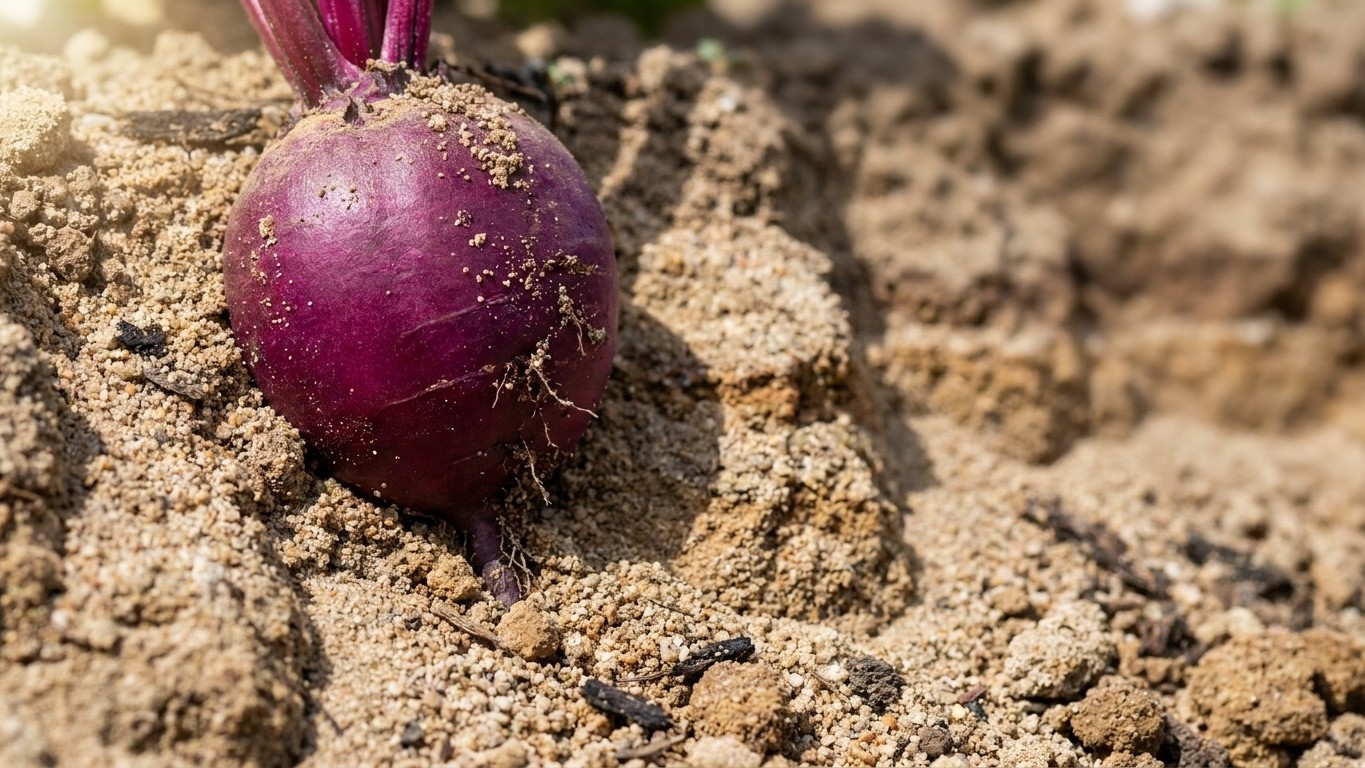

Three things go after a beet crop in Washington. The first is thirst in the first six weeks, which pushes the plant to flower instead of swell. The second is heat above 85 F paired with thirst later, which turns the root woody. The third is a refrigerator set too cold, which invites black spot and rot in storage. Each has its own fix. This page covers those three, not insect calendars, because no pest data sits behind it. The frost dates below describe western Washington only.
The short answer
What the state soil says about a beet bed
Start with the ground. USDA lists the Tokul series, an Andisol, as the representative soil of Washington. It is a volcanic-ash soil, light, porous and unusually good at holding both water and phosphorus. The surface horizon comes in at 45 percent sand, 10 percent clay and 45 percent silt, which makes it a loam to silt, and it is moderately well drained. Organic matter runs about 75.0 percent and the pH about 4.5, strongly acid. Those are representative values for the surface of the major components of the series as mapped (19 components in USDA’s Soil Data Access), not readings from a worked garden bed.
Utah State University Extension says beets want deep, sandy, well-drained soil rich in organic matter. Measured against that, Tokul looks friendly. Ten percent clay means a taproot has little to fight, the sand and silt keep the surface loose, and the water-holding ability helps a seedling through a dry week. “Moderately well drained” is a notch below the ideal, so a wet spell lingers longer than it would in sandy ground.
Now the warning. A state spans hundreds of soil series, and this one is a starting point, not a diagnosis. An organic-matter figure near 75 percent describes a natural forest-litter layer, and a cultivated bed will not have it. The pH is the series’ pH, not yours. River bottoms, hill country and any lot a builder has scraped or filled can differ completely. A soil test gives you your own number, and Beet Soil in Washington: What the Root Will Meet walks through what to do with it. If you add compost, Utah State caps it at no more than 1 inch of composted organic matter per 100 sq ft.
Heat and the woody root
Heat is the second half of the answer. Utah State’s rule is that heat above 85 F combined with water stress makes the root woody. The count of days a year the Seattle area passes 90 F is not published in the data behind this page, so there is no number here, and guessing would be worse than leaving the gap. Your county’s NOAA station records can supply it.
What the rule does tell you is that woodiness needs two conditions at once. A hot spell on well-watered beets is a different situation from a hot spell on dry ones. It also arrives late, while the root is sizing up, long after the early thirst that causes bolting. The west side’s maritime summers keep that risk lower than on the east side of the Cascades, which is high desert. Beets sown there face a far shorter season and far drier air, and nothing on this page’s frost dates applies to them.
The six weeks that decide it here
The last spring frost in the Seattle area falls between February 27 and March 18, according to NOAA NCEI climate normals for station USW00024233 (the 30 to 70 percent band of 32 F freeze probabilities). Sowing 2 to 3 weeks before that date puts seed in the ground from roughly the first week of February to the first week of March. Beets are sown in place, so the 60 to 80 days to harvest count from seeding, never from a transplant.
A mild frost date is not an early planting date, though. Cold, wet soil and low winter light hold spring crops back well past the last freeze, and seed can sit there doing little. The earliest end of that window is an arithmetic result, not a recommendation. When to Sow Beets in Washington works through the practical dates.
What does the spring around those dates usually do? On the west side it is cool, gray and frequently wet, with the dry weather building slowly from late spring into summer. For a beet, that puts the early-thirst risk in an odd place. A February or early March sowing spends its first six weeks in damp conditions, and the seedbed rarely dries out. The thirst problem belongs to the later sowings, the ones whose first six weeks run through May and into June, when a dry stretch can arrive and stay. Raised beds and containers dry faster than the ground around them. So does any seedbed that crusts over before the seedlings emerge.
Utah State is blunt on the point: water stress in the first 6 weeks causes premature flowering. A plant that bolts puts its energy into a flower stalk and not into the root you planted it for, and no later watering undoes it. The first six weeks matter more than any other stretch of the crop.
East of the Cascades the picture flips. Dry air and a short season mean the first six weeks are dry almost by default, so steady moisture from the day of seeding is not optional. Everything about timing there comes from local frost records, not from Seattle’s.
What goes wrong here
- Bolting from early thirst. It strikes later sowings and east-side beds most often, when the first six weeks go dry. Keep the seedbed evenly moist from seeding through week six, and check by pushing a finger into the soil rather than trusting the surface.
- Woody roots from later heat. This is a separate failure from bolting, and it needs heat above 85 F plus water stress while the root is sizing. Water through hot spells, and time sowing so roots finish before the hottest weeks of the year.
- Over-amended or untested ground. The state soil runs strongly acid at the surface, but your bed may not. Test before you correct anything, and keep compost to no more than 1 inch per 100 sq ft, since the Tokul-type ground is already rich in organic matter.
- Stalled seed in cold, wet soil. A frost date in late February does not make February a good sowing month. Cold soil and low light delay germination, so wait for the soil to behave rather than sowing to the calendar.
- Storing too cold. Colder is not better. USDA Agricultural Handbook 66 says storage at 32 to 34 F produces more black spot and rot than slightly warmer conditions. Topped beets belong at 33 to 36 F and 98 percent relative humidity.
- Leaving the tops on. Bunched beets with leaves last about 10 to 14 days at 32 F and high humidity, and no longer. Top them first if you want them to keep.
- Storing the small ones. Large roots keep much better because they lose water and shrivel more slowly. Eat the small beets first and store the big ones.
Common questions
Can I sow in February because the last frost is February 27 to March 18?
The arithmetic allows it, but the soil often does not. Cold, wet ground and thin winter light slow spring crops long after the last freeze. Treat the frost-based window as the earliest possible date, not the best one.
Are bolting and woody roots the same problem?
No. Bolting comes from water stress in the first 6 weeks and sends the plant into flower. Woodiness comes later, when heat above 85 F meets water stress and the root toughens. Early thirst and later heat are different failures at different stages, so “keep it watered” is not a complete plan for either.
Does the Tokul soil description apply to my garden?
Probably not exactly. It is the soil USDA lists as representative of Washington, but the state spans hundreds of soil series. Use it to understand what the region’s ground tends to do, then get a soil test for your own bed.
How cold should I store beets?
Topped beets keep best at 33 to 36 F and 98 percent relative humidity. Storage at 32 to 34 F brings more black spot and rot. If you use a pit or cellar, USDA’s handbook says to keep it from dropping below 31 F or rising above 41 F.