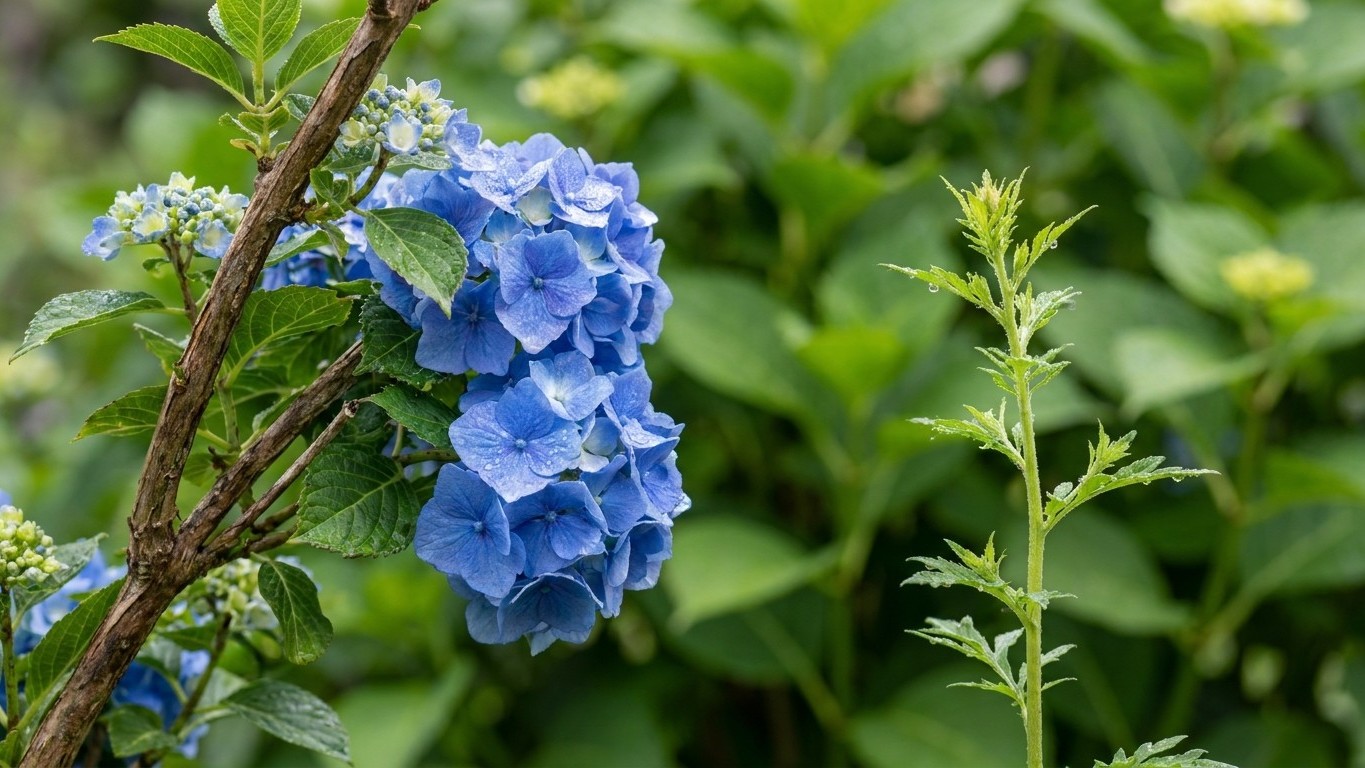

Nearly every hydrangea sold in Delaware will live through the winter. Zone 7a-8a on the USDA Plant Hardiness Zone Map is mild territory for this genus. What separates a good year from a disappointing one is the flower. Smooth, panicle and oakleaf types bloom reliably after a rough season, while bigleaf types can come back as healthy green shrubs with no blooms. The deciding factor is where each plant carries its buds.
What this comes down to in Delaware

At the Wilmington airport station, the last spring freeze falls between April 3 and April 14, and the first fall freeze between October 26 and November 7 (NOAA NCEI climate normals, 30-70% probability band at 32F). Inside that window, every hydrangea type common in Delaware nurseries survives the cold, and the real question is which ones still flower afterward.
Roots and woody stems rarely die here. The damage lands on flower buds. Some hydrangeas form next summer’s buds on the stems they grew this year (old wood), so those buds sit exposed all winter and through any warm spell that wakes them early. Others form flowers only on stems that grow fresh in spring (new wood), which means a freeze can cut them to the ground and they still bloom. The list below runs from the safest bloomers to the ones that carry the most risk, the way a vegetable list runs from short season to long.
Annabelle
A smooth hydrangea (Hydrangea arborescens) that blooms on new wood. Freeze damage to the stems barely matters, because the flower heads form on growth that hasn’t started yet. It is the most dependable bloomer on this list for a Delaware winter, though the big white heads can flop after heavy rain.
Incrediball
A smooth hydrangea bred from the same lineage, with sturdier stems. Same new-wood habit, same indifference to a hard winter. Pick it over Annabelle if drooping blooms bother you.
Limelight
A panicle hydrangea (Hydrangea paniculata), also a new-wood bloomer, and a woody, upright shrub that shrugs off Delaware cold. Its lime-green summer flowers age to pink and cream. Winter is almost never what stops it from flowering.
Quick Fire
Another panicle type, known for opening its flowers earlier than most others in the group. New-wood blooming means winter cannot take the show away. A late freeze after leaf-out may nip tender shoots, but the plant replaces them.
Snow Queen
An oakleaf hydrangea (Hydrangea quercifolia), a native-species selection. It blooms on old wood, but the buds and stems are tougher than a bigleaf’s, so it flowers reliably in most Delaware winters. Add peeling bark and red-burgundy fall foliage, and it earns its place in a yard that wants winter interest.
Endless Summer
A bigleaf (Hydrangea macrophylla) bred to bloom on both old and new wood. If winter or a late freeze kills the old-wood buds, it still produces flowers later in the season on new growth. That second chance is the reason it is the usual answer for Delaware gardeners who want blue or pink blooms.
Nikko Blue
A classic bigleaf that blooms on old wood only. When a cold snap or late freeze takes the buds, there is no backup, and you get leaves without flowers until next year. It lives through the winter without trouble, which is not the same as flowering after it.
Working it out for your own garden
Delaware’s hardiness zone tells you whether a plant lives. The frost window tells you whether it blooms. Here is the method, so it still works after a move or an odd year.
Start with the window, then adjust it
The reference-city window for the last spring freeze is April 3 to April 14. Suburban and rural gardens typically see that last freeze one to two weeks later. Adding one week to the early end and two weeks to the late end gives roughly April 10 to April 28 for a yard outside the city. The fall side runs the other way. Take one to two weeks off October 26 to November 7 and you get roughly October 12 to October 31 for the first freeze. Ranges in, ranges out. Never narrow either one to a single date.
Then look at what your shrub is doing in that spring window. Any old-wood bloomer with swelling buds or fresh leaves before the end of your range is exposed to a freeze, and a new-wood bloomer is not.
A plant that finishes, and one that does not
Take Endless Summer. It has leafed out by mid-April in a warm year, and a freeze arrives at the end of a range like April 28. The old-wood buds may die. The plant keeps growing, forms new-wood buds after the freeze has passed, and still flowers, later and lighter than in a good year. It finishes.
Run the same freeze past Nikko Blue. Its flowers were already waiting inside those buds, so losing them means losing the whole crop. It does not finish. The same logic carries to any cultivar: ask whether it can start over after the last freeze.
| Cultivar | Blooms on | What a bad winter costs |
|---|---|---|
| Annabelle | New wood | Almost nothing |
| Limelight | New wood | Almost nothing |
| Snow Queen | Old wood | Some buds in a severe season |
| Endless Summer | Old and new wood | Earlier flowers, but later ones follow |
| Nikko Blue | Old wood | A whole season of flowers |
Telling what you have
Scratch a thumbnail across a stem in late spring. Green underneath means living tissue, brown and dry means dead. Wait until the shrub has fully leafed out before judging it, because bigleaf types are slow starters. Dead tops with new shoots at the base point to a plant that froze back and will bloom only if it carries new-wood buds. Check your tag, then check When to Prune Hydrangeas in Delaware before cutting anything.
What changes across the state
Delaware looks small on a map, but it stretches from the edge of the Piedmont in the north to flat, sandy coastal plain in the south. The USDA range of 7a to 8a reflects that. The milder end of the range tends to sit toward the Atlantic coast and the Delaware Bay, where water slows the temperature swings. The colder end tends to appear in northern and inland spots, away from that moderating effect.
Elevation, which does so much in mountain states, matters less here because Delaware has the lowest average elevation of any state. Microclimate matters more. A low corner of a yard where cold air pools can freeze weeks after a ridge-top neighbor has stopped worrying, and a south-facing brick wall can pull a bigleaf into leaf too early. Cities hold a little heat, which is part of why the airport figures, collected at a single open site, will not match every backyard.
For a gardener in the southern end of the state, the difference shows up in two ways. Old-wood bloomers have a somewhat better chance of keeping their buds, but they also tend to leaf out earlier, which can set them up for a surprise freeze. Coastal gardeners with sandy soil face a different problem, since sandy ground dries fast and stresses shrubs through summer, which affects winter health. Northern gardeners are more likely to see real bud kill on a bigleaf and benefit more from choosing a new-wood or reblooming type. Neither region is exempt from a bad spring. The reference city is a starting point, and how far your yard drifts from it is something you learn by watching it.
The mistakes this state punishes

Delaware’s winters are mild enough to lull people. The mistakes that cost gardeners here are rarely about surviving cold. They are about timing.
First, trusting a warm spell. A stretch of mild March weather wakes up old-wood bloomers, and the leaves that emerge are tender. The reference city’s last freeze falls between April 3 and April 14, and gardens outside it run later still, so a freeze after leaf-out is normal here, not a freak. If a freeze is forecast and your shrub is leafing, cover it overnight with a sheet or burlap and remove the cover when temperatures rise. Protecting Hydrangeas Through a Delaware Winter covers materials and timing.
Second, pruning a bigleaf in fall or early spring. Cutting old stems on Nikko Blue removes the buds you were waiting for, and no frost damage compares to that. Wait to see where living growth starts.
Third, feeding late. Nitrogen in late summer pushes soft growth right before the first fall freeze, which for a yard outside the city can arrive in the middle of October. That growth burns, and it can drag the rest of the plant into winter weaker.
Fourth, giving up too early. Bigleaf hydrangeas often show nothing until late spring. Gardeners dig up healthy shrubs in April that would have recovered by June.
Fifth, buying a bigleaf for an exposed, low-lying spot and expecting it to behave like one on a protected wall. For those yards, start with Annabelle, Limelight or Snow Queen and add a reblooming bigleaf as a bonus.
Checking this against your county
The figures here come from one airport station in one city. A state-wide number is a starting point, not an instruction, and your own yard may be earlier or later by a week or two. Your county office of University of Delaware Cooperative Extension can tell you what local frost dates look like and which hydrangea problems are showing up in your area. For the broader picture of site, soil and care, the state guide to growing hydrangeas in Delaware is the next stop.
Common questions
Will a bigleaf hydrangea die in a Delaware winter?
Seldom. Delaware falls in USDA zone 7a-8a, which is within the comfortable range for bigleaf plants. The usual loss is flower buds on old wood, not the plant itself.
Which hydrangea is the safest choice for reliable blooms?
Smooth types such as Annabelle and Incrediball, and panicle types such as Limelight and Quick Fire. They bloom on new wood, so winter and late freezes barely touch the flowers.
My hydrangea leafed out and then turned black after a freeze. Is it dead?
Probably not. A freeze after leaf-out burns tender growth, but the plant usually pushes new shoots. Wait until late spring, then scratch a stem. Green tissue means it is alive.
Do I need to wrap my hydrangeas every winter?
Not for smooth and panicle types. Old-wood bloomers like Nikko Blue benefit from protection in a cold year or an exposed site, and a quick cover on the night of a late freeze helps any leafed-out shrub.