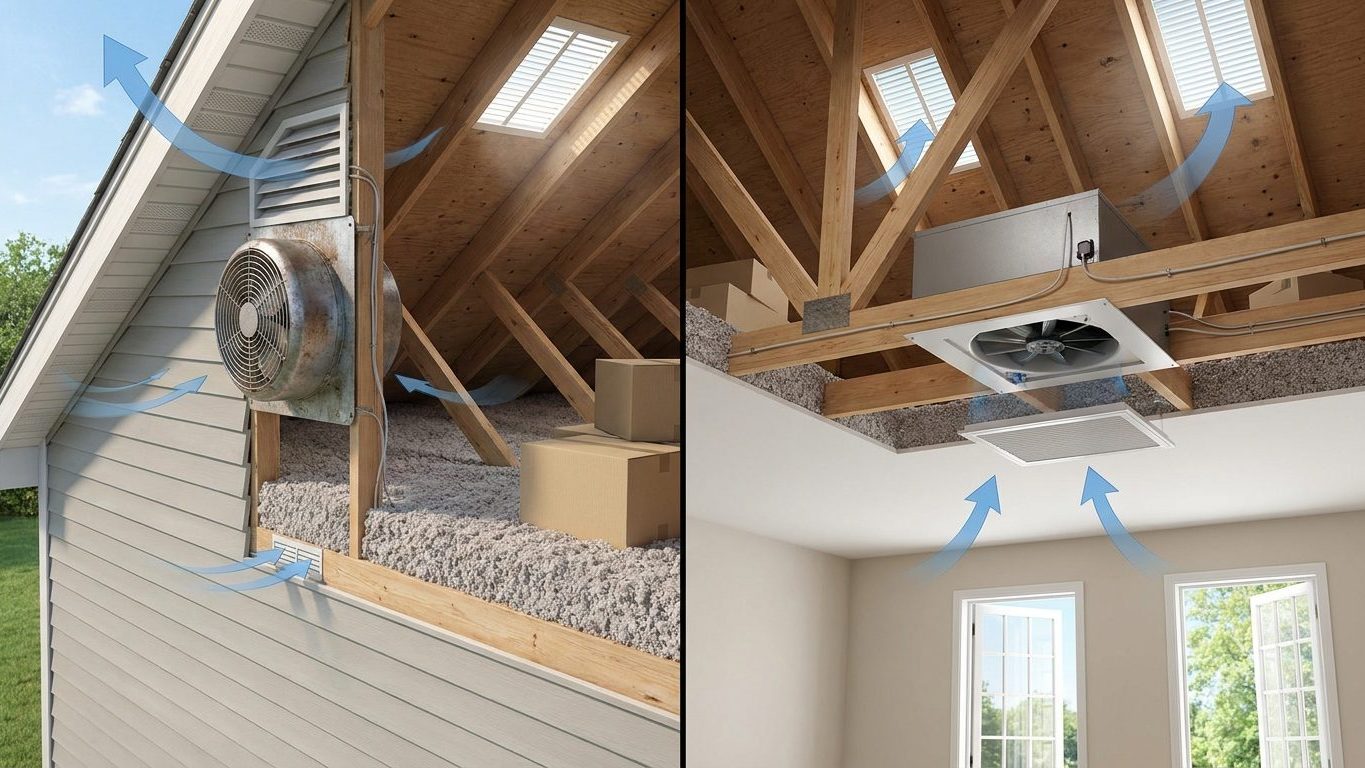

An attic fan and a Whole-House fan look similar. Both mount near the roofline, both spin large blades, and both get installed by homeowners trying to avoid running the air Conditioner. But they answer completely different questions. A whole-house fan pulls air through the living space itself, drawing outdoor air in through open windows and pushing indoor air out through the attic. An attic fan never touches the living space. It only moves air within the attic, in through vents and out through the roof, without pulling anything from the rooms below.
Two appliances people constantly confuse
The mix-up is understandable because both units sit in roughly the same spot, but the mechanism is not the same, and neither is the goal. A whole-house fan is a house-cooling tool. It is meant to replace the air inside your living space with cooler outdoor air, and it depends on open windows to do that job. An attic fan, on the other hand, is a building-maintenance tool. It manages the temperature and moisture of the attic cavity itself, and it is not supposed to interact with the rooms you actually live in at all.
| Feature | Attic Fan | Whole-House Fan |
|---|---|---|
| Where it is mounted | Attic gable wall or roof deck | Ceiling between the living space and the attic |
| Air it moves | Attic air only, in and out through attic vents | House air, pulled from rooms and pushed into the attic and outdoors |
| What it is meant to achieve | Lower attic temperature and clear attic moisture | Lower indoor temperature by exchanging house air with outdoor air |
| When it runs | Whenever the attic is hotter than a set point, day or night | Only when outdoor air is cooler than indoor air, with windows open |
Notice that last row. A whole-house fan has one non-negotiable condition: it only helps when the outdoor air is cooler than the air inside, and it only works with windows open, because it needs somewhere for house air to come from. An attic fan has no such requirement tied to indoor comfort at all, because it was never designed to touch the indoor air in the first place. If you’re weighing whether a whole-house fan fits your house and your climate, the site’s dedicated guide walks through the window-opening requirement and the conditions where it pays off.
That difference in purpose is also why swapping one for the other rarely solves the problem a homeowner actually has. Someone hoping to cool bedrooms on a warm evening needs a whole-house fan, not an attic fan. Someone dealing with curling shingles or a roof deck that seems to bake all summer needs an attic fan, not a whole-house fan. Confusing the two means buying equipment that solves a problem you don’t have.
What it is actually for
An attic on a summer afternoon runs far hotter than the outdoor air, sometimes hot enough that touching the underside of the roof deck feels like touching a car hood left in the sun. In the Northern Hemisphere, that heat load builds through the afternoon as the sun crosses to the west side of the roof, and it lingers into the evening because wood and shingles hold heat longer than open air does. Moving that trapped air out, whether with a fan or through vents, lowers the surface temperature of everything up there, which in turn reduces how much heat radiates down into the insulation and the ceiling below it.
Winter brings a different job. Warm, moist air from showers, cooking, and simple breathing leaks upward from the living space into the attic through light fixtures, attic hatches, and gaps around plumbing stacks. Once that moist air reaches the cold underside of the roof deck, it can condense. Ventilation, whether powered or passive, is what carries that moisture back outside before it has a chance to sit on wood framing and sheathing. The site’s attic ventilation guide covers how intake and exhaust vents are supposed to work together across both seasons.
A powered fan is one way to move that air, but it is not the only way, and it is often not the first way a building professional would reach for. Passive ventilation, air entering through soffit vents at the eaves and exiting through a ridge vent or roof vents near the peak, uses the natural tendency of hot air to rise. No motor, no switch, no electricity bill. It works around the clock as long as both the intake and the exhaust are actually open.
How much attics rely on any of this ties loosely to how much a region leans on mechanical cooling in the first place. Nationally, the U.S. Energy Information Administration’s 2020 Residential Energy Consumption Survey found that 89% of U.S. homes use some form of air-Conditioning equipment, with 67% running a central system and 26% relying on individual units. That split moves a long way by climate and housing stock: in Alaska, only 7% of homes use air conditioning of any kind, while 46% rely on ceiling fans; in Connecticut, 90% of homes are cooled but only 34% have central air; in Arizona, 94% are cooled and 86% of that is central. Those numbers describe what got installed when the housing stock was built, not a recommendation, but they explain why attic heat management matters more in some regions than others.
The objection worth taking seriously
Here is where a powered attic fan can quietly work against you. The fan is built to pull air from somewhere, and it will pull from wherever it can find the least resistance. In a properly built attic, that means air enters through soffit vents at the eaves. But soffit vents get blocked constantly, usually by insulation that was pushed too far into the eaves during a re-insulation job, or by paint and debris sealing the vent slots shut over the years. When the intended path is closed off, the fan does not stop working. It just finds a new source, and that new source is often the house itself.
Every gap around a recessed light, every unsealed attic hatch, every small crack around a plumbing or wiring penetration becomes a straw the fan can pull through. The air pulled up through those gaps is conditioned air, the air you already paid to cool, and once it is in the attic it gets exhausted straight outside. In practice, a fan installed to protect the roof deck can end up increasing a cooling bill rather than lowering one, because it is quietly depressurizing the rooms below and replacing that lost air with more air conditioning demand.
Before adding or running a powered attic fan, three checks are worth doing:
- Go into the attic with a flashlight and confirm there are actual soffit vents at the eaves, not just a continuous soffit panel with no venting cut into it.
- From inside the attic, look toward the eaves for daylight coming through the soffit vents. If you see insulation instead of light, the intake is blocked.
- Look for baffles, the rigid channels installed at the eaves specifically to hold insulation back from the vent openings and keep airflow moving from soffit to ridge.
One more caution applies here, and it is worth repeating rather than assuming it’s obvious: any powered fan that depressurizes a house, whether it’s mounted in the attic or ducted through a ceiling, can pull combustion byproducts back into the living space through a natural-draught flue, such as an older gas water heater or furnace vent. That risk is covered in more detail on the site’s carbon monoxide guide, and it’s a reason to have combustion appliances checked before running any fan that pulls air aggressively out of a closed house.
What to do before adding one
The order matters more than the equipment. Start by sealing the ceiling plane between the house and the attic, closing the gaps around recessed lights, hatches, and penetrations that let conditioned air leak upward in the first place. Next, confirm the intake and exhaust vents are actually open and unobstructed, using the same soffit and baffle checks described above. Only after both of those are done does it make sense to look at insulation levels and decide whether they meet the recommendation for your climate zone, since ENERGY STAR’s guidance on adequate insulation covers the attic floor, floors over unheated crawl spaces, and rim joists specifically.
A powered fan is not a substitute for any of those three steps. It cannot fix a leaky ceiling, and running one on top of an already leaky, poorly vented attic is how the depressurization problem described above actually happens. A well-sealed ceiling paired with working soffit-to-ridge ventilation and correct insulation is, for most attics, the whole answer. No motor required.
If those three things are already in good shape and the attic still runs uncomfortably hot, that’s the point where a powered fan might add something real. The site’s guides on attic sealing, attic ventilation, and attic insulation each walk through their piece of that sequence in more detail, and going through them in order avoids paying for a fan that ends up fighting the house instead of helping it.
Common questions
Can I use an attic fan instead of a whole-house fan to cool my bedrooms?
No. An attic fan only moves air within the attic and is not connected to the living space. It can lower the temperature of the ceiling above a bedroom slightly by cooling the attic, but it does nothing to exchange the air inside the room the way a whole-house fan does.
Do I need both an attic fan and a whole-house fan?
Most houses need neither, or at most one. A whole-house fan addresses indoor comfort on cool evenings with windows open. An attic fan addresses attic heat and moisture. Many attics manage both jobs with passive ridge and soffit ventilation alone, without a powered fan of either kind.
Will an attic fan lower my air conditioning bill?
It depends on whether the soffit intake vents are open. If they’re blocked, the fan can pull conditioned air out of the house through ceiling gaps, which raises cooling demand rather than lowering it. Check the intake path before assuming the fan is helping.
Does a powered attic fan replace the need for ridge and soffit vents?
No. A powered fan still needs somewhere to pull air from. Without open soffit vents feeding it outdoor air, it will draw from the house instead, which is the exact problem described above. Passive venting and a powered fan are meant to work together, not as substitutes for each other.