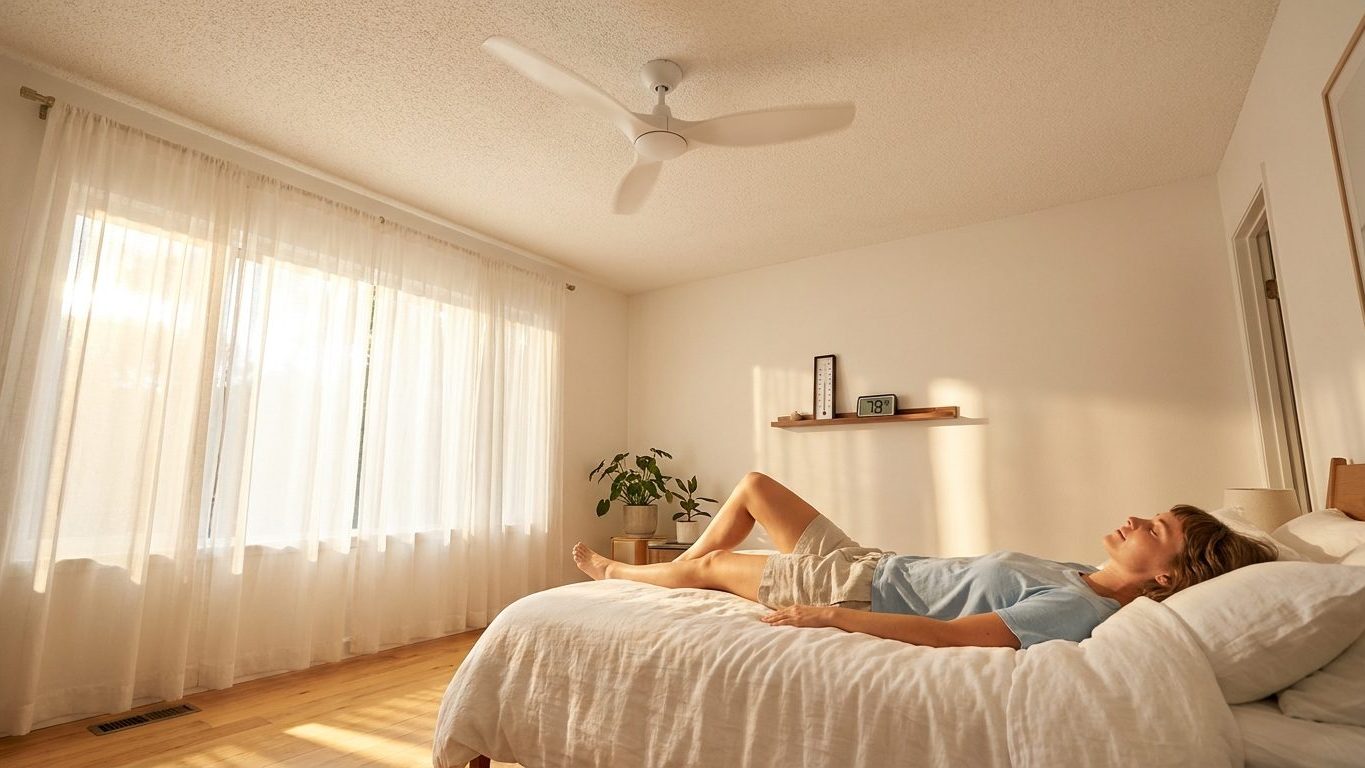

The short answer: in summer, set the switch so the blades spin counterclockwise when you look up at them. That pushes air straight down, creating a breeze across your skin. In winter, the opposite direction pulls air up and pushes warm ceiling air outward along the walls instead. This description applies to the Northern Hemisphere.
A fan cools people, not rooms
A ceiling fan does not lower the temperature of a room. Nothing about a spinning blade removes heat from the air. What a fan actually does is move air across your skin, which speeds up the evaporation of sweat and carries heat away from your body. That’s the entire mechanism. A thermometer hanging in the middle of the room will read the same number whether the fan is on or off.
The consequence of that mechanism is easy to miss but worth stating plainly: a fan running in a room nobody is in does nothing except burn a little electricity and add the motor’s own heat to the air. There’s no cooling benefit sitting there. Turning it off the moment you leave a room isn’t a minor courtesy to your utility bill, it’s the entire economic case for using a ceiling fan at all. A fan is a tool for a person, not a tool for a space.
That distinction matters more than it sounds like it should, because a huge share of American homes lean on ceiling fans specifically where air conditioning is rare or partial. According to the U.S. Energy Information Administration’s Residential Energy Consumption Survey (RECS 2020), 89% of U.S. homes use some form of air-conditioning equipment, with 67% relying on a central system and 26% on an individual unit like a window or portable model. But those national numbers hide enormous regional swings.
Where fans do the heavy lifting
In Alaska, only 7% of homes have any air conditioning at all, yet 46% have ceiling fans installed. That’s not a coincidence. Cool summers and dependable temperature swings make a moving-air strategy sufficient for most Alaskan households, and a ceiling fan costs far less to run than any cooling system. Compare that to Arizona, where 94% of homes are cooled and 86% run central air, because summer heat there simply overwhelms what airflow alone can offset.
| State | Any air conditioning | Central air | Ceiling fans |
|---|---|---|---|
| Alaska | 7% | not published | 46% |
| Connecticut | 90% | 34% | not published |
| Arizona | 94% | 86% | not published |
A share like this describes what got installed when the housing stock was built and what a region’s climate demanded, not a recommendation for any single house. Where “not published” or “Q” appears in RECS tables, it means the sample size was too small to report reliably, not that the figure is zero.
The switch on the side of the housing
Most ceiling fans have a small slide switch mounted on the side of the motor housing, just above the blades. It’s easy to miss because it’s usually flush with the casing and doesn’t look like it does much. It reverses the direction the motor spins, and that single reversal changes what the fan does to the room underneath it.
Rather than memorizing “summer setting” and “winter setting” as arbitrary labels, it helps to think about what each direction physically does. When the blades spin so that air gets pushed straight down, you feel a direct breeze on your skin. That’s the setting you want whenever the goal is to cool a person, which in practice means summer, whenever someone is actually in the room. When the blades reverse and pull air upward instead, the fan doesn’t create a downdraft. It quietly draws the warm air that naturally collects near the ceiling and pushes it outward, where it settles down the walls without anyone feeling a direct current of moving air.
Checking which direction your fan is set to isn’t complicated. It just takes standing in the right spot and paying attention.
- Turn the fan on at a medium speed.
- Stand directly underneath it, in the middle of the room if the fan is centered.
- Notice whether you feel a breeze moving across your skin or your hair.
- If you feel a clear downdraft, the fan is set for cooling. If you feel little or nothing, it’s likely set to pull air upward.
Here’s the part owners rarely hear: the winter setting only makes a noticeable difference in rooms with genuinely high ceilings, the kind where warm air has room to stack up well above head height before it needs redistributing. In a standard eight- or nine-foot ceiling, the layer of warm air near the ceiling is thin enough that reversing the fan does very little. If your house has ordinary ceiling heights throughout, don’t expect the winter direction to transform comfort in any dramatic way. It’s a real mechanism, just one with a narrow range of homes where it actually matters.
Using one alongside air conditioning
The genuinely useful pairing isn’t fan instead of air conditioning, it’s fan alongside it. Because a moving-air breeze makes a person feel cooler at a given air temperature, a room with a fan running can be comfortable at a warmer thermostat setpoint than the same room without one, for whoever is actually sitting in it. The air itself isn’t any cooler. The person feels like it is, which is the only thing that matters for comfort.
This is why the advice to raise the thermostat a bit when a ceiling fan is running holds up, without needing a specific number attached to it. How many degrees of setpoint a fan can offset depends on the person, how much air the fan is actually moving at the speed it’s running, and how humid the air is to begin with. A fan that feels perfectly adequate to one person at a given speed might feel insufficient to someone else in the same room. There’s no single number that applies to every home or every body, so the honest approach is to raise the setpoint gradually and use the fan’s speed setting to find where comfort holds.
The practical habit that makes this pairing work is turning the fan off in rooms nobody’s occupying, for the same reason described earlier: a fan cooling an empty room is pure electrical cost with zero comfort return. Running a fan in every room of the house while only one room is occupied doesn’t multiply comfort, it just multiplies the electric bill. Pair the fan with the thermostat setting in the room you’re actually in, and turn both down when you leave it.
For more detail on how to set a thermostat efficiently across a whole cooling season, the thermostat settings guide on this site walks through setpoint strategy in more depth than a single fan-focused page can cover.
Wobble, noise, and what they mean
A ceiling fan that wobbles, clicks, or hums isn’t usually announcing a dangerous problem. Most of the noises owners notice have simple mechanical explanations, and most are within reach of an ordinary homeowner to check.
- A visible wobble in the blades as they spin is almost always a balance issue between the blades or a mounting bracket that’s worked slightly loose over time, not a structural failure.
- A distinct click once per rotation is very commonly a loose screw at the point where a blade attaches to its bracket, not a motor issue.
- A hum that only shows up at low speed settings is frequently the fan’s internal speed control rather than the motor itself.
What an owner can reasonably check: clean the blades evenly, since a buildup of dust on one blade and not another throws off the balance enough to cause a visible wobble. Check the screws where each blade meets its mounting bracket, and check the screws at the point where the motor housing meets the downrod. Confirm the mounting bracket at the ceiling is still snug against the electrical box, since a bracket that has loosened slightly will let the whole fixture sway with the blades.
That’s also where the checking stops for anyone without electrical training. Before touching anything at the mounting bracket or the wiring inside the housing, cut power at the breaker rather than relying on the wall switch alone. And one detail matters more than it might seem: a ceiling fan needs to hang from an electrical box rated specifically for fan weight and motion, not an ordinary lighting box, because a standard box isn’t built to handle the ongoing vibration and load a spinning fan puts on it.
Common questions
Which way should a ceiling fan turn in summer?
Counterclockwise, when viewed from below, so the blades push air straight down and create a breeze across the skin of anyone in the room.
Does reversing the fan direction actually save energy in winter?
It can redistribute warm air in rooms with high ceilings, but in a standard-height room the effect is small, since there isn’t much warm air stacked up near the ceiling to begin with.
Is it worth leaving a ceiling fan running when the room is empty?
No. A fan only makes a person feel cooler by moving air across their skin. With nobody in the room, it’s providing zero comfort benefit while still using electricity.
How much can a ceiling fan let me raise my thermostat?
There’s no fixed number, since the effect depends on the person, the fan’s speed, and the humidity in the room. The practical approach is to raise the setpoint gradually while the fan runs and stop where comfort holds.