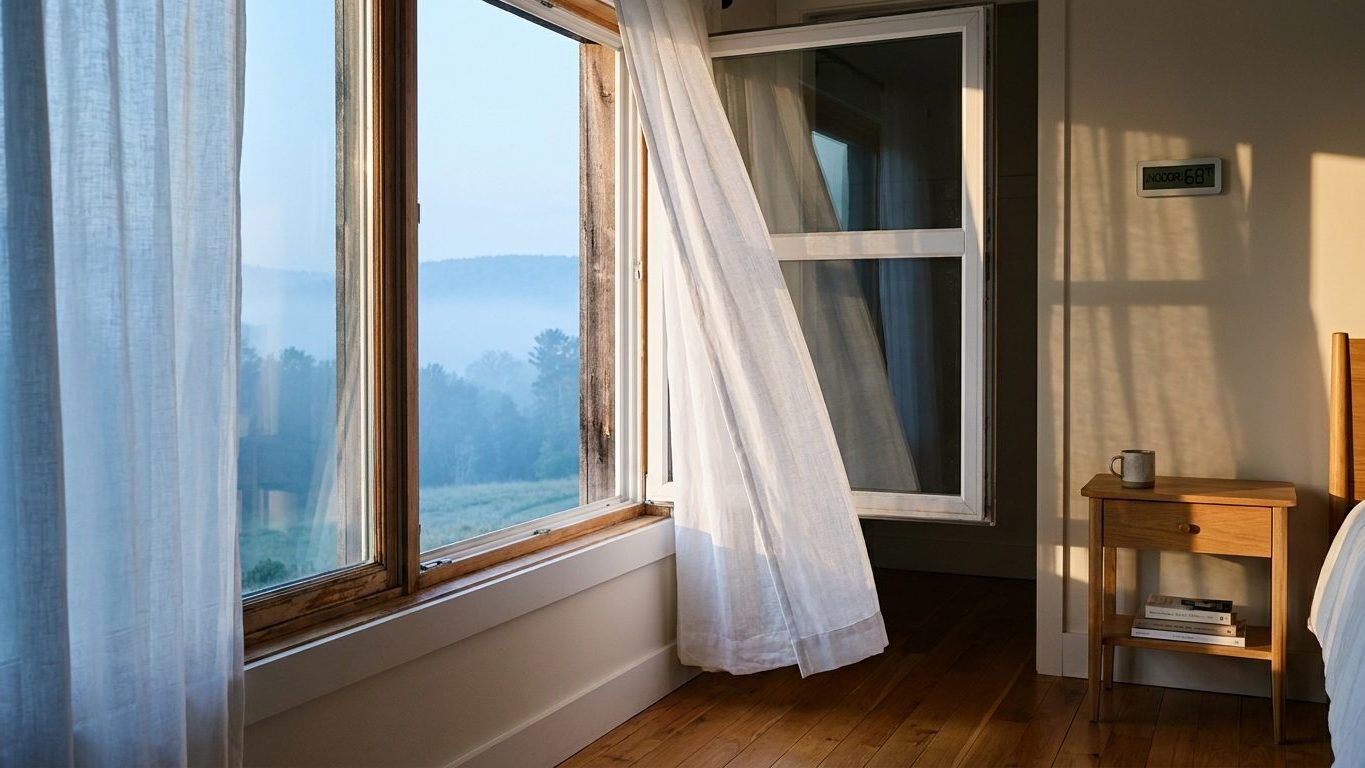

Cooling a house at night means opening it up when the outside air is cooler than the air inside, letting that cooler air replace the warm air trapped since yesterday, then sealing the house shut before the outside temperature climbs past the inside one again. It works only on nights where that swing is real, and only if the house is closed at the right moment. Get the timing wrong and the technique does nothing at all.
Store the cool, then shut it in
The whole strategy fits in three sentences. On any day where the nighttime low drops below the temperature the house is currently holding, opening windows overnight trades that stale warm indoor air for cooler outdoor air. Then, before the sun starts warming things back up, closing the house locks that cooler air inside. The walls, floors, furniture and anything with mass in the house absorb some of that coolness and release it slowly through the day, acting like a battery that was charged overnight.
Two things decide whether this actually amounts to anything noticeable by afternoon. The first is the size of the day-to-night swing. A place where nights drop well below daytime highs gives the strategy real material to work with. A place where the night barely dips gives it almost nothing to store, no matter how carefully the windows are managed. This is a summer-season pattern most relevant in the Northern Hemisphere, where the widest day-to-night swings typically show up inland and at higher elevation, away from the moderating effect of large bodies of water.
The second factor is entirely about discipline: closing the house up before the outside air gets warmer than the inside air. This sounds obvious until you’re the one who forgot the windows were open at nine in the morning, by which point the house has spent an hour taking in air that’s actively working against the cooling instead of adding to it. The technique doesn’t fail because the physics stopped working. It fails because somebody left the windows open past the point where opening them still helped.
A house with more mass, think tile floors, brick, plaster walls, poured concrete, holds onto stored coolness longer than one built mostly of drywall and carpet. That’s not a reason to renovate. It’s a reason to expect faster fade-out in a lighter-framed house and plan the schedule accordingly, watching the indoor temperature climb back sooner rather than assuming last night’s effort is still paying off by mid-afternoon.
The hour is the whole technique
There’s no clock time that works as a rule here, because the right moment moves with the weather, the season, and the specific house. What decides everything is not when the sun sets or rises, but where the indoor temperature sits relative to the outdoor one at any given moment. Open the windows too early, while the outside air is still warmer than the air already trapped inside, and the house takes in the day’s leftover heat instead of shedding it. Close everything too late, after the outside air has already warmed past the inside, and the house spends its final open hour absorbing exactly the heat this whole effort was meant to avoid.
The practical method comes down to four steps, done by comparison rather than by schedule:
- Check indoor and outdoor temperature side by side, whether by hand at a window screen or with a thermometer in each spot, rather than assuming a given hour of the evening or morning means anything on its own.
- Open windows once the outside air is genuinely cooler than the air inside the house, not simply because it’s dark or late.
- Move air through the house rather than around it: position a fan at one open window pulling air in, or at another pushing air out, so there’s an actual path from one side of the house to the other instead of air just circulating inside a single closed room.
- Close every window and door the moment the outside temperature catches up to, or passes, the indoor temperature, which usually happens sometime as the morning warms, but on the specific timeline of that day and that house.
One caution worth flagging here: a Whole-House fan or attic fan pulling large volumes of air out of a closed house can depressurize it enough to pull combustion byproducts back down a naturally-drafting flue or chimney instead of letting them vent outside. It’s not a reason to avoid the technique, but it’s a reason to know the symptoms and mechanisms of carbon monoxide exposure if the house has a fuel-burning furnace, water heater, or fireplace with a natural draft.
When it does not work
Not every night, house, or season cooperates with this strategy, and pretending otherwise just wastes an evening of open windows for nothing. The honest limits are worth laying out plainly.
| Condition | What happens | What you’d notice |
|---|---|---|
| A night that stays warm | There’s little or no swing for the house to draw on, so opening windows brings in air that’s barely different from what’s already inside | The house feels about the same in the morning as it did before you opened anything |
| A humid climate | Incoming night air can carry moisture that the house holds onto once it’s sealed back up | Rooms that feel damp or heavy the next morning, even though the temperature itself dropped |
| A house with little mass | There’s not much material to absorb and hold the overnight coolness | The indoor temperature climbs back within an hour or two of closing up, instead of holding through the afternoon |
| A noisy or unsafe street | Open bedroom windows overnight aren’t a realistic option regardless of the temperature math | You’d be trading sleep quality or safety for a cooling gain that isn’t guaranteed anyway |
| Allergy season | Pollen and other outdoor allergens move indoors along with the cooler air | Morning congestion or irritation that tracks with pollen counts rather than temperature |
None of these rule out the technique outright. They just mean the payoff depends on the specific night, the specific house, and the specific person sleeping in it, not on a general rule that says night air is always worth letting in.
What makes it work better
Night ventilation only pays off if the house doesn’t immediately undo the overnight gain once the sun comes up, and that comes down to two things happening during the day rather than at night: keeping direct heat out, and keeping heat from sneaking in through the ceiling.
Shading is what keeps the sun’s heat from ever reaching the glass and walls in the first place. A window that’s shaded from the outside, whether by an overhang, an awning, or exterior blinds, blocks heat before it ever becomes a problem the house’s mass has to absorb and slowly lose. That matters directly here, because a house that gains heat quickly during the day burns through its overnight cooling reserve faster, making the whole strategy feel less effective than it actually is.
Insulation plays a related but separate role, sealing off the pathways where daytime heat sneaks into the living space regardless of what’s happening at the windows. The U.S. Environmental Protection Agency’s ENERGY STAR program puts a number on this: “EPA estimates that homeowners can save an average of 15% on heating and cooling costs (or an average of 11% on total energy costs) by air sealing their homes and adding insulation in attics, floors over crawl spaces, and accessible basement rim joists.” That figure covers those specific parts of the building envelope, attics, floors over crawl spaces, and rim joists, not shading and not windows, which is why both pieces matter separately rather than one substituting for the other.
A house that blocks daytime heat gain through shading and stops it from leaking in through the attic gives night ventilation something worth protecting. Without that groundwork, the coolness brought in overnight gets burned through by early afternoon regardless of how carefully the windows were timed.
Common questions
Do I need a fan to cool a house at night, or do open windows work alone?
Open windows alone can work if there’s a natural cross-breeze between two sides of the house, but a fan positioned to move air through the house, in one opening and out another, generally moves more air than relying on wind that may or may not show up on a given night.
Should I open windows on the shaded side of the house or the sunny side?
At night, the sun isn’t a factor either way, so the choice comes down to which side is actually cooler and which arrangement lets air move through the house rather than just into one room and back out the same opening.
Is it worth night-cooling a house that has no attic insulation?
It’s still worth trying on nights with a real temperature swing, but the gain will likely fade faster during the day, since a poorly insulated attic lets daytime heat migrate into the living space and erode the overnight coolness sooner.
Can night ventilation replace air Conditioning entirely?
For some climates and some houses on some nights, it noticeably reduces the need for mechanical cooling, but it depends entirely on a real day-to-night temperature swing existing in the first place, which isn’t the case everywhere or every night of the summer.