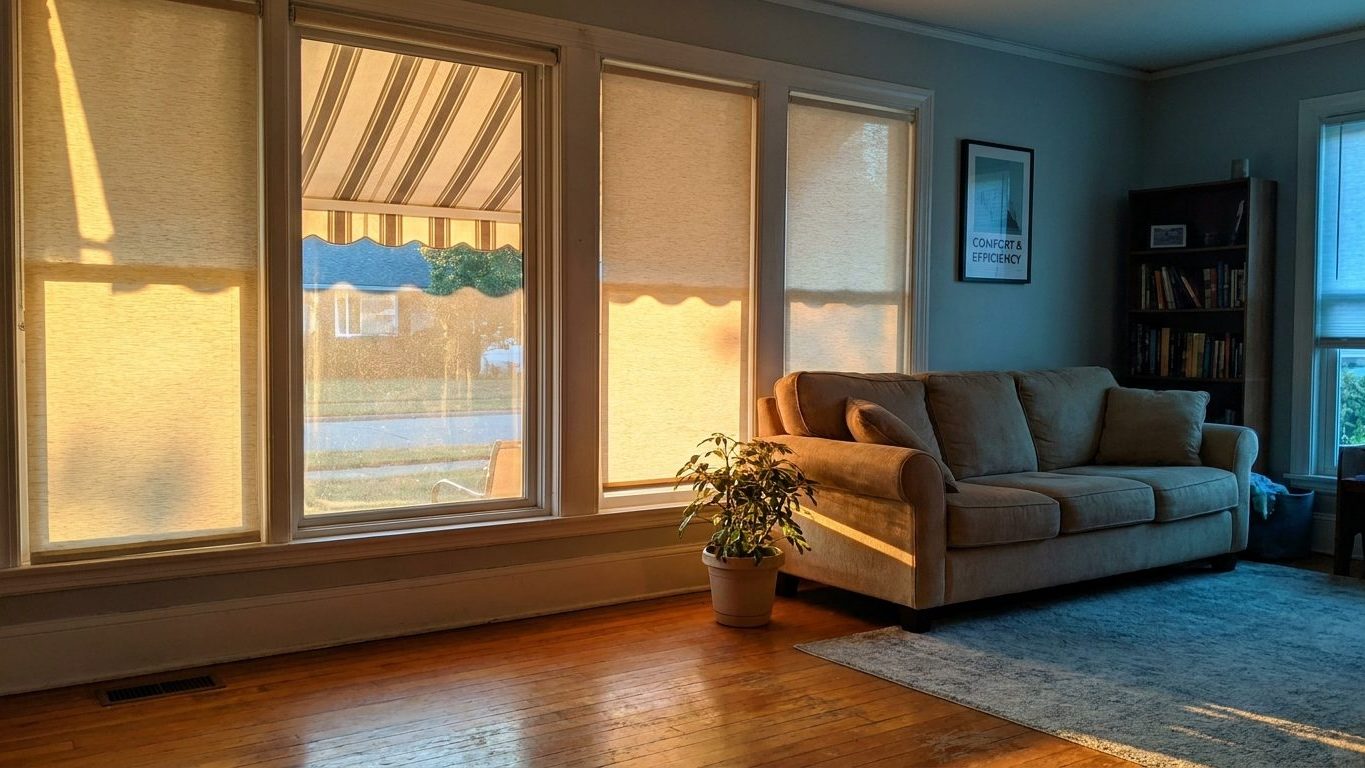

Keeping the sun out of a house comes down to stopping it on the outside of the glass: awnings, exterior shades, shutters, deep eaves, a tree on the west side. Interior blinds help less, because the heat is already indoors by the time they act. Shade never catches every bit, though, so the house still stores warmth by evening. A whole-house fan is the tool that clears that stored heat, and it comes with conditions of its own. They fill the rest of this page (everything here assumes the Northern Hemisphere, where south and west glass takes the hardest sun).
It does not cool air, it replaces it
A whole-house fan sits in the ceiling, usually in a hallway, and pulls air up out of the living space into the attic. From there the air leaves through the roof vents. Open windows let outdoor air in to replace what the fan removes. That is the entire job. No coil, no refrigerant, no compressor.
An air conditioner works the opposite way. It takes the same indoor air, runs it past a cold surface and dumps the heat outside. The fan never cools a single cubic foot. It throws the indoor air away and takes whatever the outdoors is offering. Because it moves a very large volume of air, far more than a ceiling fan stirring a single room, the house can be exchanged for outdoor air quickly. The attic needs enough vent opening to let all that air escape, and the fan’s installation instructions spell out how much.
The one condition
So the fan helps only when the outdoor air is cooler than the indoor air. When it is, the exchange pulls heat out of the rooms and, over time, out of the walls, floors and furniture that soaked up warmth all day. When it is not, the fan does the reverse and hauls heat inside at high volume.
That single condition governs everything else on this page. It also explains why shade belongs in the same plan. Sun passing through glass is what loads the house with heat in the first place, and shade on the outside of the window cuts what the fan has to clear overnight. The fan manages heat that is already inside. Shade keeps it from arriving. (Shade has its own condition: it only works from the outside of the glass.)
For a closer look at the equipment itself, see The Whole-House Fan: Emptying the House of Hot Air.
The hours when it works
Evening and early morning. After sunset, outdoor air drops below indoor air, but the house keeps its day’s heat for a while, held in the framing, the drywall and the furniture. The gap between the two is the fan’s working window. Sunset falls at a very different time in Maine than in Arizona, and a mild night in one place is a warm one in another, so no clock time applies everywhere. The test is a comparison: a thermometer outdoors in the shade beside one indoors. When outside reads cooler, the window is open. When the two match, it is closed.
Wrong hour, wrong air
Run the fan on a hot afternoon and every open window becomes an intake for hotter air. The house heats faster than it would have with everything shut, and the fan is the cause.
Moisture is the second cost. Outdoor air carries water vapor along with its heat, and a fan pulling in damp evening air delivers that vapor into the house. Carpets, upholstery and drywall absorb it and release it slowly afterward. What you would notice is air that feels clammy, surfaces that feel slightly sticky, or cool windows that fog. Whether your evenings are dry or damp is something you can judge by how the air feels. Rainfall totals will not tell you.
The routine
- Open windows first. Open several in the rooms you want flushed, and open the interior doors between those rooms and the fan.
- Run the fan once the outdoor air is cooler than the indoor air, and keep it going while that gap holds. Turn it off when the two read about the same, or the house feels cool enough.
- Close up in the morning. Switch the fan off first, then shut the windows and doors while the house is still holding the night’s cool.
- Shade the house through the day. Keep exterior shades, awnings or shutters over sun-facing glass, so the cool you stored is not immediately refilled with heat.
While people are in a room during the day, a ceiling fan takes over a different job. It cools the person, not the air, and Ceiling Fans: What They Cool, and the Switch Nobody Uses covers it in detail.
The mistake that damages things
Here is the point people get wrong. A whole-house fan moves a lot of air. Run it with the windows closed and the air it pushes into the attic has to be replaced from somewhere, so the house depressurizes. The replacement air comes in through whatever gaps exist: around doors, through the walls, down chimneys and flues.
In a home with a fuel-burning appliance, that last route matters. A water heater or furnace on a natural-draft flue relies on hot exhaust rising up the vent by itself. A strong fan can overpower that gentle pull and draw combustion products back down the flue and into the living space, carbon monoxide included. Windows open first, always. Once is enough to say it, but it has to be every time.
When a house deserves a second opinion
A house with a gas or oil water heater or furnace on a natural-draft flue is a case for professional advice before the fan is installed or used. A qualified HVAC contractor or home energy auditor can check how the appliances behave when the house is under negative pressure, and tell you whether open windows are enough or the setup needs changing. The carbon monoxide guide on this site explains the hazard, where to place alarms and what a reading means. Read it if any appliance in your house burns fuel.
A house with no fuel-burning equipment does not face this particular risk. Open windows still matter there, but for a plainer reason: a fan starved of replacement air labors, moves less, and can strain its motor and pull on doors.
And in winter it is a hole in your insulation
Nobody plans for this one. The fan is a large opening cut between the heated house and the attic. When it is off, it is closed only by light louvres, panels that swing open under airflow and drop shut when it stops. They neither seal nor insulate. On a January night, warm indoor air rises straight through the gaps into the cold attic. In July, the superheated attic air pushes back down in the other direction. Season after season, a fan that cost you nothing to run is leaking heat around the clock.
What an insulated cover does
An insulated cover is a fitted box or panel that closes the opening, usually from the attic side or from inside the house, with a gasket that seals the edge. It restores the insulation and the air seal that the louvres never provided. In winter, when the fan is idle for months, the cover is what separates a useful appliance from a permanent leak. Take it off when the cooling season starts and put it back when it ends. Some fans can be fitted with one and some come with one, so ask before you buy.
The brief for this page carries no price for covers, fans or installation, and a number pulled from somewhere else would not be reliable. What drives the cost is the size of the opening, how the fan is built into the ceiling, how easy the attic is to reach, and whether you or a contractor does the work. A written quote settles it.
The size of the problem is worth putting in context. The U.S. ENERGY STAR program states: “EPA estimates that homeowners can save an average of 15% on heating and cooling costs (or an average of 11% on total energy costs) by air sealing their homes and adding insulation in attics, floors over crawl spaces, and accessible basement rim joists.” Those are averages from modeling of a typical existing home, and they describe sealing and insulating those specific areas. They do not describe shading, windows or the fan on its own. But a ceiling opening into the attic is exactly the sort of leak that air sealing targets, which is why the attic sealing and attic insulation guides on this site belong next to this page.
One check costs nothing. On a cold, windy day, hold your hand near the louvres from inside. If you feel a draft or a chill, the opening is working against your heating bill.
Common questions
What is the best way to keep sun out of a house?
Block it outside the glass. Awnings, exterior shades, shutters and trees stop the sun before it passes through the window, while interior blinds act after the heat is already in the room. Start with the windows that face south and west, where the afternoon sun is strongest in the Northern Hemisphere.
Can I run a whole-house fan during the day?
Only when the outdoor air is cooler than the indoor air, which on most summer afternoons it is not. Compare an outdoor thermometer in the shade with one indoors. If outside is not cooler, the fan is bringing heat in.
Does a whole-house fan replace air conditioning?
No. It does not cool the air, it exchanges it, so it helps only during the hours when outdoor air is cooler than the house. On damp evenings it can also bring in moisture the house will hold onto. Judge by how the evening air feels where you live.
How much does an insulated fan cover cost?
No reliable figure applies to every home. The price depends on the size of the opening, how the fan is built into the ceiling, how hard the attic is to reach, and whether you or a contractor does the work. A written quote is the way to settle it.