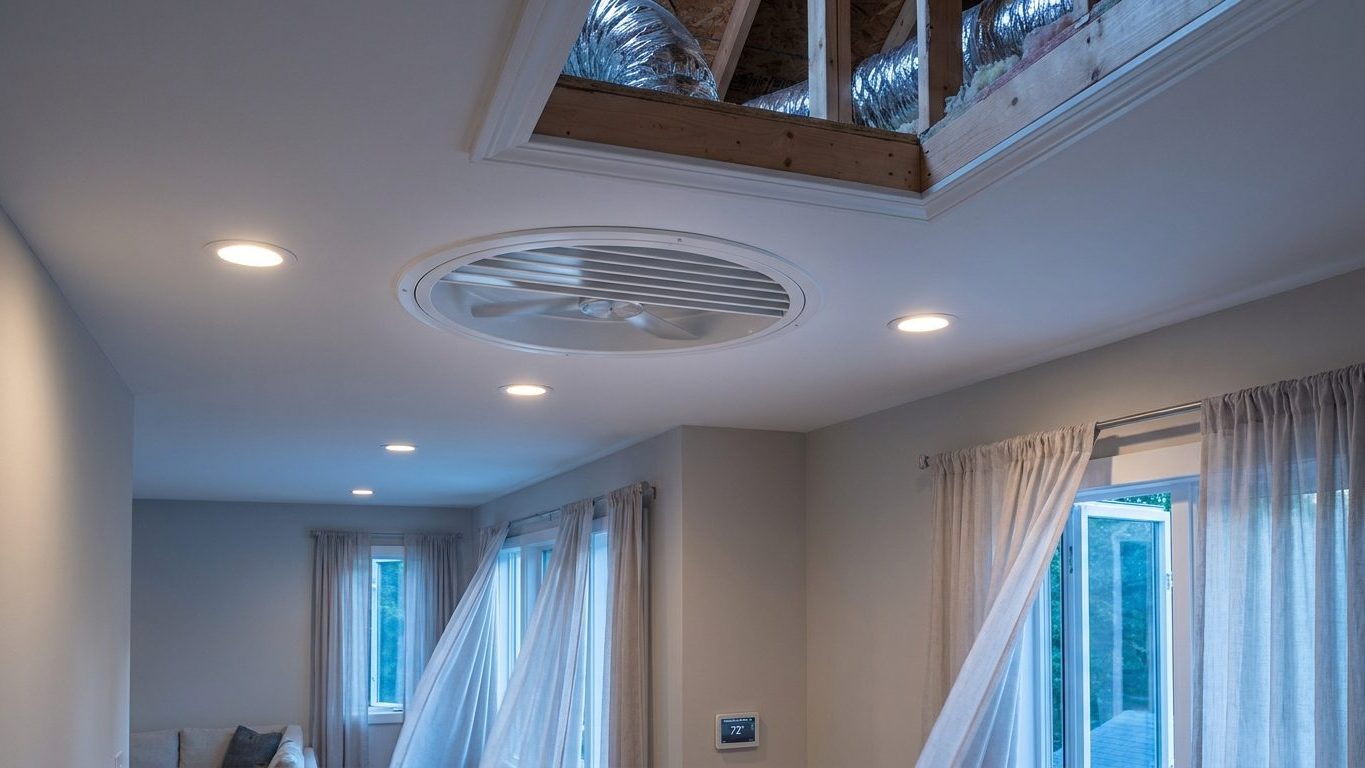

A whole-house fan cools a home by swapping its air for outdoor air, not by chilling it. Mounted in the ceiling and vented through the attic, it pulls hot indoor air upward and out while open windows let cooler outdoor air take its place. It only helps when the air outside is actually cooler than the air inside, which for most of the country means the hours around sunset and sunrise. Run it at the wrong time, or with the windows shut, and it stops helping and starts working against you.
It does not cool air, it replaces it
The unit itself is simple: a large fan set into a hole cut in the ceiling, usually in a hallway or landing, with a housing that opens into the attic space above. Flip it on and it pulls air out of the rooms below, pushes it into the attic, and forces it out through the roof or gable vents that were already there. That air has to come from somewhere, so with windows cracked open around the house, outdoor air gets drawn in to fill the gap the fan just created downstairs.
Nothing about that process lowers the temperature of the air. An air conditioner extracts heat and moisture from the air it circulates; a whole-house fan just trades the entire volume of air in the house for whatever is sitting outside at that moment. If it’s 95 degrees outside, running the fan fills the house with 95-degree air, only faster than it would arrive on its own. The appliance is a pump, not a refrigerator. Its only job is to move a large volume of air through the building envelope quickly.
That is why the single question that decides whether to flip the switch is a comparison, not a setting: is the air waiting outside cooler than the air already inside? When the answer is yes, the fan accelerates something that would happen anyway through open windows, just far faster, because the fan can exchange the entire air volume of a house in a few minutes rather than over hours of gentle drafts. When the answer is no, there is nothing for the fan to do except move warm air around, and running it burns electricity for the fan motor with no gain.
Context matters here too. Federal housing data (U.S. Energy Information Administration, RECS 2020) shows 89 percent of U.S. homes use some form of air-conditioning equipment, with 67 percent relying on a central system and 26 percent on individual units. That share swings enormously by state: Arizona sits at 94 percent overall and 86 percent central, Connecticut at 90 percent overall but only 34 percent central, and Alaska at just 7 percent air conditioning of any kind, alongside 46 percent ceiling fans. Those numbers describe what got installed when each region’s housing stock was built and what buyers there could afford, not a verdict on what any single house needs. A whole-house fan fits into that picture as a way to reduce reliance on whichever cooling system is already in place, on the days the outdoor air actually cooperates.
The hours when it works
The whole routine comes down to timing, and the timing comes down to one comparison repeated twice a day: is it cooler out there than in here right now? In the northern hemisphere, that condition is usually met in the evening as the sun goes down and again in the early morning before it climbs back up, because those are the hours when outdoor air temperature typically drops below whatever has built up inside the house during the day.
Running the fan outside that window does the opposite of what a homeowner wants. If the outdoor air is still warmer than the indoor air, drawing it through the house just adds heat load that the house didn’t have yet, and it does it aggressively, since a whole-house fan moves air far faster than a breeze through an open window ever could. In a climate where summer air carries a lot of moisture, that same exchange also pulls that moisture inside, and a house holds onto damp air a lot longer than it holds onto heat. Whether a particular summer counts as humid enough to matter is something only the person living there, in that specific location, can judge by watching what happens to the windows and walls after a night of running the fan.
A workable routine
The sequence that keeps the fan doing its job and nothing else looks like this:
- Open windows throughout the house before turning the fan on, so there’s a clear path for outdoor air to replace what the fan pulls out.
- Run the fan while outdoor air is measurably cooler than the air already inside, drawing that cooler air through the living space.
- Close windows and shut the fan off once outdoor temperatures start climbing back toward or past the indoor level.
- Shade the house through the day, since blocking sunlight before it hits glass and walls keeps the indoor air from building up as much heat for the fan to deal with come evening.
None of this requires a thermometer mounted on the porch. A hand at an open window in the evening and again at dawn tells most people everything the routine requires.
The mistake that damages things
A whole-house fan is not a subtle appliance. It is built to move a very large volume of air through the house in a short span of time, and that volume has to come from somewhere. With windows open, it comes from outside, exactly as intended. With windows closed, the fan keeps pulling anyway, and the only air left for it to draw on is whatever it can find inside the building envelope, through gaps around doors, through unsealed penetrations, and through anything else connected to the house’s air supply.
That is depressurization, and in most homes it’s a minor nuisance: a door that’s harder to open, a faint whistle at a weatherstrip. In a home with a fuel-burning water heater or furnace on a natural-draft flue, it is a different problem. Those appliances rely on that flue carrying combustion byproducts up and out through natural pressure differences. A strongly depressurized house can reverse that flow, pulling combustion products back down the flue and into the living space instead of venting them outside.
Say it plainly, once: windows open first, always, before the fan runs, no exceptions for a quick blast of air on a still evening. And a house with a natural-draft water heater or furnace is a case worth a conversation with whoever installed or services that equipment, not a guess made in the moment. For a fuller explanation of how depressurization interacts with combustion appliances, and what the warning signs of a backdraft look like, see this site’s carbon monoxide safety guide.
And in winter it is a hole in your insulation
Once summer ends, the fan doesn’t disappear, it just stops being useful. What’s left is a large opening cut straight through the ceiling, connecting the conditioned living space directly to the unconditioned attic above it. Most whole-house fans close off that opening with light louvers, spring-loaded flaps that swing shut when the fan isn’t running. Those louvers keep out insects and stop the obvious draft, but they were never designed to seal or insulate anything. Warm indoor air still finds its way up through the gaps around them all winter long, and attic cold settles right back down into the room below.
An insulated cover changes that equation. Fitted over the fan housing from the attic side, it seals the opening the way the rest of the ceiling is supposed to be sealed, and it adds insulating value roughly in line with what surrounds it, instead of leaving a bare metal grille as the weak point in an otherwise insulated ceiling. Without one, a whole-house fan behaves like an uninsulated skylight cut into the attic floor, a detail easy to overlook because it’s summer equipment being judged by a winter standard nobody thinks to apply.
This is the same logic behind broader guidance on sealing a home’s air barrier, which typically names the attic floor, floors over unconditioned crawl spaces, and rim joists as the priority points where conditioned air escapes fastest. A whole-house fan opening belongs on that same list, since it’s one more penetration through the same attic floor those recommendations are built around. For the fuller picture on where a house loses conditioned air and how to close those gaps, this site’s attic sealing and attic insulation guides cover the rest of the attic floor beyond just the fan housing.
Common questions
Does a whole-house fan replace an air conditioner?
No. It works only when outdoor air is cooler than indoor air, which limits it to certain hours and certain nights. On days when outdoor temperatures stay high around the clock, it has nothing to offer and a cooling system that actually removes heat from the air is the only option left.
Can I run a whole-house fan all night with the windows closed?
No. The fan needs an open path for replacement air to come from outside. Running it with windows shut depressurizes the house instead, which can pull combustion gases back down a natural-draft flue in a home with gas appliances.
Does a whole-house fan help with humidity?
It moves whatever air is outside into the house, moisture included. If the outdoor air carries more moisture than the indoor air already holds, running the fan adds that moisture to the house, and a house holds onto damp air longer than it holds onto heat.
Do I need to cover the fan in winter?
Yes, unless the fan came with a sealed, insulated cover already installed. Standard louvers close off the opening but don’t seal or insulate it, leaving a gap in the attic floor’s insulation that lets conditioned air escape all winter.