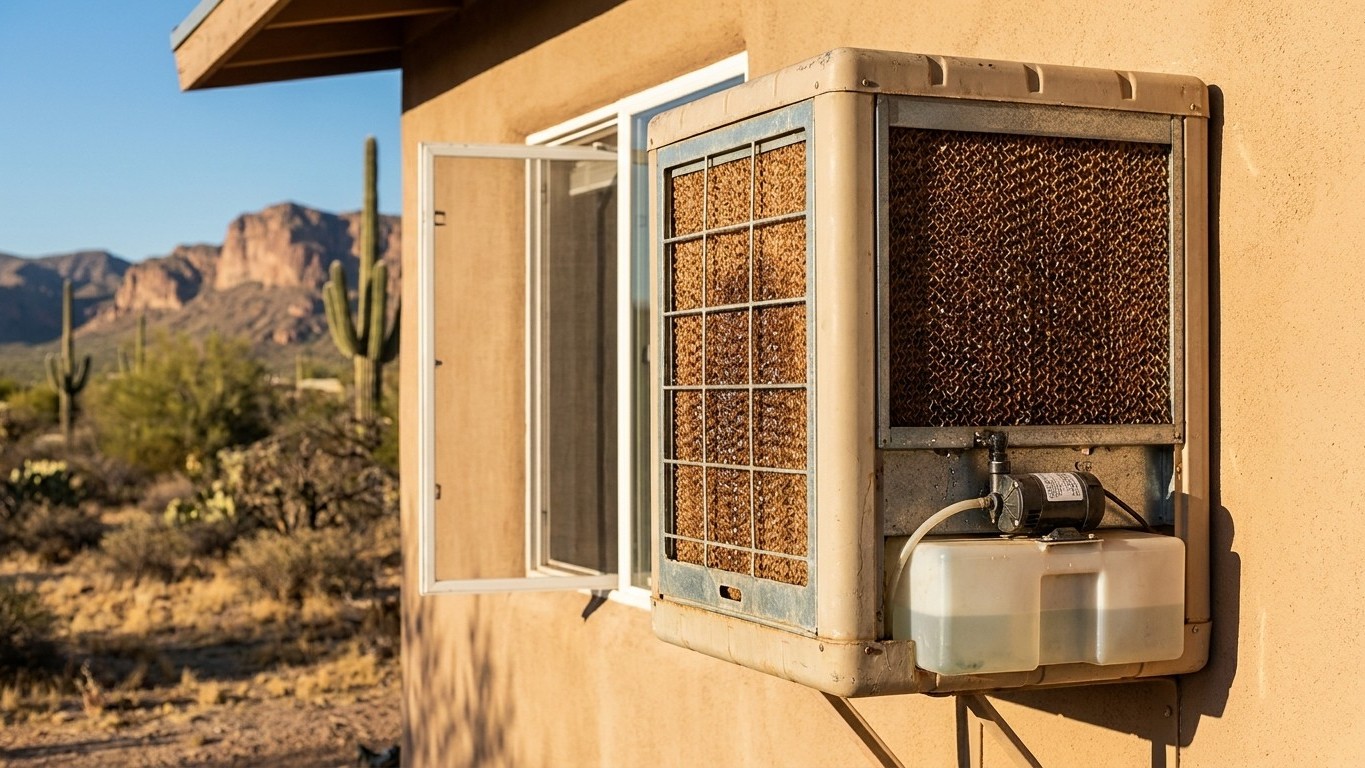

An evaporative cooler, often called a swamp cooler, lowers air temperature by pulling it through water-soaked pads so the water evaporates and takes heat with it. No refrigerant, no compressor, no sealed loop. That single mechanism explains everything else about the machine: why it performs beautifully in some regions and barely at all in others, why it demands open windows instead of a closed house, and why its maintenance calendar looks nothing like a central air system’s. This description holds for the Northern Hemisphere, where summer runs June through September.
It cools by evaporating water
A fan pulls outside air through pads kept wet by a small pump and a water reservoir. As the air passes through, some of that water evaporates directly into the airstream. Evaporation is a heat-hungry process, it draws energy from its surroundings to turn liquid water into vapor, and the energy it draws comes straight out of the air moving through the pads. That air leaves the unit measurably cooler than it entered. There’s no refrigerant cycle compressing and releasing heat outside, no sealed coils, no compressor drawing a heavy electrical load. The whole system is closer to a fan and a wet sponge than to an air conditioner, and it uses a fraction of the electricity a compressor-based unit needs to run.
The catch is built into the same reaction that produces the cooling. Air that has just picked up evaporated water is not only cooler, it’s also more humid than it was before it went through the pads. There’s no way to get one effect without the other. The machine isn’t removing moisture from the house the way an air conditioner’s cold coil does when humid air condenses against it; it’s adding moisture, on purpose, as the mechanism by which it cools.
How much cooling comes out the other side depends almost entirely on one thing: how much room the incoming air had to hold more water vapor before it arrived at the pads. Air that starts out dry can absorb a great deal of additional moisture, and each bit of water it takes on pulls more heat out of it in the process. Air that starts out already carrying a lot of moisture has little capacity left, so less water evaporates, and less heat gets pulled out. The pads and pump don’t change output, the incoming air does.
This is also why a swamp cooler’s performance swings through the day and through the season in a way a refrigerant-based system’s doesn’t. The compressor in a central air conditioner produces roughly the same cooling effect on a humid morning and a dry afternoon, because it isn’t relying on the air itself to do the work. An evaporative cooler is entirely dependent on the condition of the air it’s given, which means its output changes with the weather outside, not just the setting on a dial.
Where it works, and where it does nothing
The honest way to describe an evaporative cooler’s range is by what it needs, not by naming which states qualify. It needs air with room left to absorb more water vapor. When that room exists, the pads keep giving up moisture, the evaporation keeps drawing heat out, and the air coming through the vents feels noticeably cooler than the air it replaced. A household running one under those conditions would notice the difference within minutes of switching it on: airflow that feels cool and slightly damp, not just moving air at room temperature.
When the incoming air already carries a lot of moisture, the same pads and the same pump produce a very different result. There’s little capacity left for the air to take on more water, so evaporation slows, and the heat that evaporation is supposed to remove doesn’t leave. What a household would notice in that case is air that feels damp without feeling meaningfully cooler, sometimes even clammy, because the machine has added humidity to a house that had nowhere to put it. That’s the honest failure mode: not that the unit breaks, but that it keeps running and keeps humidifying without delivering the cooling it’s designed for.
This page carries no humidity data, no relative humidity figures and no dew point numbers, and it isn’t going to convert summer rainfall totals into a humidity forecast. Rainfall measures inches of precipitation falling from the sky; it says nothing directly about how much moisture is already sitting in the air on a given afternoon. A place can have modest annual rainfall and still see stretches of muggy air, and a place with heavier annual totals can still have dry spells. The only reliable test is the one described above: run the machine, and see whether the air coming out feels cooler than the air going in, or just wetter.
Federal housing data gives a sense of how differently U.S. households have equipped themselves for summer heat, though it describes what’s installed, not what’s recommended. According to the U.S. Energy Information Administration’s 2020 Residential Energy Consumption Survey, 89% of U.S. homes have some form of air-conditioning equipment, 67% a central system and 26% an individual unit. The spread by state is wide: Arizona reports 94% of homes cooled and 86% with central air, Connecticut reports 90% cooled but only 34% central, and Alaska reports just 7% air conditioning of any kind alongside 46% relying on ceiling fans. Those numbers reflect decades of housing stock and regional building habits, not a verdict on which cooling method suits a given climate today.
| State | Any air conditioning | Central air conditioning |
|---|---|---|
| Arizona | 94% | 86% |
| Connecticut | 90% | 34% |
| Alaska | 7% | — |
It only works with the windows open
Anyone switching from central air to an evaporative cooler runs into a habit that has to change immediately: the house can’t stay sealed up. A swamp cooler works by continuously pushing air into the house, not by conditioning air that’s already inside and recirculating it through ducts. That incoming air has to have somewhere to go, or the whole system stalls.
- Air enters through the cooler’s supply vent, moving into the house under gentle positive pressure.
- For that air to keep moving, an equal volume has to exit somewhere else, typically through windows, vents, or a door cracked open on the far side of the house.
- Opening vents on the side of the house farthest from the unit lets air travel the full length of the living space before leaving, carrying the cooling effect through more rooms instead of dumping it all near the intake.
- How far those openings are cracked determines how much air moves and how strong the cooling feels; a barely-open window restricts flow and dulls the effect, while wider openings let the system move air the way it’s designed to.
- If the house is closed up tight, with windows and doors shut the way they would be for central air, the incoming air has nowhere to go. Pressure builds against the sealed envelope, the fan struggles to push air against that resistance, and airflow through the house effectively stops even though the unit is still running.
- Under those closed-up conditions, the moisture the cooler keeps adding has no path out either. Instead of blowing through and exiting with the displaced air, it accumulates, and the house starts to feel damp rather than cool.
This is the single biggest adjustment for anyone new to evaporative cooling: the impulse to shut windows against heat, which makes sense with central air, works directly against how a swamp cooler is built to operate. The system was designed around continuous airflow through the house, and that airflow requires an exit.
The maintenance it genuinely needs
An evaporative cooler’s maintenance schedule runs on a different rhythm than a refrigerant-based system’s, and it asks more of the household running it. There’s no annual coolant check or filter swap and forget; there’s a wet system that needs attention at both ends of the cooling season, plus periodic checks while it’s running.
Start of the season
- Inspect the pads for scale buildup and rot left over from the previous season; pads that have hardened with mineral deposits or gone soft and moldy don’t evaporate water efficiently and need replacing before the unit is used.
- Check the water tray and float valve, which controls how much water sits in the reservoir; a stuck float can either starve the pads of water or let the tray overflow.
- Test the pump that circulates water up to the pads, since a weak or failing pump means the pads run dry in patches even if the reservoir itself is full.
- Flush any mineral scale that’s built up in the tray and lines, particularly in areas with hard water, where dissolved minerals concentrate as water evaporates and leave deposits behind on every surface they touch.
End of the season
- Drain the water tray completely rather than leaving it filled once the unit is shut down for the year.
- Shut off the water supply line feeding the unit before freezing weather arrives, since water left standing in lines or a tray can freeze, expand, and crack fittings or the tray itself.
- Clean out any residue and let the pads and tray dry fully before covering or storing components, rather than sealing the unit up wet.
The tray and reservoir deserve regular attention during the season too, not just at the two ends of it. Water that sits in a tray for extended periods, especially once it’s warmed by summer heat, isn’t something to leave unattended between cleanings. Keeping the tray drained when the unit isn’t running and cleaned on a regular basis during the season is a reasonable habit for reasons that go beyond scale and pump wear, without needing to make broader health claims about what standing water attracts.
Common questions
Does a swamp cooler use less electricity than an air conditioner?
It generally draws less power because it runs a fan and a small water pump rather than a compressor, which is the main energy load in a refrigerant-based system. The size of that difference depends on the specific equipment involved and isn’t something this page assigns a number to.
Can I run a swamp cooler with the house sealed like it would be for central air?
No. The unit depends on continuous airflow through the house, with incoming air displaced through an open window, vent, or door elsewhere in the home. A sealed house stops that airflow and traps the added humidity instead of venting it.
Why does the air feel damp instead of cool sometimes?
That happens when the incoming air already has little room to absorb more moisture, so evaporation at the pads slows and less heat gets pulled out even as humidity keeps rising. It’s a sign of the mechanism running into its limit, not a sign the unit is broken.
Do the pads need replacing every year?
Pads that show scale buildup, rot, or mold at the start of a new season should be replaced rather than reused, since damaged or scaled pads don’t hold and release water evenly. Inspecting them before the season starts, alongside the pump, tray, and float valve, is part of the routine startup check.