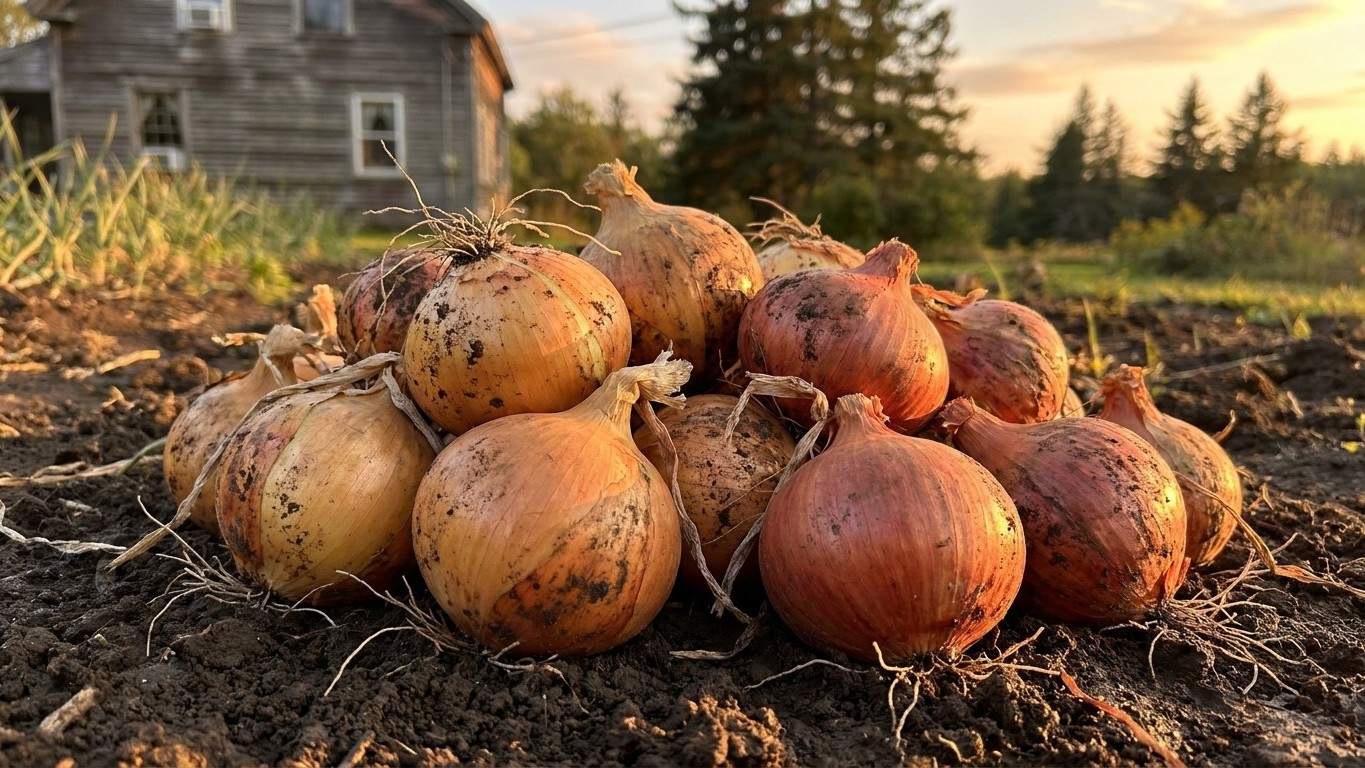

Lift Nebraska onions once the tops have fallen over and turned yellow, then cure them in a dry, airy spot until the necks are tight and the skins are papery. Nothing goes into storage straight from the ground. Day length, not the calendar, decides when an onion finishes growing. A bulb pulled early or stored wet will rot, and one that started growing late will never catch up. Below: how the timing works, what fails, and what your pantry looks like by March.
The short answer for Nebraska
Omaha sits at 41.31 degrees north, and on the longest day of the year it gets 14 h 59 of daylight. That figure is calculated for the geometric horizon, so real daylight runs about seven minutes longer. It matters because an onion bulbs when the day gets long enough, not when the weather gets warm enough. A short-day variety starts bulbing at about 12 hours of light, according to Clemson Cooperative Extension. A long-day variety waits for 14 to 16 hours. Omaha clears that bar, and that is why long-day onions are the ones that bulb well across Nebraska.
The practical result is a slow handoff. Leaves grow through spring while the days lengthen, the bulb swells around the solstice, and the plant then shifts its energy into the bulb and begins to die back. The harvest follows that dieback. The tops, not a date on the calendar, tell you when to dig.
Reading the tops
When the necks soften and the green tops flop over, the bulb has stopped growing. Wait until most of the row has gone down and the leaves are yellowing, then loosen the soil with a garden fork on a dry day and lift. Pulling while the tops are still upright and green usually gives you thick, wet necks. Those are the first spot where rot gets in during storage. Rain near harvest is a nuisance, so if a wet spell is forecast and the tops are down, lift early and cure under cover.
Curing before storage
Curing is drying, and it comes first. Lay the bulbs in a single layer with the tops still attached, somewhere shaded, dry, and moving air: a garage with the door cracked, a covered porch, a shed with open windows. The job is done when the necks are tight and wiry, the outer skins rustle like paper, and the roots are dry. Only then trim the tops short and brush off loose soil. Don’t wash the bulbs.
What will not work here
Planting late does not push the harvest later. It shrinks it. Whatever size the plant has reached when day length triggers bulbing is the size of the bulb, so a seedling that went in behind schedule makes a small onion on the same date as everyone else’s big ones. The same logic governs the rest of the process. Several habits that seem reasonable fail in a predictable way:
- Short-day varieties planted in spring: they bulb at about 12 hours of light, which Nebraska passes early in the season, so the plant stops leafing out while still small and gives you a small bulb.
- Storing straight from the ground: an uncured bulb still holds moisture in the neck, and that moisture is where rot starts in the bin.
- Pulling while the tops are green and upright: the bulb is still growing and the neck is still open, so the onion comes out smaller and will not seal.
- Washing the bulbs: added water on the skins slows curing and invites mold.
- Keeping onions in a damp root cellar: onions want 50 to 60 percent humidity, the opposite of carrots, and one cellar cannot hold both well.
- Counting on sweet types for winter: they run out first, as the fourth section explains.
A long-day variety in the wrong place fails more slowly. Plant one in the Deep South, where the longest day never gets near 14 hours, and you get leaves all season, no bulb, then rot. Nebraska is on the right side of that line. Your risk here is planting the wrong group for your spring, not the wrong state. For the sorting, see The Best Onion Varieties for Nebraska.
What changes across Nebraska
The figures above belong to Omaha, in the east of the state, and a state is not one latitude. Nebraska runs from the Kansas line in the south to the South Dakota line in the north, a span of several degrees. Day length climbs as you go north, so a gardener near the northern border gets a slightly longer longest day than 14 h 59, and one near Kansas gets a slightly shorter one. We do not publish those edge figures here, so check your own.
| Location | Latitude | Longest day | What it changes |
|---|---|---|---|
| Omaha (reference city) | 41.31 degrees north | 14 h 59 | Long-day onions bulb reliably; tops fall after the solstice |
| Far northern Nebraska | Higher than Omaha | Slightly longer than 14 h 59 | Even more room for long-day types; they will keep longer |
| Far southern Nebraska | Lower than Omaha | Slightly shorter than 14 h 59 | Still well above 12 hours; bulbing and lifting may come a bit earlier |
Neither edge changes the group. The whole state clears 12 hours easily, and it sits in or near the 14-to-16-hour band that long-day onions need. What moves is the timing. A garden in the south may be ready to lift earlier than one in the north, and a gardener at either edge will find that planting and harvest dates drift by a week or two from Omaha’s. Local frost dates and soil temperature adjust that further. If pests are cutting into your crop before you reach harvest, What Eats Onion in Nebraska, and When covers the timing, and the broader picture lives in Onions in Nebraska.
Sweet now, or onions that last
The bite of an onion comes from volatile sulfur compounds. Those same compounds are what protect the bulb in storage. A sweet onion has fewer of them. That makes it better raw and worse in the cellar. University of Missouri Extension puts it flatly in its onion guide (G6355): “As a rule, ‘sweet’ onions do not store as well as the more pungent types.” It is chemistry, not bad luck, and no growing trick changes it.
Day length lines up with this. Short-day types run sweeter, long-day types keep longer. Southern gardens tend to get onions to eat soon, and northern ones get onions that last. Nebraska, grown to long-day types, sits on the keeping side of that trade.
Here is what the pantry looks like in March. A well-cured, pungent long-day onion stored cool and dry should still be firm, with a few soft ones to cull as you go. A sweet onion, even a well-cured one, will have gone soft, sprouted, or turned to mush well before that. The practical split is simple: eat the sweet ones first, in late summer and fall, and save the pungent ones for winter. Clemson Extension’s onion, leek, shallot and garlic factsheet gives the ideal storage conditions as between 45 °F and 55 °F, and 50 to 60 percent humidity.
Checking this against your own garden
Everything here is anchored to one station in Omaha, so treat it as a starting point, not a verdict for your yard. A few things you can check this week:
- Look up your own latitude, especially if you are far north or far south of Omaha, and compare it with 41.31 degrees north.
- Find your local first and last frost dates. They are not published here, and they decide how much growing season your onions get on either side.
- Call or visit your county’s University of Nebraska–Lincoln Extension office and ask which onion types and planting windows suit your area.
- Put a thermometer and a humidity gauge in the spot where you plan to store onions. You want 45 °F to 55 °F and 50 to 60 percent humidity.
- Check which variety you planted. If it is a short-day type, expect smaller bulbs and a shorter shelf life, and plan to eat them first.
Common questions
How do I know when onions are ready to lift?
Wait until most of the tops have fallen over and started to yellow. That means the bulb has stopped growing. Pulling while the tops are still green and upright gives you smaller bulbs with open necks that will not store well.
How long does curing take?
There is no fixed number of days in our sources. Cure until the necks are tight and the skins are papery, which depends on weather and airflow. Hot, dry, breezy conditions finish faster than humid ones. Do not store the onions until both checks are met.
Can I store sweet onions through winter?
Not reliably. University of Missouri Extension notes that sweet onions do not store as well as pungent ones, because they carry fewer of the sulfur compounds that protect a bulb. Eat them first and keep the pungent ones for later.
Where should I keep cured onions?
Somewhere cool, dry, and airy, at 45 °F to 55 °F and 50 to 60 percent humidity. A damp root cellar suits carrots but not onions, so keep the two apart if you can.