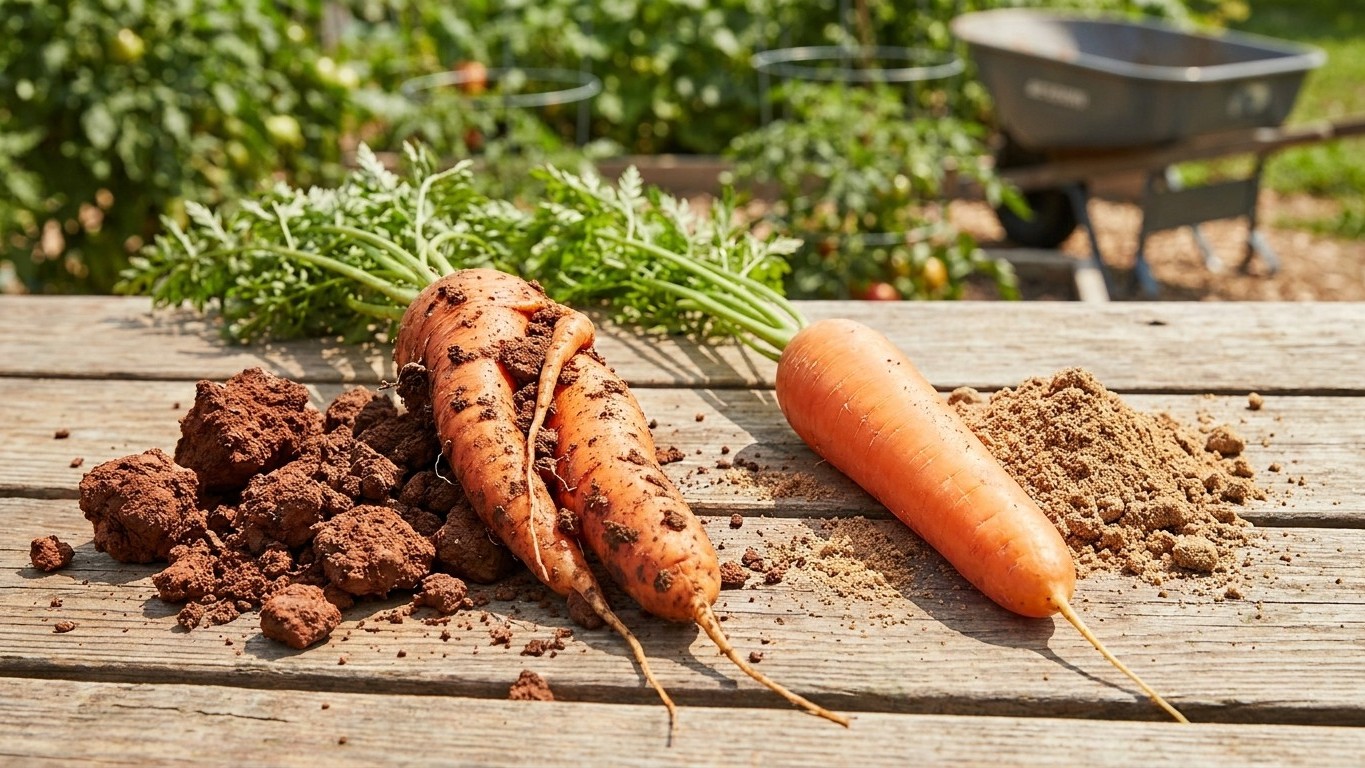

Pull carrots when the roots reach the mature size on your seed packet, counting 70 to 100 days from seeding. Clemson Cooperative Extension puts harvest at about 65 to 75 days after planting. Cut the tops off the same day, then store the roots at 33 °F in high humidity. Bunched with tops on, they keep about 10 to 14 days. Trimmed, they last far longer. What the ground does in the meantime is covered in Growing Carrots in Arizona.
The short answer
What the state soil is made of
Arizona’s representative soil is the Casa Grande series, an Aridisol. That is a dry-climate soil, usually alkaline and often carrying salts. USDA’s Soil Data Access records the surface horizon of its major components (21 of them) at 64 percent sand, 14 percent clay and 22 percent silt. Organic matter sits at about 0.8 percent, and the drainage class is well drained. The surface pH comes in around 8.5, which is alkaline.
Utah State University Extension describes the carrot’s ideal as deep, sandy, well-drained soil rich in organic matter. Heavy or rocky ground makes the root fork, and heavy soil calls for plenty of compost and double digging. Set that beside the Casa Grande numbers and two of the three requirements line up on paper: sandy, and well drained. The third, organic matter, is the weak spot.
Will a carrot fork in it?
Not because of clay. At 14 percent clay and 64 percent sand, this soil is not the dense, sticky ground that bends a taproot sideways. The trouble runs the other way. At 0.8 percent organic matter, sand sheds water fast and holds little, so the bed swings between dry and soaked, and that matters for the splitting covered below. Compost is the fix: work it in before seeding, because carrots are sown in place and the root cannot be corrected once it has started down.
Double digging and raised beds are for gardens that do not match the state profile. If your ground is heavy, rocky or compacted, a raised bed filled with loose, compost-rich mix solves forking directly. A different variety will not, and the source names none anyway. Likewise, the 8.5 pH belongs to the series’ mapped surface, not to your yard, and the source gives no pH target for carrots, so none is offered here.
Treat all of this as a starting point rather than a diagnosis. Arizona spans hundreds of soil series. River bottoms, hill country and any lot a builder has scraped or filled can differ completely from Casa Grande. Our piece on Will Carrots Fork in Arizona Soil? goes deeper, and the next section shows how to check your own bed.
The test that settles it in your own garden
An afternoon and a spade will tell you more than any state map. Do this before you sow, and do it in the exact spot where the carrots will go.
- Dig a hole about as deep as the carrots you hope to grow are long. Set the soil on a tarp so you can look at it in layers.
- Read the walls of the hole. Look for a hard layer, a sudden change in color or texture, rubble, or buried construction debris. Any of these can stop a root cold and send it sideways. Count the stones you pull out, too. Rocky ground forks roots.
- Feel the texture. Take a handful of damp (not soaked) soil and rub it between your fingers. Gritty and loose means sand. Smooth and floury means silt. If it squeezes into a sticky ribbon that holds its shape, it is heavy with clay.
- Test the drainage. Fill the hole with water, let it empty, then fill it again and watch. Water that vanishes quickly points to sandy, fast-draining ground. Water that sits for hours, or until the next day, points to heavy or compacted soil. This gives you a comparison, not a published number, because no figure here defines a pass or a fail.
- Send a sample for a lab test. Your own pH and salt level come from a soil test, not from the state’s representative value. Ask the lab for organic matter as well, so you know how much compost to add.
- Decide on the bed. Loose and sandy with decent drainage means compost and you are ready. Dense, stony or slow to drain means double digging with plenty of compost, or a raised bed.
Do the texture check on a day when the soil is workable, not rock dry. Dry ground in a desert yard can feel like concrete regardless of what it is made of.
What goes wrong here
Arizona’s climate and soil produce a short, predictable list of carrot failures. Each one has a fix that costs little.
- Forked or stubby roots. Heavy, rocky or compacted ground makes the root fork. Work in plenty of compost and double dig, or move to a raised bed filled with loose mix. Pull stones as you go, and do all of it before seeding, since the crop is never transplanted.
- Poor germination in a hot spell. Carrot seed is slow and needs a steady, damp surface to sprout. In a heat wave the top of a sandy bed dries out in hours. Keep the seedbed evenly moist until the seedlings are up, and shade it if the weather turns hot. This guide holds no sowing dates or frost dates for Arizona, so check local timing before you plant.
- Splitting from uneven water. A root that sits dry and then drinks heavily can crack. Sandy soil with 0.8 percent organic matter swings between those states quickly. Compost helps the bed hold moisture, and regular, even watering does the rest.
- Salt and alkalinity surprises. The Casa Grande series is a dry-climate soil that often carries salts. Your bed may or may not. A lab test, not guesswork, tells you whether to worry.
- Losing the crop after harvest. Leaves keep drawing moisture out of the root, which is why bunched carrots last only about 10 to 14 days. Cut the tops off first, then chill the roots at 33 °F with high humidity. That temperature sits just above freezing, so a cellar at 50 °F will not do. At that warmth carrots sprout and soften in a fraction of the time. A home refrigerator is the practical option, though you should check how close yours gets to 33 °F.
Pests belong in this list too. Something else may want your crop before you do, and What Eats Carrot in Arizona, and When covers who shows up.
Common questions
How do I know a carrot is ready to pull?
Start with the days. Count 70 to 100 days from the date you seeded, since carrots are never transplanted. Then brush the soil back from the top of a root and check its shoulder against the size on your seed packet. Clemson Extension’s figure is about 65 to 75 days after planting, so begin checking early in that range.
Do I count the days from transplanting?
No. Carrots are sown directly where they will grow, so there is no transplant date. The count always starts on the day you seed.
How long do carrots keep, and at what temperature?
Clemson Extension advises storing carrots at 33 °F and high humidity to prevent wilting. With the tops still on, they keep about 10 to 14 days. Trim the tops first and they keep for months, because the leaves are no longer pulling moisture out of the root.
What eats carrots before I can pull them?
Several pests go after carrot crops, and the timing varies. The pests guide linked above walks through who shows up and when, so you can protect the bed before harvest.