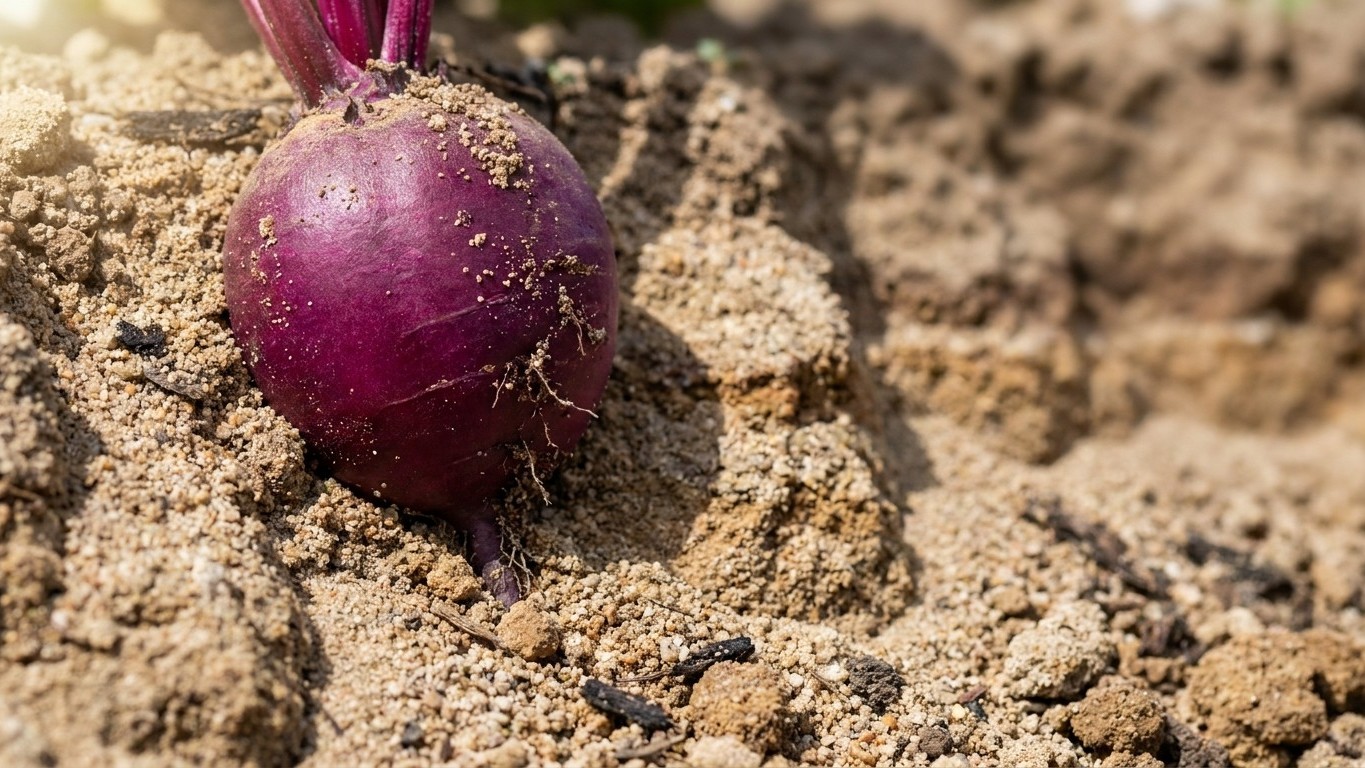

Pull beets 60 to 80 days after seeding, and plan the sowing so that window closes before afternoon heat settles in. Beets are sown in place, so the count starts at the seed, not at a transplant. In low-desert Arizona, heat sets the deadline, not frost. Once the roots are out, top them and store them at 33 to 36 F. Colder is not better: 32 to 34 F produces more black spot and rot.
The short answer
Start with the ground. The soil USDA lists as representative of Arizona is the Casa Grande series, an Aridisol, which is a dry-climate soil that is usually alkaline and often carries salts. Its surface runs 64 percent sand, 14 percent clay and 22 percent silt, with a pH of about 8.5 and organic matter near 0.8 percent. It is well drained. Utah State University Extension asks for beet ground that is deep, sandy, well drained and rich in organic matter. Casa Grande delivers the first three and misses the fourth by a wide margin. Sand with under one percent organic matter lets water go fast, so a beet seedling here runs out of moisture sooner than the same seedling would in loam.
That is a starting point, not a diagnosis. A state spans hundreds of soil series, and your back garden may be nothing like this one. River bottoms, hill country and any lot a builder has scraped or filled will behave differently. The figures above are the representative values USDA records for the surface horizon of the major components of the series as mapped (21 components in the query), not a measurement of a worked garden bed, and the pH is not your pH. A soil test gives you your own number. For what the root will meet underground, see Beet Soil in Arizona: What the Root Will Meet.
Heat sets the harvest date
Phoenix is the reference city, and 90 F is routine there for much of the year. The verified figures here do not include a count of days above 90 F, so I will not invent one. What they do include is the benchmark that matters: Utah State Extension says heat above 85 F combined with water stress makes the root woody. A Phoenix summer sits far beyond that line. NOAA lists the frost-free season at 365 days, and summer heat stops fruit set for months, so the limit on the calendar is the hot season, not the cold one.
Put those together and the answer takes shape. The 60 to 80 day clock runs from seeding. Count backward from the point where your own afternoons start to climb past 85 F, and sow so the roots come out before that point. This page sets no calendar date, because Arizona’s low desert, mid elevations and high country do not share one. Woodiness is a late failure, and it belongs to roots left in the ground too long. It is a different problem from the early failure covered next. For the full growing picture, start with Growing Beets in Arizona.
The six weeks that decide it here
The usual advice is to sow beets two to three weeks before the last spring frost, which drops the first six weeks into a known stretch of spring. That rule needs a frost date to hang on, and low-desert Arizona mostly does not have one. NOAA’s records for Phoenix show no freeze in most years. A rare cold snap can bring 32 F between late December and mid January, and Phoenix reached 32 F in only 6 of 30 springs. Writing a frost-based planting calendar for the low desert would be false precision.
What the first six weeks look like here
With the frost anchor gone, the useful question is what the early weeks do instead. In the low desert they are dry and they warm quickly, and a sandy, well-drained soil like Casa Grande’s gives up its moisture just as fast. Utah State Extension is direct about the consequence: water stress in the first 6 weeks causes premature flowering. That is bolting. A beet that bolts is spending its energy on a flower stalk, not on a root you can eat.
So the bolting risk sits at the very start, in the seedbed, and it is driven by thirst more than by temperature. A week of neglect at week two can cost you the crop in a way that a week of neglect at week ten cannot. This is the stretch to watch hardest, and watering a sandy bed deeply and often early on is cheaper than resowing.
Why bolting and woodiness are separate jobs
Early thirst causes bolting. Later heat above 85 F, with water stress, causes woody roots. The two failures arrive at different times and fix at different points, so “keep it watered” covers neither properly. The first is a seedling-stage discipline. The second is a harvest-timing decision: pull on schedule instead of letting roots sit in warming ground.
Cold-climate gardeners get a frost to end the season and a spring to wait out. Low-desert growers get neither. Higher ground is different. Flagstaff and the high country freeze hard, and the frost-based rule applies there as it does elsewhere in the country. The last-frost date for those places is not published in the figures on this page, so look up your own station.
What goes wrong here
In the bed
- Bolting from early thirst. Sandy, well-drained ground dries quickly, and water stress in the first 6 weeks triggers premature flowering. Remedy: keep the seedbed evenly moist from sowing through week six, and check the soil by hand instead of trusting the calendar. For what else chews on young plants, see What Eats Beet in Arizona, and When.
- Woody roots from late heat. Heat above 85 F with water stress toughens the root. Remedy: harvest inside the 60 to 80 day window, counted from seeding, and do not leave roots in the ground to size up through a heat spell.
- Over-amending a thin soil. With organic matter near 0.8 percent, it is tempting to pile on compost. Utah State Extension caps it at no more than 1 inch of composted organic matter per 100 sq ft. Remedy: stay under that, and let a soil test, not the surface numbers on this page, tell you what your bed needs.
- Trusting the state soil as your own. Alkaline, salt-prone ground is typical of Aridisols, but your bed may differ. Remedy: test your own soil, including pH and salts, before you amend anything.
In the kitchen
- Storing with the leaves on. Bunched beets keep only 10 to 14 days at 32 F and above 98 percent relative humidity. Remedy: top them first, then store.
- Chilling too hard. USDA Agricultural Handbook 66 (the commercial storage chapter by F. Adamicki) is explicit that 32 to 34 F produces more black spot and rot than a little warmer. Topped beets belong at 33 to 36 F and 98 percent humidity. Remedy: aim for the warmer end of that range, and check the setting before assuming the coldest dial is best.
- Keeping the small roots. Large roots keep much better because they lose water and shrivel more slowly. Remedy: eat the small ones first and save the big ones for storage.
- Cellar or pit that swings. The handbook says temperatures in pits and cellars should not drop below 31 F or exceed 41 F. A low-desert summer makes that range hard to hold outdoors, so treat any improvised cold room with caution.
Common questions
How many days from seeding until I pull beets in Arizona?
Plan on 60 to 80 days, counted from seeding. Beets are sown in place, so there is no transplant date to count from. This page gives no variety-by-variety timing, and the source names five varieties without any data on them.
Do I need a frost date to time beets in Phoenix?
Not in the low desert. NOAA lists a 365-day frost-free season, and Phoenix reached 32 F in only 6 of 30 springs. The deadline comes from summer heat. In Flagstaff and the high country, where hard freezes do occur, the frost-based approach applies, though a local date is not published here.
Why is 32 F storage worse than 34 F or 36 F?
USDA Handbook 66 reports more black spot and rot at 32 to 34 F than at slightly higher temperatures. Its target for topped beets is 33 to 36 F at 98 percent humidity. The full text is in the USDA Agricultural Handbook 66.
Which roots should I store and which should I eat first?
Store the big ones and eat the small ones first. Small roots lose water and shrivel faster, while large roots hold up much better. Top every root before it goes into storage, since leaves-on bunches last only 10 to 14 days.