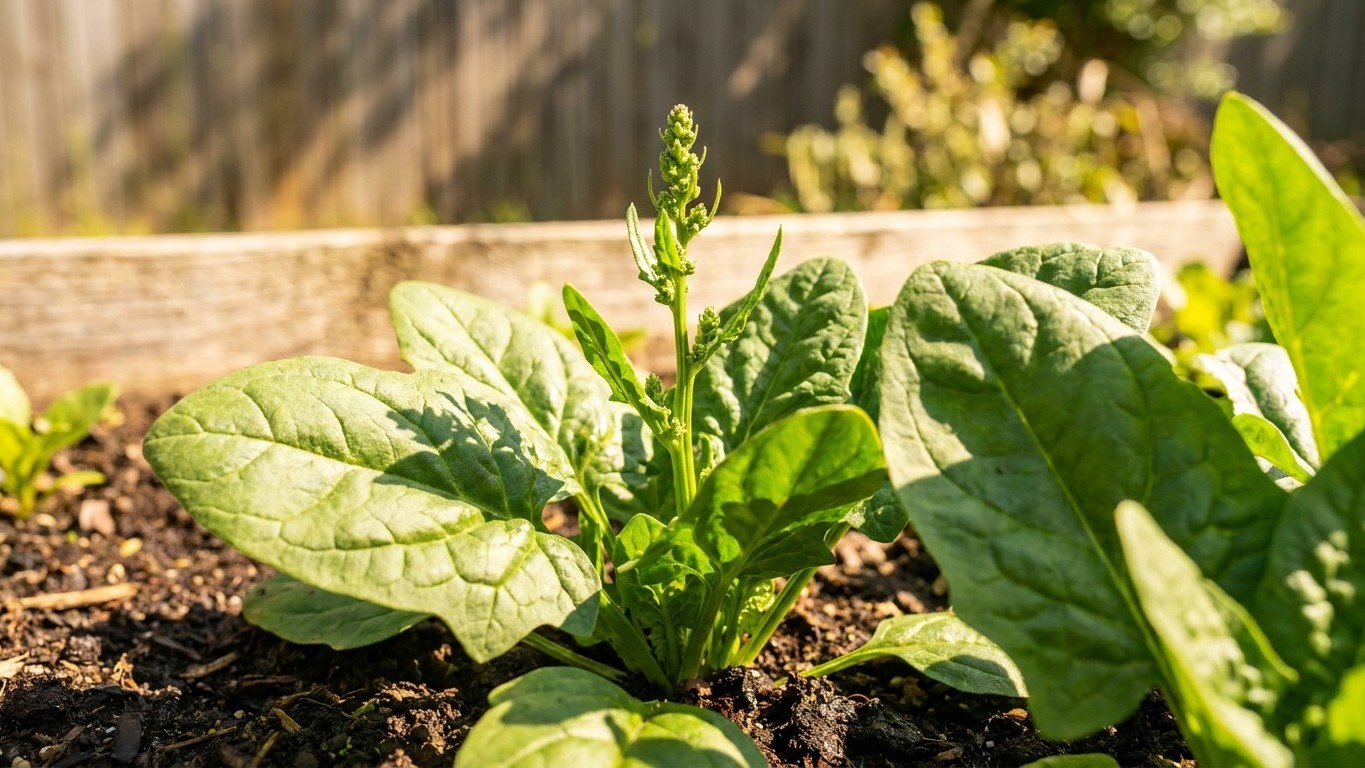

In Arizona’s low desert, cut spinach while the plant is still growing leaves: pick the outer ones once they’re big enough to eat, and pull the whole plant when a flower stalk starts to rise or the days settle above 75 F. That puts the harvest in the cool months, not summer. After cutting, the leaves keep two weeks at the very most, and only in a fridge held at 32 F.
The short answer
On the longest day of the year, Phoenix gets 14 h 13 of daylight. That number matters more for spinach than most Arizona gardeners expect. According to Utah State University Extension, spinach bolts under long days and warm temperatures, and long days alone are enough to start the flowering. Cool weather doesn’t cancel that out. A mild summer would not buy extra weeks here, and a 14-hour day is long by the standards of any leafy crop that wants to stay vegetative.
So is the limit the day length, the heat, or both? Both, and they arrive together. The days stretch past what spinach tolerates just as the thermometer climbs past the other threshold: spinach grows best where temperatures do not exceed 75 F, and that number is also where bitterness starts. Phoenix averages 168.9 days a year at 90 F or higher, which is about 24 weeks, close to half the calendar. In the low desert, heat usually ends the harvest first, but the long days are working against you the whole time. They are the reason a late-winter crop that looks healthy can send up a stalk almost overnight.
What to cut, and when
The source publishes no days-to-maturity figure for spinach, so any “ready in six weeks” promise you’ve seen is not backed up here. A better signal is the plant itself. Start taking outer leaves once they’re a usable size, leave the growing center alone, and the plant keeps making more. Switch to cutting the whole plant at ground level the moment the center starts to elongate into a stalk, or when daytime highs begin to hold above 75 F. Waiting past that point buys you bitter leaves, not extra volume.
If your plants are bolting earlier than you expected, Will Spinach Bolt Early in Arizona? covers what triggers it. If leaves are showing up chewed or ragged before you can cut them, What Eats Spinach in Arizona, and When sorts out the likely culprits.
Varieties, and what is not known
The extension source names four varieties: Bloomsdale, Melody, Teton and Olympia. It gives no data about any of them, so there’s nothing honest to say about which bolts last or which tolerates heat best. The data is not published. Treat any claim of “slow bolting” on a seed packet as the seller’s, not a measured result. For the broader picture of getting a crop started, see Growing Spinach in Arizona.
How long the spring window really is
- Set the frost rule aside. The standard advice is to sow 2 to 3 weeks before the last spring frost. In Phoenix that rule produces no date. Freezing temperatures are absent in most years, a rare cold snap can bring 32 F between late December and mid January, and Phoenix reached 32 F in only 6 of 30 springs. NOAA lists the frost-free season as 365 days. A frost-based calendar for the low desert would be invented.
- Start from the ceiling instead. Growth stops being good above 75 F. That number is a temperature, not a date, and it moves from year to year. Keep a thermometer in the shade near the bed and treat the first stretch of afternoons above it as the end of good growth. It is also where the bitterness begins, so one number carries two consequences.
- Count what is left. Because the source gives no sowing-to-harvest figure for spinach, you can’t subtract a precise number of weeks. What you can say is that the window runs from the moment seed will sprout in cool soil to the first run of days that top 75 F. In the low desert that stretch is measured in weeks, not months, and it is shorter than it feels on a warm, sunny February afternoon.
- Add the daylight. Days keep lengthening toward that 14 h 13 solstice peak. Spinach reads the lengthening days as a flowering signal even when the air is still pleasant. So the spring window closes from two sides at once, heat and light, and the gap between “still fine” and “bolted” can be a matter of days.
What the arithmetic leaves you
A few weeks of spring cutting, in a good year, is the honest answer for the low desert. Sow as early as the soil allows and take leaves steadily instead of waiting for a big single harvest. The winter crop, which starts in the previous autumn, gives you a far longer stretch than anything you sow in spring.
The high country is a different story. Flagstaff and the surrounding elevations freeze hard, so the 2 to 3 weeks before last frost rule works there as written. This page carries no frost dates for those areas, so check with your local extension office before you commit to a sowing date.
The autumn crop, and when the soil lets you sow
Warm soil blocks the start
Germination is reduced above 80 F soil, per Utah State University Extension. In a hot region the problem is not cold, it is that the ground stays too warm long after the air starts to feel like autumn. Soil holds heat well past sunset, so a cool morning can fool you into sowing a week or two too early. In the low desert, the window opens when the soil temperature falls, not when the calendar flips. A soil thermometer a few inches down tells you more than the weather forecast does. Shade cloth over the seedbed and sowing in the evening can help, though the source doesn’t test either method, so view them as practical hedges.
Frost is the wrong clock in the low desert
Elsewhere, the end of the season is a frost date. In Phoenix there’s no reliable fall freeze, and the 365-day frost-free season means nothing ends the crop abruptly. What stops spinach in the low desert is the return of warmth the next spring. So the date you count back from is a realistic harvest window in the cool part of winter, not a frost.
The rule from the source is to plant 50 to 75 days before the date you want to harvest. That is roughly 7 to 11 weeks. Pick the date you want leaves on the table, subtract those weeks, and check the soil on that day. If it is still above 80 F, wait. The 50 to 75 day range is a planting guide, not a maturity figure for spinach itself, and the source publishes no days-to-maturity for the crop or for any of the four named varieties.
In the high country, where hard freezes arrive, the same count-back works from your first fall frost date. That date isn’t published here, so get it from a local source before you sow.
Common questions
Can I cut the same spinach plant more than once?
Yes, if you take outer leaves and leave the center growing. The plant keeps producing until it bolts or the heat passes 75 F. The source gives no number of cuttings, so go by how the plant looks.
Is bolted spinach still worth eating?
Warm weather and bolting both push leaves toward bitterness, and 75 F is the threshold the source ties to that change. Taste a leaf before you decide. Once a stalk is up, the plant is done producing good new growth, so pull it and clear the bed.
How long does cut spinach keep in the fridge?
UC Davis Postharvest lists the optimum at 32 F with 95 to 98 percent relative humidity, and says spinach “will not maintain good quality for more than 2 weeks.” Treat that as a ceiling, not a plan. Wilting, yellowing and decay increase after 10 to 14 days, and faster at 41 to 50 F, which is what a home fridge door actually holds. Put it at the back of the bottom shelf, the coldest spot, not in the door. The full fact sheet is at UC Davis Postharvest Technology Center.
Which variety lasts longest before bolting?
The source names Bloomsdale, Melody, Teton and Olympia but publishes no data on any of them. That means no honest ranking is possible here. Pay more attention to when you sow and how you harvest than to the name on the packet.