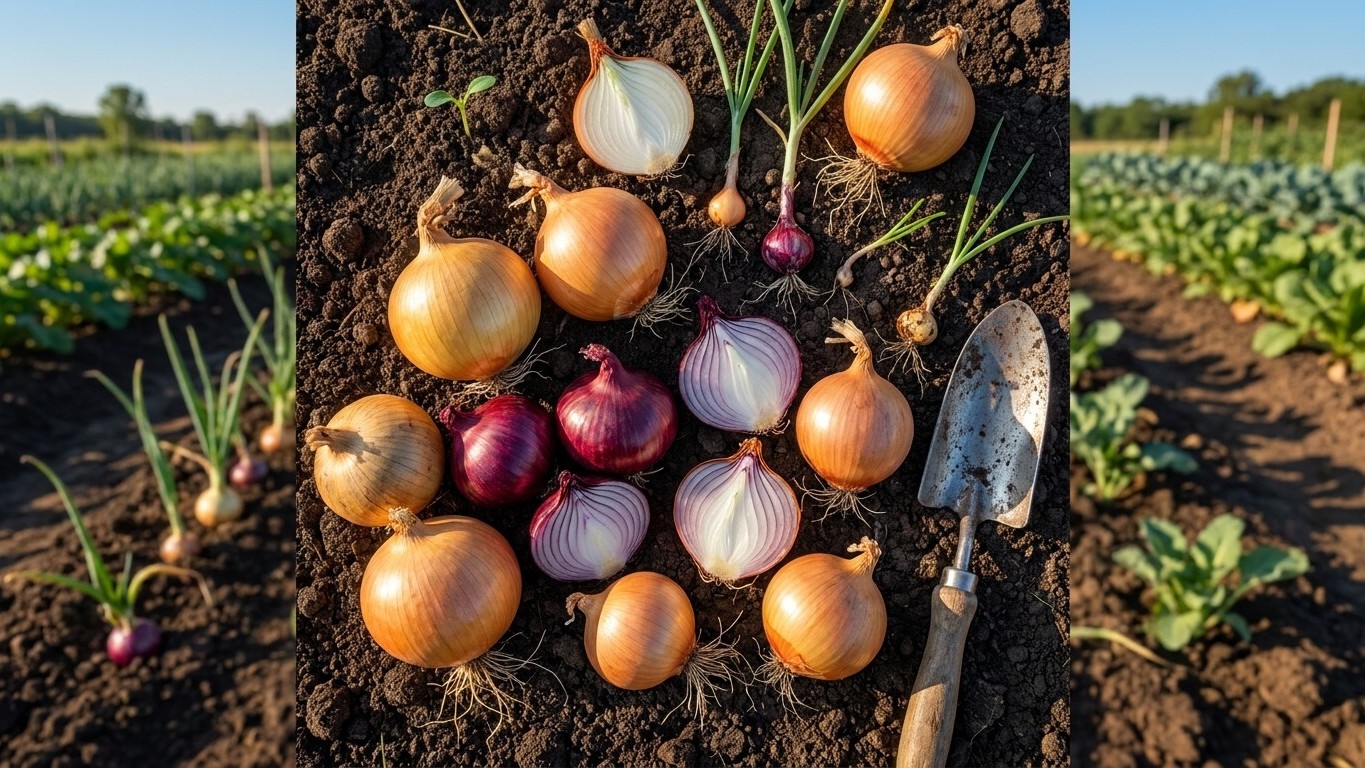

In southern Nevada, short-day onions planted in fall are ready to lift in late spring or early summer, once most of the tops have toppled over and started to yellow. Dig on a dry day, then cure the bulbs in a shaded, airy spot until the necks are tight and the outer skins turn papery. Only then do they go into storage. Skip the curing and you will be composting bulbs by midwinter, however good they looked coming out of the ground.
The short answer for Nevada
The figures on this page come from Las Vegas, at 36.07 degrees north. On the longest day of the year, the sun is up there for 14 h 27 (a geometric calculation, so real daylight runs about seven minutes longer). That number, not the thermometer, tells an onion to stop making leaves and start swelling a bulb. Clemson Cooperative Extension puts the trigger for short-day varieties at about 12 hours, and Las Vegas passes that mark every spring long before the desert heat settles in. Short-day onions are the group that suits this latitude, which is why fall planting is the norm in the south of the state. For the varieties themselves, see The Best Onion Varieties for Nevada.
Reading the tops, not the calendar
Because the plant sets its own schedule, the tops are your clock. When bulbing finishes, the necks soften and the green tops fall over. Lift when most of them have gone down and begun to yellow, and ease off watering as it starts so the necks can dry. Slide a garden fork under the row, loosen the soil, and pull the bulbs by hand. Don’t yank them by the tops. A nicked or bruised bulb is an open door for rot, and one that was chewed in the ground belongs in tonight’s dinner. The timing of that damage is covered in What Eats Onion in Nevada, and When.
Curing: the step that decides storage
Curing dries the neck and the outer skins into a seal. Spread the bulbs in a single layer with the tops still attached, somewhere shaded with good airflow: a covered patio, a garage with the door cracked, a table under a ramada. Full desert sun can scald the bulbs, so shade matters more than speed. The job is done when the neck is tight and no longer squeezes when pinched, and the skins rustle. Trim the tops to an inch or two and brush off loose soil without peeling.
Storage comes after that, never before. Clemson’s extension service describes the target this way: “Ideal conditions are between 45 °F and 55 °F, and 50 to 60 percent humidity” (Clemson Cooperative Extension, Home & Garden Information Center). Cool, dry, dark, and with air moving. Onions want the opposite of a carrot’s damp cellar.
What will not work here
Planting the wrong day-length group is the most common way to lose a whole onion bed in Nevada. Long-day varieties need 14 to 16 hours of daylight before they bulb. At 36.07 degrees north, Las Vegas touches 14 h 27 only around the June solstice, and the plants have spent the whole spring building leaves by then. A long-day onion planted here makes foliage all season, then little or no bulb, and then it rots in the ground when summer heat arrives. It does not produce a small version of the onion on the seed packet. It produces a row of green tops.
Varieties that fail at this latitude
- Walla Walla: a long-day sweet onion that waits for 14 to 16 hours, so in the south it makes leaves and rots.
- Copra: a long-day storage onion; the keeping quality is real, but only where the bulb actually forms.
- Ailsa Craig: a long-day exhibition type bred for big bulbs, which need the long northern days to swell.
- Yellow Sweet Spanish: a long-day sweet type that is a poor match for the southern desert.
- Any packet labeled “long-day,” whatever the name or the photo on the front.
Late planting shrinks the crop
Timing has its own trap. Planting late does not push the harvest back. It shrinks it. Whatever size the plant has reached when day length triggers bulbing is the size the bulb will be, so a short-day onion set out late in the season is still ready to bulb on schedule, but with a small plant. Spring-planted sets in the south are the classic case: the days cross 12 hours almost immediately, and you harvest marbles. Fall planting gives the plant the cool months to build leaves first, and each leaf becomes one ring of the bulb.
What changes across Nevada
Nevada is a long, narrow state, and the reference figures belong to Las Vegas, near the southern tip. The northern border at Oregon and Idaho lies several degrees of latitude farther north. The exact day length at that edge is not published here, but it is longer than 14 h 27 at the solstice, and that shifts which group of onion makes sense. A gardener in Elko, Winnemucca or the northern Reno area is working with a different sky, and also with a shorter, colder growing season, so the advice does not transfer from the south.
| Area | Latitude | Longest day | What it changes |
|---|---|---|---|
| Las Vegas (reference city) | 36.07 degrees north | 14 h 27 | Short-day group; fall planting; lift in late spring to early summer |
| Northern Nevada (Oregon and Idaho border) | Several degrees farther north; check your own | Longer than 14 h 27; exact figure not published here | A reader here may belong to the neighboring long-day group; spring planting, later lifting |
What that means for your lift date
Lift dates follow the plant, and the plant follows the latitude. A northern garden that plants in late winter to early spring lifts later in the year than a southern one, and its tops fall over weeks after Las Vegas has finished. In between, in the middle of the state, you may sit on the line between groups. If so, an intermediate-day variety is the safer bet. The general page on Onions in Nevada covers the state-wide picture, but the numbers on this page change as you travel north.
Sweet now, or onions that last
The trade-off is chemistry, not luck. The bite of an onion comes from volatile sulfur compounds, and those are the same compounds that protect the bulb while it sits in storage. A sweet onion carries fewer of them. It tastes better raw, but it has less protection against rot, sprouting and slow shrinkage. University of Missouri Extension states the rule plainly: “As a rule, ‘sweet’ onions do not store as well as the more pungent types.” There is no sweet onion that stores, and a seed packet promising both is selling a compromise.
What your pantry looks like in March
Day length lines up with sweetness. Short-day types run sweeter, long-day types keep longer. So a southern Nevada garden gives you onions to eat soon: sliced onto burgers in June, grilled in July, and mostly finished or going soft by the time you would want them in a March stew. A northern garden grows sharper, long-day onions that, properly cured and held at 45 °F to 55 °F, can still be firm on the shelf in March.
That is not a defect in southern gardens. It is the deal the latitude offers. Eat the sweetest and thinnest-necked bulbs first, keep the thickest-skinned for last, and check the bin every week or two for any bulb going soft. One rotting onion will damage its neighbors.
Checking this against your own garden
The figures above describe Las Vegas, not your yard. Nevada spans enough latitude and elevation that a state-wide number would mislead more gardeners than it helped. Before you plant or lift, confirm the following this week:
- Your own latitude. Look up the coordinates of your address; if it is well north of 36.07 degrees, you may belong to a different day-length group.
- Your local frost dates, from your county’s University of Nevada, Reno Extension office. They are not published on this page, and they differ sharply between valleys and high desert.
- The day-length label on whatever you have already planted or bought: short-day, intermediate or long-day.
- The temperature and humidity of your storage spot, measured with a cheap thermometer and hygrometer. You are aiming for 45 to 55 degrees and 50 to 60 percent humidity.
- The necks of your cured bulbs. Press them; any that are still soft or moist go into the kitchen, not the bin.
Common questions
How do I know when onions are ready to lift?
Watch the tops. When most of them have fallen over and begun to yellow, the bulbs have finished sizing. Stop watering as the tops go down, then lift on a dry day.
How long do onions need to cure?
It depends on the weather and the size of the bulbs, so go by the signs, not a number of days. They are cured when the necks are tight and dry and the outer skins are papery. Keep them in shade with airflow while they dry.
Can I store sweet onions through winter?
Not reliably. Sweet onions have fewer of the sulfur compounds that protect the bulb, so they soften and sprout sooner than pungent ones. Eat them first and keep the sharper bulbs for later.
Can I leave onions in the ground after the tops fall?
Not for long. Once the tops are down the bulb has stopped growing, and wet soil or summer heat can start rot. Lifting and curing them protects what you have grown.