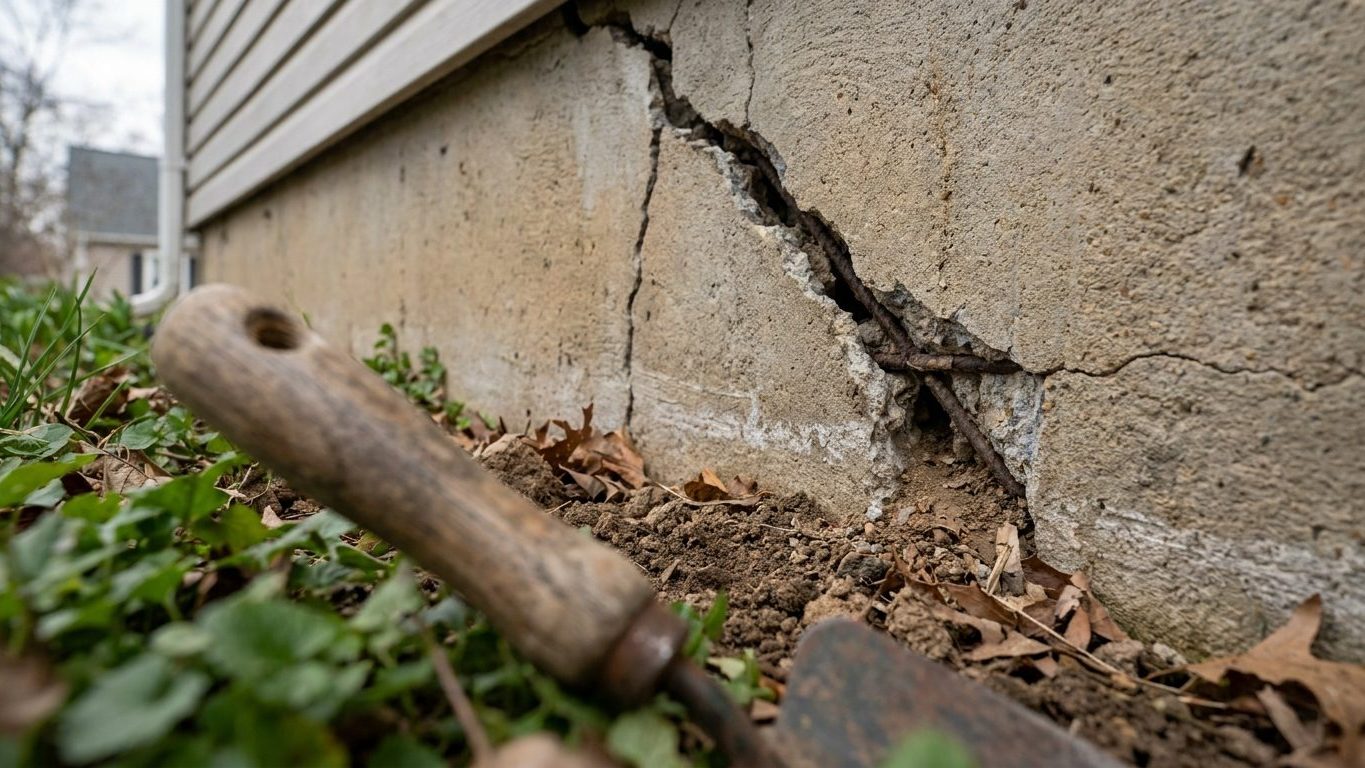

Settlement cracks that stopped moving years ago look almost identical to ones still opening right now, and that is the trap. The only way to tell the two apart is to measure the same spot over time, not to stare at it once and guess. Mark the ends of a crack with a pencil line and a date, check it again in a few weeks, and let the crack answer the question itself.
Movement that is still happening usually shows up twice: in the crack itself, and in the damp and mold that follows water finding the same path.
What is actually going on

Why settlement stops, and why it sometimes doesn’t
Every foundation settles a little. The soil under it compresses as the weight of the house presses down, the same way a mattress compresses when you first lie on it. That compression, called consolidation, happens fastest in the first year or two after construction and then tapers off as the soil reaches a new equilibrium. Once it stops, it stays stopped, unless something changes.
What changes it is almost always water. Soil that dries out shrinks. Soil that gets saturated expands and then loses strength as it drains. Roots from a tree planted too close pull moisture out of the soil under a foundation and keep it shrinking on that side, season after season, long after the rest of the yard has settled down. A gutter that stopped draining away from the house, or a grade that used to slope away and now slopes toward it, can restart movement in soil that had been stable for decades. This is especially true on expansive clay, which swells and shrinks with moisture more than most other soil types, and the clay soils that swell and shrink are worth understanding on their own if that is what your area sits on.
When a crack points to something more than settlement
Most settlement cracks are cosmetic. They open slowly, follow predictable lines in concrete or block, and stay put once the soil beneath them stops moving. A crack becomes a different conversation when it is wider at one end than the other, when it runs diagonally from a corner, when it appears alongside a door or window frame that has gone visibly out of square, or when a horizontal crack in a basement wall is paired with the wall bowing inward. Those patterns can mean the foundation is experiencing differential settlement, where one part of the house is moving more than another, or they can mean lateral soil pressure is pushing on a wall.
This page will not tell you how wide is too wide or how to read a crack’s severity, because that call belongs to a structural engineer standing in front of it, not to a description on a page. What this page will do is tell you what to check next, and who to call once you have checked it.
What to look at, and in what order
Signs across the house, not just at one crack
A single crack tells you almost nothing on its own. What tells you something is whether the same story shows up in more than one place, at the same time, in a pattern that makes sense together. Work through the cheap, non-invasive checks first, in this order, and let each one narrow down what you are dealing with before you spend money on anything else.
| Check | What to look for | What a positive result suggests | What it rules out |
|---|---|---|---|
| Doors and windows | Sticking, gaps at the top corners, latches that no longer catch | The frame has racked out of square, consistent with movement under that part of the house | A one-time seasonal swell of the wood itself, if it only sticks in humid months |
| Floors with a level or marble | A slope in one direction, a spot where a marble consistently rolls | Differential settlement under that area specifically, rather than the whole house sinking evenly | Uniform settlement across the whole slab, which rarely causes a noticeable slope |
| Exterior grade and gutters | Soil sloping toward the foundation, downspouts discharging right at the wall, standing water after rain | An active water source that could be driving ongoing movement | An old, finished settlement event with no live cause still feeding it |
| Crack monitoring marks | A pencil line and date at each end of a crack, rechecked after several weeks | The crack is still opening, meaning the movement is current, not historical | A crack that hasn’t changed, which points toward old settlement rather than active movement |
| Basement dampness or staining | Efflorescence, musty smell, visible water lines on the wall | Water is reaching the foundation, which both drives soil movement and creates conditions for growth problems inside | A dry basement rules out water as the current driver, even if old cracks remain |
That last row matters beyond settlement itself. A basement that stays damp long enough eventually grows something you will smell before you see, and the questions people ask about “/foundations/mold/”>mold in a basement almost always start with a foundation that was letting water in for months before anyone noticed. Treat a damp basement as two problems worth checking, not one.
Watch it, or get someone in
What you can monitor yourself
A crack with no other symptoms around it, dated and measured, unchanged after several weeks, is something you can reasonably keep an eye on without calling anyone. Recheck it every few months, note the date each time, and keep a simple written log rather than relying on memory. Monitoring only works if you actually measure, not if you just glance at it and feel reassured. A crack that has not moved in a year of measurement is doing exactly what old settlement does: nothing.
When to call, and who to call
Get someone in when the crack is still opening on your marked measurements, when it is paired with a door or window that has gone out of square, when a basement wall shows horizontal cracking or visible bowing, or when a slope in the floor has appeared or worsened since you first noticed it. Any one of those on its own is worth a call. Two or more together is not something to keep monitoring.
The call to make is to a structural engineer, not a foundation repair company. An engineer’s job is to assess the house and tell you whether what you are seeing is old, stable, or active, without a repair to sell at the end of the visit. That is a different role from a waterproofing salesman, whose estimate starts from the assumption that you need his product, and different again from a drainage contractor, whose job is grading and gutters rather than the structure itself. If a foundation company offers a free inspection and quotes a fix in the same visit, get a second, independent opinion from an engineer before agreeing to anything. The foundations and basements guide on this site covers how those different trades divide up the work, if you have not already been through it.
What has to happen first
Sequence matters more than any single fix
The single most common mistake in this subject is fixing the wrong end of the problem first. Someone notices a damp basement, waterproofs the inside walls, and is surprised when the water shows up somewhere else the next season, because the water was never dealt with outside. Outside drainage always comes before inside treatment. Grading, downspout extensions and gutter maintenance keep water away from the foundation in the first place, and a foundation that stays dry stops most active settlement on its own without any interior work at all. If your gutters are part of the problem, that is a roofing question before it is a foundation one.
Water control comes before finishes, too. Painting over a damp basement wall, or laying flooring on a slab that still gets damp from below, hides a problem instead of solving it, and both jobs will fail again once the water comes back. If a sump pump is part of your drainage plan, get it sized and installed correctly before anything else goes on top of that floor. And diagnosis always comes before repair. An engineer’s assessment of whether movement is active or historical should happen before any contractor starts work, because the fix for water-driven active settlement is not the same fix as cosmetic patching of an old, stable crack. Spend the diagnosis money first. Everything after it depends on what that assessment finds.
Common questions
Can I fill a settlement crack myself once I’ve watched it for a while?
Not until it has been assessed. Filling a crack that has not been diagnosed hides the movement you would otherwise be tracking, and if it is still active, the filler will crack again anyway. Get the crack looked at first, then follow whatever the assessment recommends.
How long should I monitor a crack before deciding it’s old?
Long enough to cover a full range of moisture conditions, not just a dry spell. A crack that hasn’t moved across a wet season and a dry one is a much stronger sign of old settlement than one checked only twice over a few weeks.
Does a house always keep settling forever?
No. Most settlement finishes within the first few years after a house is built and then stops unless something new starts it up again, usually a change in water at the site. A house standing for decades with no new symptoms has almost certainly finished settling.
Is a sloping floor always a foundation problem?
Not always. Some slope can come from the original construction rather than from movement afterward, especially in older houses. A level check over time, and an engineer’s opinion if the slope is new or worsening, is the only reliable way to tell the difference.